DJ Headphones Compared by Driver Power and Booth Isolation
Pioneer DJ’s HDJ-X10 suits most working DJs with swiveling one-ear cups and a 32 ohm driver that runs clean off a standalone mixer. Audio-Technica’s ATH-M50x matches much of that isolation at a lower cost with three included cables. Sennheiser’s HD 25 stays lightest for back-to-back club sets.
Pioneer DJ’s HDJ-X10 tops this lineup for club and mobile DJs who need loud, durable cueing gear. Swiveling one-ear cups and a 32 ohm driver let it run clean off a standalone mixer or a phone. Its 328 gram weight becomes noticeable across a six-hour set, which is why lighter builds follow below.
We compared published driver specs, impedance ratings, and owner feedback from DJ forums and Amazon listings to separate club-ready builds from studio crossovers. Isolation, cable durability, and long-set comfort carried more weight than headline sound quality, since those are the parts DJs actually wear out.
The best picks, ranked
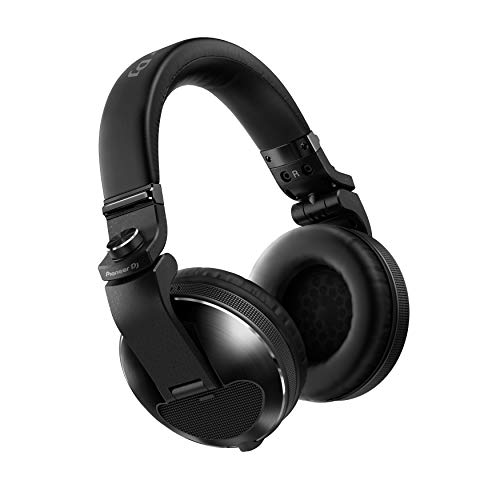
Pioneer DJ HDJ-X10
A 50mm dome driver gives the HDJ-X10 a 5Hz to 40kHz range wide enough for bass-heavy tracks and vocal cues alike. Earcups swivel flat for one-ear monitoring, a standard DJ technique. Memory foam pads and a magnesium housing carry the weight of long club sets without extra clamping pressure.
Pros
- Swiveling cups allow one-ear cueing mid-set
- Two cables ship in the box, coiled and straight
- Memory foam pads ease pressure on long sets
Cons
- Weight builds up across a six-hour night
- Carrying case costs extra beyond the base bundle

Audio-Technica ATH-M50x
A 45mm driver and 38 ohm load let the M50x run from most controllers and audio interfaces without a separate amp. Three swappable cables ship in the box, including a coiled version built for booth cueing. Earcups rotate 90 degrees, a holdover from the studio design this model started as.
Pros
- Three cables included, no extra purchase needed
- Rotating cups support quick one-ear checks
- Replacement pads and cables stay easy to find
Cons
- Clamping force feels tight until the headband breaks in
- Earpads wear out faster than the headband under nightly use

Sony MDR-7506
Broadcast engineers and DJs have leaned on the MDR-7506 since the 1990s, built around a 24 ohm driver that plays loud off a basic mixer jack. A folding hinge and coiled cable suit location work over home listening. Its 10Hz to 20kHz range skips the extreme highs other picks chase but keeps vocals clear for cueing.
Pros
- Plays at full volume from low-power mixer outputs
- Folds flat for a gig bag
- Parts remain in stock decades after its release
Cons
- Plastic headband yoke feels flimsier than metal rivals
- Ear pads leak more sound onto a booth mic than sealed designs
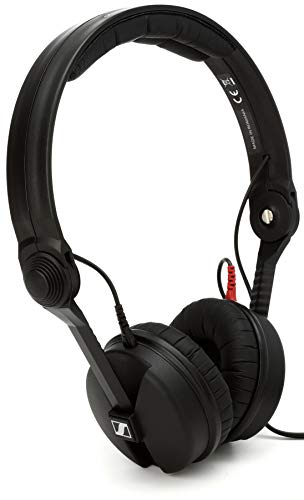
Sennheiser HD 25
Sennheiser trimmed the HD 25 to 140 grams using a single-sided split headband that resists cracking under repeated folding. Its 70 ohm driver needs more voltage than budget picks, so club mixers suit it better than a phone. A 180 degree earcup rotation lets a DJ press one cup to an ear while the other stays clear.
Pros
- Lightest headphone in this lineup at 140 grams
- Single-sided cable stays clear of a crowded deck
- Replaceable pads and headband keep it usable for years
Cons
- 70 ohm impedance plays quiet on phones without an amp
- Bass feels thinner than the larger-driver designs here
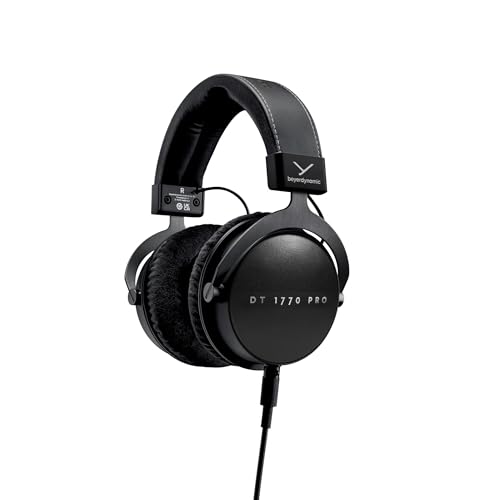
Beyerdynamic DT 1770 Pro
A Tesla 2.0 driver targets mixing accuracy over club volume, and its 250 ohm impedance needs an interface or headphone amp to reach full output. Velour and leatherette pads ship together, so a producer can swap for isolation or comfort by session. At 388 grams it suits a desk chair more than a standing four-hour set.
Pros
- Swappable velour and leatherette pads adjust isolation
- Wide 5Hz to 40kHz range aids close EQ work
- Detachable cable simplifies replacement
Cons
- 250 ohm load stays quiet on unpowered mixer outputs
- 388 gram weight is not built for standing sets

AIAIAI TMA-2 DJ Preset
AIAIAI sells the TMA-2 in separate modules, and the DJ Preset bundles S02 speaker units with an H02 headband and E02 bearings. Owners can later swap a headband, cable, or earcup instead of replacing the whole headphone. A titanium-coated diaphragm in the 32 ohm driver reaches 117dB SPL for loud rooms.
Pros
- Worn parts swap out instead of the full unit
- Coiled C02 cable resists stretching from booth movement
- Titanium-coated driver hits 117dB SPL for loud rooms
Cons
- Third-party accessories are scarcer than for Sennheiser or Pioneer
- Matte plastic housing scuffs faster than metal-reinforced builds
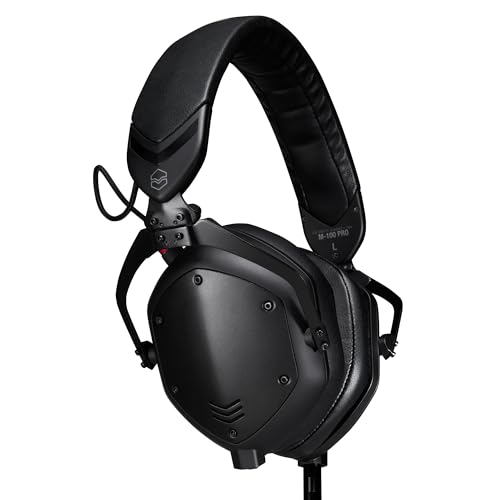
V-MODA Crossfade M-100
V-MODA folds the Crossfade M-100 flat into an included carrying case sized for a backpack or gig bag. Dual-diaphragm 50mm drivers cover a 5Hz to 40kHz range. A kevlar-reinforced cable resists the fraying plain cables show after months of travel, and steel hinges handle repeated folding between gigs.
Pros
- Folds flat into an included hardshell case
- Kevlar cable resists wear from frequent packing
- Steel hinges rated for repeated folding
Cons
- Earcups run smaller than circumaural rivals and can feel snug
- Passive isolation trails thicker-padded designs like the DT 1770 Pro
Compared at a glance
| # | Model | Driver size | Best for | Score | Price |
|---|---|---|---|---|---|
| 1 | Pioneer DJ HDJ-X10 | 50mm dome | Best overall | 9.4 | Check price |
| 2 | Audio-Technica ATH-M50x | 45mm | Best value | 9.1 | Check price |
| 3 | Sony MDR-7506 | 40mm dome | Best budget | 8.8 | Check price |
| 4 | Sennheiser HD 25 | 38mm | Best for all-night club sets | 8.6 | Check price |
| 5 | Beyerdynamic DT 1770 Pro | 45mm Tesla 2.0 | Best for producers and home studio use | 8.4 | Check price |
| 6 | AIAIAI TMA-2 DJ Preset | 40mm, titanium-coated | Best for a customizable, modular build | 8.2 | Check price |
| 7 | V-MODA Crossfade M-100 | 50mm dual-diaphragm | Best for travel and mobile DJ setups | 8.0 | Check price |
What matters most
What to look for in DJ headphones Driver size and impedance decide how loud a headphone plays off a given mixer. Closed-back designs block crowd noise from leaking into a microphone, while a swiveling cup lets a DJ check the room with one ear free. Cable type changes how gear behaves on a crowded deck; coiled cables stretch and spring back instead of dragging across faders. Weight and pad material decide comfort across a multi-hour set more than sound quality alone.
Closed-back vs open-back for booth use Every headphone in this comparison uses a closed-back design, and that pattern is not accidental. Open-back models leak sound into a microphone and let crowd noise bleed into the cue mix. Sealed cups on the Pioneer HDJ-X10 and Beyerdynamic DT 1770 Pro trade soundstage width for isolation near a subwoofer. A producer working from home can tolerate more leakage than a DJ standing beside a PA system.
How earcup swivel and cable type affect cueing Sennheiser’s HD 25 rotates a full 180 degrees, letting a DJ press one cup to an ear while reading the crowd with the other. Pioneer’s HDJ-X10 and Audio-Technica’s ATH-M50x swivel too, just not as far. Coiled cables on the HD 25, HDJ-X10, and TMA-2 DJ Preset resist snagging on turntables or channel faders. A straight cable packs flatter, which suits a mobile DJ moving gear between venues each week.
Best headphones for producers and home studios A producer mixing at a desk cares less about SPL headroom and more about frequency accuracy. Beyerdynamic’s DT 1770 Pro needs an audio interface to drive its 250 ohm load, a tradeoff that pays off in flatter response for EQ decisions. AIAIAI’s modular TMA-2 lets a hybrid DJ-producer replace a pad or cable without buying a new headphone. Lower-impedance picks like the ATH-M50x still work at a desk, just with less headroom for quiet, critical listening.
Frequently asked questions
Do DJs need special headphones, or do regular ones work?
Regular headphones lack the SPL headroom and isolation a booth needs beside a subwoofer. DJ-specific builds like the Pioneer HDJ-X10 add swiveling cups and reinforced cables that consumer models skip. Owners report standard earbuds distort at booth volume well before dedicated DJ headphones do.
Is closed-back or open-back better for DJing?
Closed-back wins for DJing since it blocks crowd noise and keeps cue audio out of a microphone. All seven picks here use closed-back designs for that reason. Open-back headphones suit quiet studio mixing more than a loud club booth.
What impedance works best for DJ headphones?
A 32 to 40 ohm range, like the Pioneer HDJ-X10 or Audio-Technica ATH-M50x, drives cleanly from a standalone mixer or phone. Higher-impedance builds such as the Sennheiser HD 25 at 70 ohms or the Beyerdynamic DT 1770 Pro at 250 ohms need more voltage. A mixer with a dedicated headphone amp handles those higher-impedance builds without trouble.
Coiled or straight cable for booth use?
Coiled cables stretch across a crowded deck and spring back instead of dragging on faders. Sennheiser’s HD 25 and Pioneer’s HDJ-X10 both ship with coiled options for that reason. Straight cables pack flatter, which suits a mobile DJ moving gear between venues.
How much does earcup swivel matter for cueing?
Swivel lets a DJ hold one cup to an ear while monitoring the room with the other, a technique called cueing. Sennheiser’s HD 25 rotates a full 180 degrees, the widest range in this lineup. Fixed-cup designs force a DJ to remove the whole headphone to check the room mix.
Are studio headphones like the Beyerdynamic DT 1770 Pro good for DJing?
Its 250 ohm impedance and 388 gram weight suit a mixing desk more than a standing set. A flatter frequency response helps producers catch EQ mistakes a club-tuned headphone might mask. A DJ running four-hour sets would likely find it heavier and quieter off a basic mixer than the Pioneer or Sennheiser options here.
Which driver size gives the strongest bass for DJ headphones?
Larger 50mm drivers, used in the Pioneer HDJ-X10 and V-MODA Crossfade M-100, generally produce fuller low end than 38mm or 40mm drivers. Driver size alone does not guarantee bass output; enclosure design and pad seal matter just as much. AIAIAI’s 40mm titanium-coated driver in the TMA-2 DJ Preset still reaches 117dB SPL despite its smaller size.
Can DJ headphones double as home studio headphones?
Closed-back DJ headphones like the Audio-Technica ATH-M50x cross over well into home studio mixing. Owners report the swiveling cups and detachable cables suit both a booth and a desk setup. Dedicated studio models such as the Beyerdynamic DT 1770 Pro trade portability for a flatter response geared toward mixing.
Which DJ headphones are best for travel?
V-MODA’s Crossfade M-100 folds flat into an included hardshell case sized for a backpack or gig bag. Steel-reinforced hinges and a kevlar cable hold up to repeated packing between gigs. Sony’s MDR-7506 also folds flat and costs less, though its case is not included.
The verdict
Most working DJs land best with Pioneer’s HDJ-X10, thanks to swiveling one-ear cups and cueing gear built for a six-hour set. Sennheiser’s HD 25 makes more sense for back-to-back club nights, where its 140 gram build and full swivel cut fatigue. Anyone splitting time between DJing and studio mixing should pick Beyerdynamic’s DT 1770 Pro instead, assuming they already own an interface to drive its 250 ohm load.


