AV Receivers Compared on Power, Inputs and Sound
Denon AVR-X3800H suits most home theaters, with 9.4 channel processing, six HDMI 2.1 inputs and Audyssey MultEQ XT32. Marantz Cinema 50 steps up to 11.4 channels for larger dedicated rooms. Yamaha RX-V6A covers a 7.2 layout with HDMI 2.1 for far less.
Denon AVR-X3800H handles nearly every home theater layout, pairing 9.4 channels with full bandwidth HDMI 2.1. Larger dedicated rooms justify the 11.4 channels in a Marantz Cinema 50. For a 7.2 living room build, Yamaha RX-V6A does the job for far less.
Spec sheets blur together here, and headline watt ratings rarely survive all channels driven at once. We compared processing channels, which HDMI ports actually carry full bandwidth, room correction systems, streaming platforms and pre out provision. Owner reports about setup menus and real speaker loads settled the close calls. Start from your speaker layout, then work up.
The shortlist, ranked

Denon AVR-X3800H
Nine channels of amplification plus four subwoofer outputs cover Atmos layouts up to 7.2.4 in a real room. Six HDMI 2.1 inputs let a console, a PC and a player all run 4K at 120Hz without swapping cables. Audyssey MultEQ XT32 measures at far higher resolution than basic auto calibration, which shows most in the bass.
Pros
- Full bandwidth HDMI 2.1 across six inputs
- XT32 correction resolves bass problems well
- Pre outs allow later external amplification
Cons
- Setup menus overwhelm first time buyers
- More channels than a small living room can use

Marantz Cinema 50
Eleven channels of processing open up 7.2.4 and 5.2.6 Atmos layouts without an external amp. Marantz voicing runs warmer than Denon’s, which owners often prefer across long film sessions. Chassis weight and the porthole display mark it as a rack centrepiece rather than a starter unit.
Pros
- Eleven channels cover ambitious Atmos layouts
- Warmer voicing suits long viewing sessions
- Heavy chassis and thorough connectivity
Cons
- Overkill for rooms under about 250 square feet
- Deep chassis needs a full size rack shelf

Yamaha RX-V6A
Seven channels and two subwoofer outputs cover a 5.1.2 Atmos layout in most living rooms. YPAO calibration measures fewer points than XT32 but sets levels and distances reliably. Voicing leans neutral rather than warm, which suits mixed music and film use.
Pros
- Neutral balance works for music and film
- HDMI 2.1 on the inputs gamers use
- MusicCast links other rooms easily
Cons
- YPAO measures fewer points than XT32
- Only some inputs carry HDMI 2.1

Onkyo TX-NR6100
Chromecast built in, Sonos certification and AirPlay 2 make this the easiest unit here to feed from a phone. THX certification means the amplifier meets defined output and distortion targets at reference level. Three HDMI 2.1 inputs handle current consoles, while AccuEQ covers basic room correction.
Pros
- Widest streaming platform support in this group
- Sonos and Chromecast work without extra boxes
- THX certified output targets
Cons
- AccuEQ trails Audyssey XT32 in the bass
- Seven channels cap the Atmos layout at 5.1.2

Denon AVR-S770H
S series construction trims features rather than core performance, keeping HDMI 2.1 on three inputs and HEOS streaming intact. Audyssey MultEQ calibrates at lower resolution than XT32 but still fixes obvious room problems. No pre outs means external amplifiers are off the table later.
Pros
- HDMI 2.1 gaming inputs without stepping to the X series
- HEOS multiroom on a midrange chassis
- Straightforward guided setup assistant
Cons
- MultEQ resolves less detail than XT32
- No pre outs for adding amplifiers later
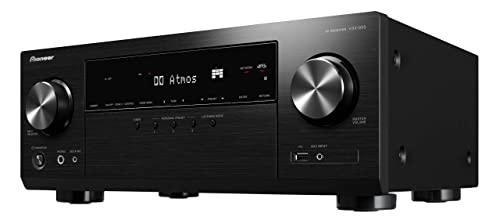
Pioneer VSX-LX305
Nine channels allow 5.2.4 height layouts, which few units at this level offer. Dirac Live upgrade capability sits alongside Pioneer’s own MCACC calibration, giving a route to better correction later. Input count runs deep, which suits a rack holding several legacy sources.
Pros
- Nine channels support taller Atmos layouts
- Dirac Live upgrade path available
- Deep input count for mixed source racks
Cons
- Dirac Live licence is a separate purchase
- On screen interface feels dated

Sony STR-DH790
Atmos and DTS:X decoding arrive here with almost nothing else attached. HDMI 2.0 with HDCP 2.2 passes 4K at 60Hz, so film and streaming are covered while 120Hz gaming is not. Setup takes minutes because there is no network stack to configure.
Pros
- Lowest cost route into a full 7.2 Atmos layout
- Setup finishes in minutes
- Handles 4K 60Hz film sources cleanly
Cons
- No Wi-Fi, app or network streaming
- Lacks 4K 120Hz and variable refresh rate
How to pick the right one
How many channels does an AV receiver need Numbers like 7.2 or 9.4 state powered speaker channels and subwoofer outputs. A 5.1 or 7.2 layout fits most living rooms comfortably. Nine and eleven channel units add height speakers for Dolby Atmos, which need ceiling mounts or upfiring modules and a room that can take them. Count your actual speaker positions and seating first. Unused channels add cost and heat while sitting idle, though pre outs let you expand later without replacing the receiver.
Do you need HDMI 2.1 on an AV receiver Current consoles and high refresh PCs need full bandwidth HDMI 2.1 for 4K at 120Hz, variable refresh rate and auto low latency mode. Not every unit puts 2.1 on every port, so read the input list rather than the headline. Denon AVR-X3800H carries six such inputs, while several rivals fit two or three. Movies and streaming at 4K 60Hz still run happily on HDMI 2.0 with HDCP 2.2. Passthrough behaviour matters too when the receiver sits between a console and the display.
Which room correction system makes the biggest difference Automatic correction measures your room with a microphone, then flattens the peaks and nulls that walls and furniture create. Audyssey MultEQ XT32 and Dirac Live take the most measurement points and resolve bass problems simpler systems smear over. AccuEQ, YPAO and basic auto calibration handle levels and distances well but do less below 100Hz. Correction usually improves perceived sound more than a jump in rated power. Run it with the microphone on a tripod at ear height, never held in your hand.
How much power does an AV receiver really need Advertised watt figures usually come from two channels driven, not seven at once. Compare ratings measured into the same impedance with the same channel count, or ignore them. Speaker sensitivity matters just as much, since a 90dB speaker needs half the power of an 87dB one for the same level. Room size and seating distance shift the requirement again. Every receiver here reaches reference level in a normal living room with sensible speakers.
The lineup, side by side
| # | Model | Channels | Best for | Score | Price |
|---|---|---|---|---|---|
| 1 | Denon AVR-X3800H | 9.4 processing | Best overall | 9.4 | Check price |
| 2 | Marantz Cinema 50 | 11.4 processing | Best for large rooms | 9.2 | Check price |
| 3 | Yamaha RX-V6A | 7.2 | Best value | 9.0 | Check price |
| 4 | Onkyo TX-NR6100 | 7.2 | Best for streaming | 8.8 | Check price |
| 5 | Denon AVR-S770H | 7.2 | Best midrange | 8.6 | Check price |
| 6 | Pioneer VSX-LX305 | 9.2 | Best for connectivity | 8.3 | Check price |
| 7 | Sony STR-DH790 | 7.2 | Best budget | 8.0 | Check price |
Good to know
What does 7.2 or 9.4 mean on an AV receiver?
The first number counts powered speaker channels, the second counts subwoofer outputs. A 7.2 unit drives seven speakers and two subs, while 9.4 adds height channels and two more subwoofer outputs.
Do I need HDMI 2.1 on my AV receiver?
Only for 4K at 120Hz, variable refresh rate or auto low latency mode from a current console or PC. Film and streaming at 4K 60Hz run fine on HDMI 2.0 with HDCP 2.2.
How many watts does an AV receiver need?
Less than the box suggests. Speaker sensitivity and room size drive loudness as much as amplifier rating, so match impedance first and prioritise a unit that reaches reference level cleanly.
Is room correction worth using?
Yes in almost every room. Correction tames bass peaks caused by walls and corners, and stronger systems such as MultEQ XT32 or Dirac Live audibly improve clarity and imaging.
Can any AV receiver do Dolby Atmos?
It needs Atmos decoding plus spare channels for height speakers. A 5.1.2 or 7.1.2 layout is the usual starting point, using either ceiling speakers or upfiring modules.
Which AV receiver is best for gaming?
Look for full bandwidth HDMI 2.1 on more than one input, since a console and a PC both want it. Denon AVR-X3800H fits six, while Onkyo TX-NR6100 and Denon AVR-S770H each provide three.
Denon vs Marantz: what is the difference?
Both sit under the same parent company and share Audyssey correction and HEOS streaming. Marantz voices its amplifiers warmer and builds heavier chassis, while Denon leans neutral and packs more features into each model.
Do I need built in streaming on a receiver?
Useful if you play music from apps or across rooms, where HEOS, MusicCast or Chromecast save a separate device. Watching only through a console or streaming stick makes Bluetooth enough.
Should I buy a receiver with pre outs?
Buy them if you expect to add external amplification or extra zones later. Denon AVR-S770H omits them, which caps that upgrade path, while the X3800H and Cinema 50 both provide them.
How long does an AV receiver last?
Amplification often outlives the connectivity. HDMI and audio codec standards move faster than the hardware wears out, so current port and format support extends useful life more than build quality does.
The bottom line
Denon AVR-X3800H is the receiver most enthusiasts should build around, covering current formats, six HDMI 2.1 inputs and the strongest room correction here. Larger dedicated rooms wanting eleven channels should step up to the Marantz Cinema 50 instead. Tighter budgets are well served by the Yamaha RX-V6A, or the Sony STR-DH790 when 120Hz gaming is not a factor.