Which Dolby Atmos Soundbar Suits Your Living Room?
The Sonos Arc Ultra is the strongest all round pick for balanced height effects and simple setup. The Samsung HW-Q990D suits anyone who wants real rear surrounds included in the box, and the Polk Audio MagniFi Max AX delivers convincing overhead cues from a far simpler two piece system.
If you want a Dolby Atmos soundbar that sounds genuinely three dimensional rather than just wide, the Sonos Arc Ultra, Samsung HW-Q990D and Polk Audio MagniFi Max AX are the three to shortlist. Each takes a different route to height, and each fits a different room.
Atmos is tricky because the badge on the box tells you almost nothing. Some bars fire drivers at the ceiling, some only simulate height with processing, and a low ceiling or an open plan room can erase the effect entirely. We compared published channel layouts, driver counts, calibration systems, HDMI capability and what owners report about bounce performance in real rooms.
The top picks, ranked

Sonos Arc Ultra
The Arc Ultra pairs a wide 9.1.4 layout with the Sound Motion woofer, so it carries low end that older single bar designs could not. Room calibration runs from a phone and adapts the height channels to your ceiling. Owners report it is the easiest premium bar to live with day to day.
Pros
- Convincing height without add on speakers
- Automatic room calibration from the app
- Grows into a full surround system later
Cons
- Only one HDMI port, so no passthrough
- Full effect needs a Sonos ecosystem buy in

Samsung HW-Q990D
This is a genuine 11.1.4 package with wireless rear speakers and a subwoofer included, so the overhead layer has something to work with behind you. SpaceFit Sound Pro measures the room and adjusts output. Owners report the rear height drivers make a clear difference in dedicated media rooms.
Pros
- Rear speakers and sub arrive in the box
- Height drivers front and rear
- Passthrough port for a console or player
Cons
- Four boxes need four mains outlets
- Best features favour Samsung televisions

Sony BRAVIA Theater Bar 9
Sony leans on beam forming and its 360 Spatial Sound Mapping to spread height cues wider than the cabinet suggests. Voice Zoom keeps dialogue forward when the mix gets busy. Based on specifications it is one of the few slim bars with a genuinely wide phantom soundstage.
Pros
- Excellent speech intelligibility
- Wide soundstage from a slim cabinet
- Optional wireless rears and sub
Cons
- Subwoofer sold separately
- Mapping works best with Sony televisions

LG S95TR
A 9.1.5 layout adds a centre up firing channel that most rivals skip, which helps anchor overhead effects in wide rooms. The bundled sub and rears are wireless. Owners report it plays loud without hardening, which matters in open plan spaces.
Pros
- Extra centre height channel
- Complete surround package included
- Handles high volume cleanly
Cons
- Bar is tall enough to block low set screens
- App setup is fiddlier than rivals

Bose Smart Soundbar Ultra
Bose combines up firing drivers with its TrueSpace processing so upmixed stereo content also gains height. The cabinet is short enough to sit under most screens. Owners report it fills apartments and bedrooms convincingly without a separate subwoofer.
Pros
- Compact footprint suits small rooms
- Upmixes non Atmos content well
- Strong bass for the cabinet size
Cons
- No subwoofer included
- Height effect limited by only two drivers

Polk Audio MagniFi Max AX
A two piece bar and wireless sub combination with genuine up firing drivers rather than processed height alone. Polk includes several voice adjustment presets. Owners report the overhead layer reads clearly under normal ceiling heights, which is the whole point of Atmos.
Pros
- Real up firing drivers, not just processing
- Wireless subwoofer included
- Useful dialogue and night presets
Cons
- No app based room calibration
- Surrounds cost extra to add
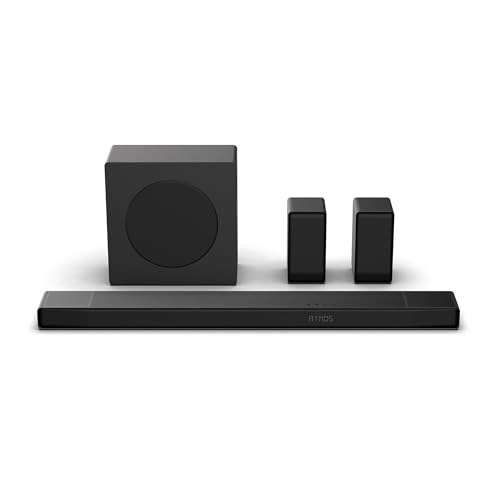
Hisense AX5125H
A 5.1.2 system with satellites and a subwoofer that brings Atmos decoding to a modest setup. Height comes from up firing drivers in the main bar. Owners report it is a large step up from television speakers, with the usual caveats about ceiling bounce.
Pros
- Full satellite package at entry level
- Simple plug in setup
- Clear improvement over built in speakers
Cons
- Height layer is subtle in tall rooms
- No Wi-Fi streaming
How they stack up
| # | Model | Channels | Best for | Score | Price |
|---|---|---|---|---|---|
| 1 | Sonos Arc Ultra | 9.1.4 | Best overall | 9.4 | Check price |
| 2 | Samsung HW-Q990D | 11.1.4 | Best for full surround out of the box | 9.2 | Check price |
| 3 | Sony BRAVIA Theater Bar 9 | 13 effective channels | Best for dialogue clarity | 9.0 | Check price |
| 4 | LG S95TR | 9.1.5 | Best for large rooms | 8.8 | Check price |
| 5 | Bose Smart Soundbar Ultra | 5.1.2 effective | Best for small rooms | 8.6 | Check price |
| 6 | Polk Audio MagniFi Max AX | 5.1.2 | Best value | 8.3 | Check price |
| 7 | Hisense AX5125H | 5.1.2 | Best budget | 8.0 | Check price |
What matters most
Ceiling height decides more than the bar does Up firing drivers work by bouncing sound off a flat ceiling back down to your seat. Flat, hard ceilings between about eight and twelve feet give the effect its best chance. Vaulted, beamed, sloped or heavily textured ceilings scatter that reflection, and the height layer collapses into ordinary stereo. If your ceiling is unusual, a bar that leans on processing rather than reflection, or a system with rear height speakers, will serve you better.
Read the channel notation properly A label like 5.1.2 breaks down as five ear level channels, one subwoofer channel and two height channels. The last digit is the one that matters for Atmos. A 5.1 bar with a Dolby Atmos badge is decoding the format but folding the height information down into ordinary channels, which is not the same experience. More height drivers generally means more precise overhead placement, particularly in wider rooms.
Check the HDMI situation before you buy HDMI eARC is what carries a full bitrate Atmos stream from your television to the bar, so both ends need it. If your television has only one spare HDMI port, look for a bar with an HDMI input so a console or player can pass through. Optical connections cannot carry lossless Atmos at all, which surprises a lot of owners after setup.
Decide whether you will add rear speakers later Rear surrounds change Atmos more than any other upgrade because they give the mix somewhere behind you to place effects. Some bars ship with rears in the box, others sell matching wireless rears separately, and some cannot be expanded at all. Buying into a platform that supports expansion keeps the option open even if you start with the bar alone.
Good to know
Do I need a Dolby Atmos television to use an Atmos soundbar?
Not strictly. You need a source that outputs Atmos and a path to the bar that can carry it. A television with HDMI eARC passing an Atmos stream from a streaming app works, and so does plugging a player or console directly into a bar that has an HDMI input.
Will an Atmos soundbar sound better than a normal one on regular content?
Usually yes, because these bars tend to have more drivers and better amplification. Most also upmix stereo and 5.1 content into the height channels. The difference on non Atmos material is smaller than on a true Atmos mix, though.
Are up firing drivers better than virtual height processing?
In a room with a flat, reasonably low ceiling, up firing drivers give more convincing placement. In a room with a vaulted or open ceiling, processing based virtual height can actually sound more consistent because it does not depend on a reflection.
How high should the soundbar sit?
At or just below ear height when seated, and ideally directly under the screen. Mounting a bar inside a closed cabinet blocks the up firing drivers completely, which is the most common reason owners report that Atmos does nothing for them.
Do I need a subwoofer for Atmos?
You do not need one to decode the format, but low frequency effects are a big part of the impact. Bars with a bundled wireless sub generally satisfy more owners than single cabinet designs, unless your room is small or you have neighbours below.
Can I use an old soundbar as rear speakers?
No. Wireless rear surrounds have to be the manufacturer’s matching models so they can sync timing with the main bar. Mixing brands is not supported by any of the systems ranked here.
Does Atmos work over Bluetooth?
No. Bluetooth does not have the bandwidth for an Atmos stream, so music and phone audio sent that way arrives as ordinary stereo. Use HDMI eARC or Wi-Fi streaming for spatial audio.
How much space do I need behind the bar?
Very little for the bar itself, but leave the up firing drivers a clear line to the ceiling. Shelves directly above the bar, deep alcoves and low mounted televisions all interfere with the reflection path.
Our take
For most living rooms the Sonos Arc Ultra is the pick, because it delivers a real height layer from a single cabinet and calibrates itself to the room. If you have a dedicated media space and want rear height channels immediately, the Samsung HW-Q990D is the more complete system. The Polk Audio MagniFi Max AX covers the middle ground with genuine up firing drivers and a wireless subwoofer included.


