Which Soundbar Actually Delivers Real Dolby Atmos?
The Sonos Arc leads this list, delivering room-filling Dolby Atmos from a premium 11-driver bar with genuine upward-firing speakers. The Sonos Beam Gen 2 is the best compact option for smaller rooms, while the Samsung HW-Q800 pairs true 5.1.2 sound with an included wireless subwoofer for movies.
Cinematic sound without a full home theater starts with the Sonos Arc for its premium Dolby Atmos performance, the Sonos Beam Gen 2 for compact rooms, or the Samsung HW-Q800 for movie nights with an included subwoofer.
Channel labels like 5.1.2 mean little without knowing whether a subwoofer and up-firing drivers actually ship in the box. To pick these seven, we compared channel layouts, connectivity and bundled subwoofers, then weighed them against how owners report each bar sounds with movies and music.
The best picks, ranked

Sonos Arc
Eleven drivers, including genuine upward-firing speakers, bounce Dolby Atmos height effects off the ceiling for real immersion rather than simulated width. Owners report excellent clarity for both movies and music. It connects only through HDMI eARC and skips a subwoofer entirely.
Pros
- True up-firing Dolby Atmos height channels
- Excellent clarity for movies and music
- Expandable with Sonos Sub and rear speakers
Cons
- No subwoofer included
- Only connects via HDMI eARC

Sonos Beam Gen 2
A compact bar fits under smaller TVs and in tighter rooms while still virtualizing Dolby Atmos through processing rather than physical drivers. Dialogue stays clear and the sound is fuller than the size suggests, according to owner reports. Height effects land subtler here than on the Arc since there is no up-firing hardware.
Pros
- Compact size fits smaller TVs and rooms
- Clear dialogue and full sound for its size
- Expandable into a full Sonos system
Cons
- Atmos is virtualized, not up-firing
- No subwoofer included
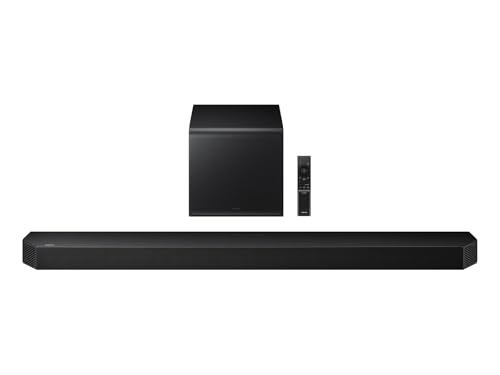
Samsung HW-Q800
A 5.1.2 layout pairs a wireless subwoofer for deep bass with up-firing drivers for Dolby Atmos height, a strong combination for movie nights. Owners report punchy, cinematic sound and value the Q-Symphony feature that pairs it with compatible Samsung TVs. The included subwoofer is large and needs floor space.
Pros
- Wireless subwoofer included for deep bass
- Up-firing Atmos drivers for height effects
- Q-Symphony pairs with Samsung TV speakers
Cons
- Subwoofer is large to place
- Some features favor Samsung TV owners

LG S90QY
An extra center up-firing channel widens the height layer beyond a standard 5.1.2 setup, and the included wireless subwoofer adds real low end. Powerful, spacious sound is what owners report most often. The full 5.1.3 footprint takes more floor space and syncs best with LG TVs.
Pros
- 5.1.3 layout with extra height channel
- Wireless subwoofer included
- Powerful, spacious sound for larger rooms
Cons
- Full setup needs more space
- Best sync features favor LG TVs

Bose Smart Soundbar 600
Balanced, natural tuning suits music as well as movies, and built-in voice assistants handle hands-free control. Clear vocals and a wide soundstage are the traits owners mention most. No subwoofer ships with this compact Dolby Atmos bar, so deep bass needs a separate Bose module.
Pros
- Balanced, natural sound well suited to music
- Built-in voice assistants and app control
- Compact bar with Dolby Atmos
Cons
- No subwoofer included
- Bass is limited without an add-on module

Vizio M-Series 5.1.2
Dolby Atmos, a wireless subwoofer and satellite-ready surround arrive at a value position most rivals cannot match. Strong movie sound for the outlay is what owners report most, even if the app and interface feel less polished than premium brands. Build quality is more basic than the Sonos or Samsung bars above it.
Pros
- Wireless subwoofer included at a value price
- 5.1.2 Dolby Atmos configuration
- Strong movie performance for the outlay
Cons
- App and interface feel less refined
- Build quality is more basic than premium bars

Yamaha SR-C20A
Built-in subwoofers inside a compact all-in-one bar suit bedrooms, desks and small living rooms where space is tight. A clear upgrade over TV speakers and easy Bluetooth streaming are the main draws, according to owner feedback. This is a simple 2.1 bar without Dolby Atmos or a separate sub.
Pros
- Compact all-in-one design with built-in bass
- Clear step up from TV speakers
- Easy Bluetooth streaming
Cons
- No Dolby Atmos or separate subwoofer
- Limited output for large rooms
Before you buy
How do soundbar channel numbers like 5.1.2 work? Three numbers describe a soundbar’s layout. The first counts horizontal speakers for surround, the second is the subwoofer, and the third is up-firing height speakers for Dolby Atmos. A 5.1.2 bar has five main channels, a subwoofer, and two height drivers, while a 2.1 bar is a simple stereo pair with bass. More channels generally mean a more enveloping sound.
Dolby Atmos: real drivers versus virtual processing Physically bouncing sound off the ceiling is what up-firing drivers do on bars like the Sonos Arc and Samsung HW-Q800, and it is the more convincing approach. Processing creates height virtually on bars like the Sonos Beam Gen 2, which is subtler but keeps the unit smaller. Prioritize dedicated up-firing drivers and a flat, reflective ceiling if height effects matter most to you.
Which soundbars include a subwoofer, and which need one added? Bass is where these bars differ most. A wireless subwoofer ships with the Samsung HW-Q800 and Vizio M-Series for deep, cinematic bass. The Sonos Arc and Bose 600 leave the subwoofer as a separate add-on, which raises the total outlay. Many premium bars also let you add wireless rear speakers later for a true surround setup.
How should connectivity and room size shape your pick? Full-quality Atmos audio over one cable, synced with your TV remote, is what HDMI eARC delivers; optical is a simpler fallback with less bandwidth. Match the bar to your room too, since compact bars like the Beam Gen 2 and Yamaha SR-C20A suit small spaces while 5.1.2 and 5.1.3 systems shine in larger living rooms.
How they compare
| # | Model | Channels | Best for | Score | Price |
|---|---|---|---|---|---|
| 1 | Sonos Arc | 5.0.2 Dolby Atmos | Best overall | 9.4 | Check price |
| 2 | Sonos Beam Gen 2 | Dolby Atmos, virtualized | Best compact | 9.2 | Check price |
| 3 | Samsung HW-Q800 | 5.1.2 Dolby Atmos | Best for movies | 9.0 | Check price |
| 4 | LG S90QY | 5.1.3 Dolby Atmos | Best for immersive surround | 8.8 | Check price |
| 5 | Bose Smart Soundbar 600 | Dolby Atmos, compact | Best for music | 8.6 | Check price |
| 6 | Vizio M-Series 5.1.2 | 5.1.2 Dolby Atmos | Best value | 8.4 | Check price |
| 7 | Yamaha SR-C20A | 2.1, built-in subwoofers | Best budget | 8.1 | Check price |
Common questions
Which soundbar is best overall?
The Sonos Arc is the top pick here. Its 11 drivers and genuine up-firing speakers produce real Dolby Atmos height and excellent clarity for both movies and music, making it the most complete single-bar system on this list.
What do soundbar channel numbers like 5.1.2 mean?
The first number is the horizontal surround speakers, the second is the subwoofer, and the third is the up-firing height speakers for Dolby Atmos. A 5.1.2 bar has five main channels, a subwoofer, and two height drivers, while a 2.1 bar is stereo with bass.
Do you need Dolby Atmos in a soundbar?
Height and overhead effects for a more immersive feel are what Atmos adds, which suits movies well. It is worth it with a flat, reflective ceiling and a steady cinema habit. Non-Atmos bars can still be a big upgrade for news or everyday shows.
What is the difference between real and virtual Atmos?
Up-firing drivers, as on the Sonos Arc and Samsung HW-Q800, physically bounce sound off the ceiling for convincing height. Processing on the Sonos Beam Gen 2 simulates height instead, which is subtler but keeps the bar smaller.
Which soundbars come with a subwoofer included?
A wireless subwoofer ships with the Samsung HW-Q800, LG S90QY, and Vizio M-Series. The Sonos Arc, Sonos Beam Gen 2, and Bose Smart Soundbar 600 do not, so deep bass requires buying a matching subwoofer separately.
How should you connect a soundbar to a TV?
Full-quality Dolby Atmos over a single cable, synced with your TV remote, is what HDMI eARC provides, making it the best option. An optical connection works as a fallback if your TV lacks eARC, but it has less bandwidth and cannot pass the highest-quality Atmos formats.
Which soundbar suits a small bedroom or apartment?
The Sonos Beam Gen 2 and Yamaha SR-C20A fit small rooms best. Both stay compact enough for smaller TVs and tight spaces, with the Beam offering virtualized Atmos and the SR-C20A providing a simple, affordable step up from TV speakers.
Can rear surround speakers be added later?
Yes, on several models. Sonos rear speakers pair with the Arc and Beam, and the Samsung and LG systems support their own wireless rears. Adding rears creates true surround, though it raises the total outlay.
Is a soundbar better than the speakers built into a TV?
In almost all cases, yes. Flat TVs leave little room for quality speakers, so even a budget bar like the Yamaha SR-C20A noticeably improves dialogue clarity and bass. Premium bars go much further with Dolby Atmos, included subwoofers, and expandable surround.
Do these soundbars work with music streaming apps?
Yes. Bluetooth or Wi-Fi streaming is supported across every bar here, and the Sonos and Bose models integrate with popular music apps and voice assistants. The Bose Smart Soundbar 600 stands out for balanced, natural sound that suits music especially well.
The verdict
For most people, the Sonos Arc is the soundbar to buy, thanks to its genuine Dolby Atmos height and all-round clarity. Choose the Samsung HW-Q800 if you want cinematic movie sound with an included subwoofer, or the Yamaha SR-C20A if you need a compact, affordable upgrade for a small room.