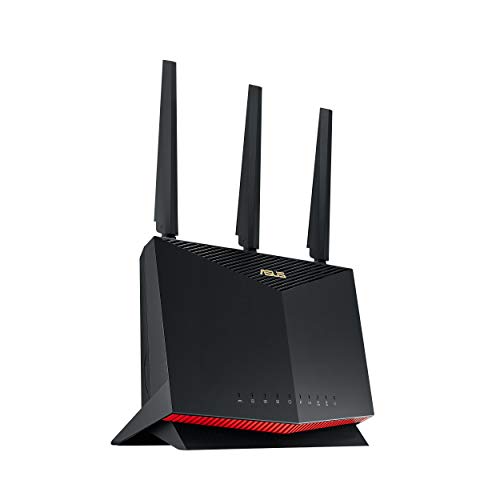
Which Router Actually Covers a Whole Large Home?
TP-Link Deco X90 balances coverage and speed best for most large homes. Netgear Orbi RBK753 reaches the furthest at roughly 7500 square feet in its three-piece kit. ASUS ZenWiFi XT8 suits gaming households that need low latency. Coverage ratings, backhaul design, and port speed all matter more than raw specs alone.
TP-Link Deco X90 tops this list for most large homes, pairing AX6600 tri-band Wi-Fi 6 with a 2.5 Gigabit port. Its two-unit coverage rating tops out around 6500 square feet, so sprawling three-story houses may still need a third unit or a bigger kit like the Orbi RBK753.
Square footage, wall material, and device count all change what a coverage rating really means once you move in. We compared published coverage figures, tri-band backhaul design, wired port speeds, and owner feedback on dead zones to rank these seven picks.
The top picks, ranked

TP-Link Deco X90
A dedicated backhaul band lets a two-unit Deco X90 set cover up to 6,500 square feet, according to the listing, while running AX6600 tri-band Wi-Fi 6. Each unit includes a 2.5 Gigabit WAN/LAN port for a fast wired backhaul link or a faster-than-gigabit internet plan. TP-Link’s HomeShield app adds parental controls and network-wide device management.
Pros
- Dedicated 5GHz backhaul keeps speeds steady across multiple units
- 2.5 Gigabit port supports faster-than-gigabit internet plans
- HomeShield app covers parental controls and basic network security
Cons
- Three-story homes over 6,500 sq ft may need a third unit
- Advanced HomeShield security features require a subscription

Netgear Orbi RBK753
Three pieces make up the Orbi RBK753 kit, a router plus two satellites rated for up to 7,500 square feet of coverage. AX4200 tri-band Wi-Fi 6 runs alongside a dedicated wireless backhaul channel, so satellites do not compete with device traffic for bandwidth. Each satellite includes gigabit LAN ports for wiring a smart TV or game console directly.
Pros
- Widest rated coverage in this roundup at 7,500 sq ft
- Dedicated backhaul band avoids congestion from client devices
- Multiple wired LAN ports on every satellite
Cons
- Larger and pricier than two-piece mesh kits
- No 2.5G or multi-gig port on this model

ASUS ZenWiFi XT8
ASUS AiMesh support lets ZenWiFi XT8 owners add older ASUS routers as extra nodes instead of buying a matched pair. AX6600 tri-band Wi-Fi 6 powers a 2-pack that covers roughly 5,500 square feet, according to ASUS, and each unit includes a 2.5G WAN port. Built-in AiProtection Pro, powered by Trend Micro, filters malicious sites at the network level.
Pros
- AiMesh lets owners mix in existing ASUS routers as extra nodes
- Built-in AiProtection Pro network security at no extra cost
- Owners focused on gaming report consistently low latency
Cons
- Slightly less rated coverage than the Deco X90 or Orbi RBK753
- Setup app has more advanced menus than some rivals

Amazon eero Pro 6E
A 6GHz band joins 2.4GHz and 5GHz on the eero Pro 6E, cutting interference in homes with many nearby Wi-Fi networks. A 3-unit set is rated for around 6,000 square feet, and each unit doubles as a Zigbee and Thread border router for smart home devices. Advanced security features and automatic backups require an eero Secure subscription.
Pros
- 6GHz band cuts down on interference from neighboring networks
- Built-in Zigbee and Thread radios pair directly with smart devices
- Setup app is simple for households already using Alexa
Cons
- Core units lack a dedicated multi-gig port
- Full security and backup features need an eero Secure subscription

Netgear Nighthawk RAX50
Rather than a mesh kit, the Nighthawk RAX50 is a single dual-band AX5400 Wi-Fi 6 router, rated for up to 2,500 square feet on its own. 4×4 MU-MIMO and beamforming push a stronger signal to devices farther from the router. Four gigabit LAN ports make it easy to wire a home office or media center directly.
Pros
- No monthly fees or mesh satellites required
- Four gigabit LAN ports for wired devices
- Beamforming antennas give a stronger single-point signal
Cons
- 2,500 sq ft rating will not fill larger multi-story homes alone
- Dual-band design can get congested with many connected devices
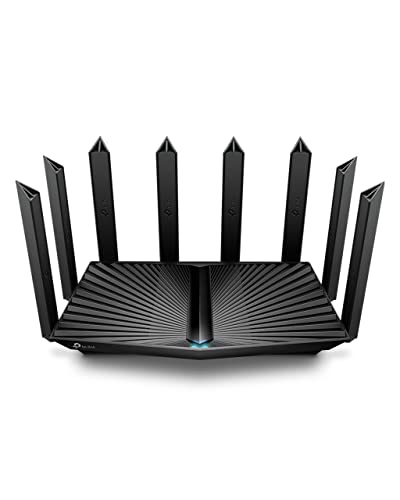
TP-Link Archer AX6000
Dual-band AX6000 Wi-Fi 6 shares space with an eight-port gigabit switch and a 2.5G WAN port inside one router. Mesh expansion is not included, but a 1.8GHz quad-core processor with OFDMA support keeps many devices responsive at once. It is rated for around 2,500 square feet as a standalone router.
Pros
- Eight gigabit LAN ports, more than most routers in this list
- 2.5G WAN port supports faster-than-gigabit internet plans
- Lower cost than most mesh kits with similar Wi-Fi 6 speeds
Cons
- Single-point coverage will not reach detached garages or far bedrooms
- No dedicated backhaul band since it is not a mesh system

Linksys Velop MX4200
Also sold as the Atlas 6, the Velop MX4200 uses AX4200 tri-band Wi-Fi 6, and Linksys rates a 2-pack for around 4,000 square feet. A 3-pack extends that to roughly 6,000 square feet for larger or oddly shaped floor plans. Intelligent Mesh technology automatically routes each device to the fastest available node.
Pros
- Lower per-node cost than Orbi or Deco tri-band kits
- 3-pack option scales coverage for larger floor plans
- Intelligent Mesh automatically steers devices to the best node
Cons
- Gigabit-only ports, no multi-gig WAN option
- Fewer advanced parental controls than ASUS or TP-Link HomeShield
How they compare
| # | Model | Wi-Fi standard | Best for | Score | Price |
|---|---|---|---|---|---|
| 1 | TP-Link Deco X90 | AX6600 tri-band Wi-Fi 6 | Best overall | 9.4 | Check price |
| 2 | Netgear Orbi RBK753 | AX4200 tri-band Wi-Fi 6 | Best for the largest homes | 9.2 | Check price |
| 3 | ASUS ZenWiFi XT8 | AX6600 tri-band Wi-Fi 6 | Best for gaming and low latency | 8.9 | Check price |
| 4 | Amazon eero Pro 6E | Tri-band Wi-Fi 6E (2.4/5/6GHz) | Best for smart home integration | 8.7 | Check price |
| 5 | Netgear Nighthawk RAX50 | Dual-band AX5400 Wi-Fi 6 | Best single-router setup | 8.5 | Check price |
| 6 | TP-Link Archer AX6000 | Dual-band AX6000 Wi-Fi 6 | Best value | 8.2 | Check price |
| 7 | Linksys Velop MX4200 | AX4200 tri-band Wi-Fi 6 | Best budget mesh kit | 8.0 | Check price |
How to choose
What to look for in a router for a large home Wi-Fi 6 (AX) handles many connected devices better than older Wi-Fi 5 hardware, and Wi-Fi 6E adds a 6GHz band with less interference. Floor plan decides whether a mesh kit or a single high-power router fits better, since mesh systems spread multiple access points across a house while a single router leans on stronger antennas and beamforming. Tri-band mesh kits dedicate a separate 5GHz band just for backhaul between units, keeping speeds steadier than dual-band designs. Wired port speed matters too, since a 2.5G WAN port avoids becoming a bottleneck on faster internet plans.
How much coverage does a large home actually need? Manufacturer coverage ratings, like the Deco X90’s 6,500 square feet or the Orbi RBK753’s 7,500 square feet, come from open-floor test conditions rather than typical construction. Plaster, brick, and metal ductwork all cut effective range, so a home rated at 4,000 square feet on paper may need a bigger kit in practice. Multi-story homes should count total square footage across every floor, not just the main level, since signal has to pass through floors as well as walls. Detached garages and basements often need an extra mesh node placed in that separate structure.
Mesh kits vs single routers for multi-story homes A mesh kit like the Deco X90 or Orbi RBK753 places a node on each floor, so a signal only crosses one ceiling instead of traveling the length of the house from a single point. Single routers such as the Nighthawk RAX50 or Archer AX6000 work fine for two-story homes under roughly 2,500 square feet, especially when the router sits centrally. Homes over three floors, or with an unusual layout like an L-shape or finished basement, generally see fewer dead zones with a 3-node mesh kit than with one powerful router. Wired backhaul, where a node connects to the router by Ethernet instead of Wi-Fi, further improves reliability in homes with existing wiring.
Smart home hubs, gaming, and detached structures Households running many Zigbee or Thread smart home devices benefit from a router with a built-in hub, such as the eero Pro 6E, instead of a separate smart home bridge. Gaming setups that need low, consistent latency do better with a wired connection to the nearest mesh node or a dedicated router like the ASUS ZenWiFi XT8, since Wi-Fi backhaul alone can add jitter under heavy device load. Detached garages, guest houses, and finished basements often sit outside a kit’s rated coverage even when the main house is fully covered, so an extra node or a wired Ethernet run closes the gap. Homes with dozens of connected devices, like smart plugs, cameras, and streaming boxes, benefit from tri-band designs that separate device traffic from backhaul traffic.
Good to know
How many mesh nodes do I need for a large home?
Most manufacturers rate a 2-node kit for 4,000 to 6,500 square feet and a 3-node kit for 6,000 to 7,500 square feet. Thick walls, metal ductwork, and multiple floors typically shrink that range in practice.
What Wi-Fi standard works best for a large house?
Wi-Fi 6 (AX) is the current baseline for large-home routers and mesh kits, handling many connected devices better than older Wi-Fi 5 (AC) hardware. Wi-Fi 6E adds a less crowded 6GHz band on top of that.
Is Wi-Fi 6E worth it for a large home?
Wi-Fi 6E mainly helps in areas with many neighboring networks competing for the same channels. The eero Pro 6E’s added 6GHz band reduces that interference, but only 6E-capable client devices actually connect to it.
Can a single router replace a mesh system in a large home?
A high-power router like the Netgear Nighthawk RAX50 or TP-Link Archer AX6000 can cover around 2,500 square feet alone. That works for smaller two-story homes but usually leaves dead zones in homes over roughly 3,000 square feet.
What is the difference between tri-band and dual-band mesh?
Tri-band systems like the Orbi RBK753 and Deco X90 dedicate a separate 5GHz band just for backhaul between units. Dual-band systems share bandwidth between backhaul and connected devices, which can slow things down as more nodes are added.
Which router works best for homes with thick walls or multiple floors?
Owners of older homes with plaster or brick walls report better results from tri-band mesh kits with dedicated backhaul, such as the Orbi RBK753 or Deco X90. A weak backhaul connection affects every device behind that node.
Netgear Orbi vs TP-Link Deco: which is better for a large home?
The Orbi RBK753’s 3-pack is rated for more total square footage at 7,500 square feet. The Deco X90 pairs similar tri-band Wi-Fi 6 with a 2.5G port and typically costs less for a 2-pack.
How much coverage does a typical 3-pack mesh system provide?
Rated coverage for 3-node kits in this roundup ranges from about 6,000 square feet for the Linksys Velop MX4200 to 7,500 square feet for the Netgear Orbi RBK753. These figures come from manufacturer listings rather than in-home testing.
Our pick
TP-Link Deco X90 stands as the strongest all-around pick for most large homes, combining AX6600 tri-band Wi-Fi 6, a 2.5G port, and roughly 6,500 square feet of rated coverage from just two units. Households over 7,000 square feet, or with several persistent dead zones, should look at the Netgear Orbi RBK753’s 3-pack instead. Anyone who wants one router with no satellites can consider the TP-Link Archer AX6000 for its eight-port gigabit switch.