Which Smartphone Gimbal Actually Stops the Shake?
DJI Osmo Mobile 6 leads this group with a built in extension rod, compact folded size and reliable ActiveTrack. Insta360 Flow Pro 2 tracks moving subjects more aggressively through its own vision chip. Budget shoppers get a real extension rod and long battery life from the Zhiyun Smooth Q4.
DJI Osmo Mobile 6 stays the safest all around pick for phone stabilization. Insta360 Flow Pro 2 chases moving subjects harder. Anyone on a tight budget should start with the Zhiyun Smooth Q4.
Gimbal spec sheets hide the numbers that matter most for daily use. A 290 gram payload ceiling decides whether a large phone in a case balances at all. Folded dimensions decide whether the gimbal ever leaves a drawer. We compared payload ranges, folded size, battery hours, extension rod length and tracking method, then weighed owner reports on balancing and app reliability.
The top picks, ranked
DJI Osmo Mobile 6
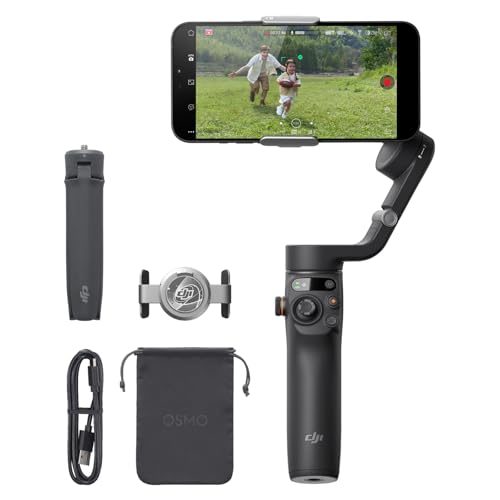
A 215 mm extension rod hides inside the handle, so high and low angle shots need no extra stick. Three axis stabilization keeps horizons level while walking. ActiveTrack 5.0 follows faces and bodies through the DJI Mimo app, and the folded body shrinks to roughly the size of a large chocolate bar.
Pros
- Built in extension rod removes a separate accessory
- Side wheel handles zoom and manual focus pulls
- Magnetic clamp swaps phones in seconds
Cons
- Shortest battery life of the gimbals here
- Tracking works only through the DJI Mimo app

Insta360 Flow Pro 2
Tracking runs on a dedicated vision chip built into the gimbal itself, not the phone. Subjects stay centered even after turning away briefly. Apple DockKit support extends that tracking into the native iPhone camera and third party apps, and a tripod plus selfie stick fold out of the grip.
Pros
- Tracking works inside native and third party iPhone camera apps
- Integrated tripod legs steady static interview shots
- Recovers a lost subject faster than app based tracking
Cons
- DockKit tracking works only on recent iPhone models
- Heaviest folded package in this group at 369 g

Hohem iSteady M6
A magnetic fill light clips onto the phone clamp and adjusts from warm to daylight color temperature. Battery life stretches to about 18 hours, well past a full event or travel day. Payload tops out at 280 g, enough for large phones without heavy cases attached.
Pros
- Longest battery life in this group by a wide margin
- Removable fill light doubles as a standalone lamp
- Rear touchscreen shows the active mode without opening an app
Cons
- Bulkier folded footprint than either DJI option
- Fill light adds weight at the top of the clamp

Zhiyun Smooth 5S
Physical controls dominate this handle: a focus wheel, mode switch and dedicated zoom rocker sit under the thumb. Motors run stronger than most phone gimbals, so a heavy phone with an anamorphic lens still balances cleanly. Combo kits add a magnetic fill light and diffusion filters.
Pros
- Real buttons beat touchscreen menus mid shoot
- Handles phones fitted with clip on cine lenses
- Vortex mode adds a repeatable rolling shot
Cons
- Does not fold as small as the Osmo Mobile 6
- Heaviest handle in this roundup at 625 g

DJI Osmo Mobile SE
This model shares the same magnetic clamp system as pricier DJI gimbals, minus the extension rod and side control wheel. Battery runs about eight hours, enough for a full day of casual filming. ActiveTrack still follows faces and bodies through the DJI Mimo app.
Pros
- Magnetic mount attaches a phone in seconds
- Longer runtime than the Osmo Mobile 6
- Same gesture control and ActiveTrack features
Cons
- No extension rod for high or low angles
- Missing the side wheel for focus and zoom
Hohem iSteady V3
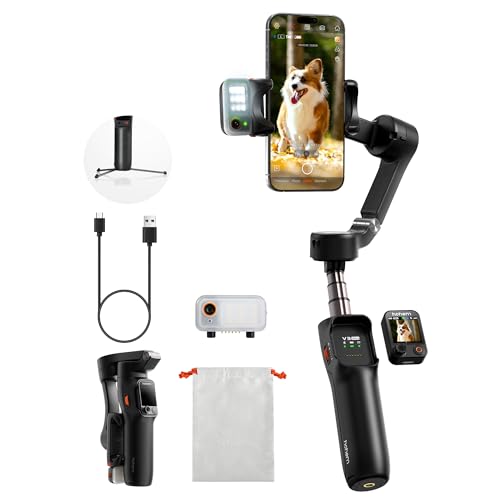
An AI tracking module sits on the gimbal head and doubles as a detachable remote, so recording can start from across a room. Tracking runs without the Hohem app, useful when filming straight into a phone’s native camera. A fill light and folding tripod round out the kit.
Pros
- Detachable remote frames a shot from a distance
- App free tracking works with the stock camera app
- Gesture control starts and stops recording hands free
Cons
- Remote is easy to misplace once detached
- Motors struggle with heavy folio style cases

Zhiyun Smooth Q4
A 215 mm telescoping rod slides out of the grip, unusual at this price. Runtime reaches roughly 15 hours per charge, so travel days rarely need a top up. Build materials feel plainer than the DJI handles, though the motors still hold a steady horizon.
Pros
- Extension rod at an entry level price point
- Very long runtime for casual filming
- Folds flat enough for a jacket pocket
Cons
- Tracking loses fast moving subjects more often
- Plastic clamp flexes with larger phones
What matters most
What should you look for in a smartphone gimbal? Payload comes first, since most phone gimbals cap out near 280 to 290 grams. A large phone in a rugged case can exceed that limit quickly. Folded dimensions matter next, because a gimbal that lives in a drawer never gets used. Battery hours range from six to eighteen across this group, and tracking works either inside a manufacturer app or through the phone’s native camera, depending on the model.
How much do payload and balance really matter? Balance failures cause most gimbal frustration. Motors fight a phone sitting off center, which drains the battery and creates visible drift. Remove thick wallet cases and pop sockets before clamping the phone. Clip on lenses shift weight forward, so a stronger motor set like the Smooth 5S suits anamorphic adapters better. Counterweights help too, though they add strain to the handle.
Which gimbal suits travel and light packing? Folded size decides this branch of the decision. The Osmo Mobile 6 collapses to roughly 189 by 84 by 44 mm, small enough for a jacket pocket. Osmo Mobile SE and Smooth Q4 stay similarly slim. Anyone carrying a daypack all day should skip the 625 gram Smooth 5S. A built in tripod, like the one on the Flow Pro 2, also saves packing a separate stand for timelapse work.
Best smartphone gimbal for solo creators and streaming Filming yourself changes the priority list entirely. On device tracking beats app based tracking here, since tapping a screen from six feet away is not an option. Flow Pro 2 pairs a vision chip with Apple DockKit so tracking survives inside streaming apps. Hohem iSteady V3 solves the same problem with a detachable remote instead. Both models keep a fill light nearby, useful for indoor talking head video.
The lineup, side by side
| # | Model | Weight | Best for | Score | Price |
|---|---|---|---|---|---|
| 1 | DJI Osmo Mobile 6 | 309 g | Best overall | 9.4 | Check price |
| 2 | Insta360 Flow Pro 2 | 369 g | Best for subject tracking | 9.2 | Check price |
| 3 | Hohem iSteady M6 | About 570 g | Best for low light shooting | 9.0 | Check price |
| 4 | Zhiyun Smooth 5S | 625 g | Best for filmmaking control | 8.8 | Check price |
| 5 | DJI Osmo Mobile SE | About 353 g | Best value | 8.6 | Check price |
| 6 | Hohem iSteady V3 | About 500 g with remote | Best for solo creators | 8.3 | Check price |
| 7 | Zhiyun Smooth Q4 | About 360 g | Best budget | 8.0 | Check price |
Frequently asked questions
What does a smartphone gimbal actually do?
Three brushless motors counteract hand movement across pan, tilt and roll axes. The result is smooth walking footage and level horizons. Digital stabilization crops the frame instead, so a gimbal preserves the phone’s full sensor width.
Do I still need a gimbal if my phone has optical stabilization?
Optical stabilization only corrects small shakes. Walking, running or panning still produces jitter and rolling horizons. A gimbal handles that range of motion and adds tracking and preset moves a phone cannot do alone.
Which smartphone gimbal is best for beginners?
DJI Osmo Mobile SE keeps setup simple with a magnetic clamp and few controls. Nothing needs manual balancing, and the DJI Mimo app walks new users through modes. Save gimbals with focus wheels for when manual control actually matters.
Can a gimbal hold a phone with a case on?
Slim cases usually fit within the 280 to 290 gram payload ceilings listed here. Thick folio cases, battery cases and pop sockets often push past that limit or block the clamp. Weigh the phone with its case on before buying.
How long do smartphone gimbal batteries last?
Runtime spans six to eighteen hours across current models. Osmo Mobile 6 sits at the short end near 6.4 hours, while Hohem iSteady M6 claims up to 18. Fill lights and heavy motor correction shorten those figures in practice.
DJI Osmo Mobile 6 vs Osmo Mobile SE: what is different?
Osmo Mobile 6 adds a 215 mm extension rod, a side control wheel and a status screen. SE runs longer per charge at about eight hours. Both share the same magnetic clamp and ActiveTrack tracking system.
Is a gimbal with a built in fill light worth it?
Indoors and after dark, yes. Phone sensors are small, so extra light cuts noise more effectively than any software setting. Hohem iSteady M6 and the Zhiyun Smooth 5S combo kit both include magnetic lights with adjustable color temperature.
Do smartphone gimbals work with Android phones?
Yes, all seven mount any phone within their payload and width limits. Tracking features differ by brand though. Apple DockKit tracking on the Flow Pro 2 works only on iPhone, so Android owners rely on each brand’s own app.
How much does a good smartphone gimbal weigh?
Folded weight ranges from about 309 grams for the Osmo Mobile 6 to 625 grams for the Zhiyun Smooth 5S. Lighter models suit all day carrying, while heavier ones usually add stronger motors or extra controls.
The verdict
DJI Osmo Mobile 6 balances folded size, controls and reliable tracking better than any other gimbal here, which keeps it the default pick. Creators who film themselves should spend more on the Insta360 Flow Pro 2 for its on device tracking. Zhiyun Smooth Q4 covers the basics, extension rod included, for occasional filming.