Which Mesh Wifi System Actually Kills Dead Zones?
The TP-Link Deco XE75 leads this roundup because its dedicated 6 GHz backhaul keeps distant nodes fast. Amazon eero 6+ is the easiest system to live with day to day, while the ASUS ZenWiFi XT8 suits larger homes that need wired backhaul and deeper controls.
For a busy multi storey home, the TP-Link Deco XE75 is the pick, with Amazon eero 6+ for simple plug and forget setups and the ASUS ZenWiFi XT8 for larger floorplans. Each one solves a different coverage problem rather than simply adding more nodes.
Mesh shopping gets tricky because square footage claims assume open space, and a tri band kit with a clean backhaul can beat a dual band kit with more nodes. We compared published specifications, radio layouts, port counts and app features, then weighed those against what owners report about dead zones, node placement and firmware behaviour over time.
The best picks, ranked
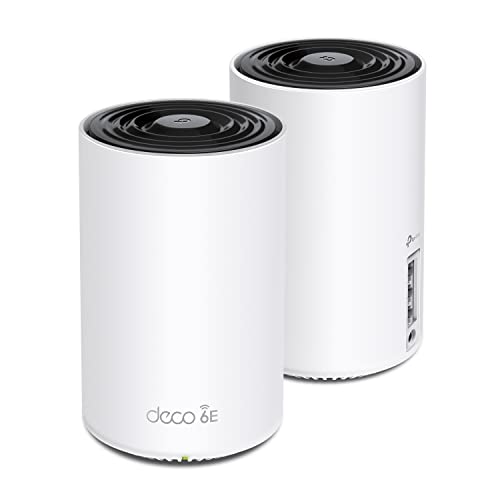
TP-Link Deco XE75 Mesh WiFi 6E System
A dedicated 6 GHz band handles the link between nodes here, so satellites keep more of their speed instead of halving it. Two gigabit ports per unit let you hardwire a console or a work desk. Owners report straightforward app setup and steady roaming between units.
Pros
- Dedicated 6 GHz backhaul protects satellite speed
- Simple app setup with clear signal strength guidance
- Wired backhaul supported if you can run cable
Cons
- 6 GHz only helps if your devices support it
- Only two Ethernet ports per node

Amazon eero 6+ Mesh WiFi System
Reliability and a setup process that takes minutes matter more here than exotic radios. It handles gigabit plans, supports Thread and Zigbee smart home devices on the gateway, and updates itself quietly in the background. Anyone who does not want to manage a router should start here.
Pros
- Fastest setup of anything here
- Automatic background firmware updates
- Doubles as a smart home hub
Cons
- Dual band shares the backhaul with clients
- Advanced features sit behind a subscription

ASUS ZenWiFi AX XT8 Mesh System
Full ASUS router software rides along with the tri band radio set, so you get VPN support, granular QoS and detailed traffic reporting. A 2.5 Gbps WAN port suits faster internet plans. It runs bulkier than most mesh nodes, but the control on offer is unmatched in this group.
Pros
- Deepest settings of any kit here
- Extra LAN ports on every node
- 2.5 Gbps WAN suits multi gig plans
Cons
- Large chassis is hard to hide
- Settings menu overwhelms casual users

NETGEAR Orbi RBK752 Mesh WiFi System
High powered satellites built Orbi’s reputation, and the RBK752 keeps that character with a tri band design and a strong 5 GHz backhaul. Coverage per node runs generous, which suits sprawling single storey homes. A polished app comes with the kit, though several security features sit behind a subscription.
Pros
- Strong per node reach in open layouts
- Three spare LAN ports on each satellite
- Stable roaming between units
Cons
- Security suite requires a subscription
- Nodes are physically large

Amazon eero Pro 6E Mesh WiFi System
A 6 GHz radio and a 2.5 Gbps port join the familiar eero formula here, so the system can actually use a fast internet plan. Setup remains as painless as the cheaper eero models. This one makes most sense once your laptops and phones already speak WiFi 6E.
Pros
- 2.5 Gbps port unlocks faster plans
- Same simple app as the standard eero
- 6 GHz band stays uncongested
Cons
- Costlier per node than dual band kits
- Best features assume 6E client devices

Google Nest Wifi Pro Mesh System
Nest Wifi Pro looks more like decor than networking gear and folds neatly into the Google Home app alongside speakers and cameras. WiFi 6E and Matter support come standard, and the setup flow stays genuinely simple. A thin settings menu is the trade off, along with no backward compatible pairing with older Nest units.
Pros
- Blends into a room better than rivals
- Matter and Thread support built in
- Managed inside the Google Home app
Cons
- Very limited advanced settings
- Does not mesh with older Nest WiFi units
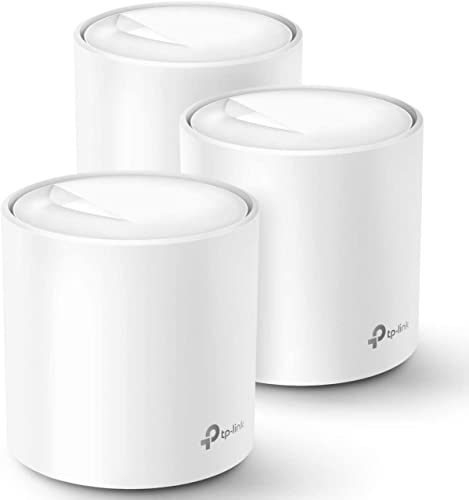
TP-Link Deco X20 Mesh WiFi 6 System
Apartments and smaller homes that just need to kill one or two dead spots fit this entry level kit well. Dual band radios mean satellites share airtime with clients, but the app, parental controls and roaming behaviour match pricier Deco kits. A three pack covers a lot of ground for the cost.
Pros
- Lowest entry cost in this group
- Same Deco app and parental controls
- Compact nodes fit on a shelf
Cons
- Shared backhaul limits satellite speed
- Not suited to multi gigabit plans
How they stack up
| # | Model | Standard | Best for | Score | Price |
|---|---|---|---|---|---|
| 1 | TP-Link Deco XE75 Mesh WiFi 6E System | WiFi 6E, AXE5400 | Best overall | 9.4 | Check price |
| 2 | Amazon eero 6+ Mesh WiFi System | WiFi 6, AX3000 | Best value | 9.2 | Check price |
| 3 | ASUS ZenWiFi AX XT8 Mesh System | WiFi 6, AX6600 | Best for large homes | 9.0 | Check price |
| 4 | NETGEAR Orbi RBK752 Mesh WiFi System | WiFi 6, AX4200 | Best for wide open floorplans | 8.8 | Check price |
| 5 | Amazon eero Pro 6E Mesh WiFi System | WiFi 6E, AXE5400 | Best for gigabit plans | 8.6 | Check price |
| 6 | Google Nest Wifi Pro Mesh System | WiFi 6E, AXE5400 | Best for smart home households | 8.3 | Check price |
| 7 | TP-Link Deco X20 Mesh WiFi 6 System | WiFi 6, AX1800 | Best budget | 8.0 | Check price |
Before you buy
What actually decides mesh WiFi coverage? Backhaul matters more than any coverage figure on the box. Every mesh node relays traffic back to the gateway, and how it does that decides your real speed. Tri band systems reserve one radio for that relay job, so a device on a satellite loses far less throughput. Dual band systems share the same airwaves with your phones and laptops, which is fine for browsing but noticeable on large file transfers. Wired backhaul beats any wireless arrangement, and most kits here support it if you have Ethernet in the walls.
How many mesh nodes does my home actually need? Manufacturer coverage figures assume open space, and brick, plaster with metal lath, tile and mirrored surfaces all cut signal hard. A two pack in an open plan single storey home can outperform a three pack in a narrow terrace. Plan placement so each satellite sits roughly halfway between the gateway and the weak area, in open air rather than inside a cabinet. Add a node only after you have tested placement with what you already own.
Which ports and WAN speed matter for heavy use? Look past WiFi speed to what each node gives you for wired gear. Two ports sounds fine until the gateway uses one for the modem, leaving a single free socket. Anyone with a desktop, games console, NAS or smart TV that prefers a cable should favor kits with three LAN ports per node. A connection faster than gigabit needs a 2.5 Gbps WAN port, because a gigabit port caps the whole system regardless of wireless speed.
Do mesh apps and subscriptions matter long term? Mesh systems are software products as much as hardware. Some vendors put parental controls, ad blocking and threat protection behind a monthly plan, while others include a basic version free. Check how long the maker has supported previous generations with firmware, since a router that stops receiving security patches becomes a liability. Owners report that update cadence and app stability shape satisfaction more than the headline speed rating.
Common questions
How many mesh nodes do I actually need?
Most homes under about 2,000 square feet are well served by two units, and three suits larger or awkwardly shaped layouts. Adding nodes past that point can hurt, because each extra wireless hop adds latency. Start with two, test the weak rooms, then add one if a real dead zone remains.
Is mesh WiFi better than a single powerful router?
Only when distance or walls are the problem. A single strong router in a central spot beats mesh in a small flat, since there is no hop penalty. Mesh wins in long, tall or heavily divided homes where no single position reaches everywhere.
Do I still need my internet provider’s router?
You need the modem or fibre unit, but the provider router can usually be put into bridge or modem mode so the mesh gateway handles routing. Running both in router mode creates a double NAT setup that can break gaming and remote access.
What is the difference between WiFi 6 and WiFi 6E?
WiFi 6E adds the 6 GHz band, which is wide and largely empty compared with the crowded 2.4 and 5 GHz bands. It shines as a backhaul link and for close range high speed transfers, though 6 GHz signal does not travel through walls as well.
Can I mix mesh nodes from the same brand?
Often yes within a product line, and both eero and Deco allow mixing generations, though the network usually settles to the capabilities of the weaker unit. Check the maker’s compatibility list before buying a mismatched satellite.
Will a mesh system improve my internet speed?
It cannot exceed what your plan delivers, but it can stop rooms from receiving a fraction of that speed. If a speed test at the modem is already slow, the connection is the problem rather than the WiFi.
Should I use wired backhaul if I can?
Yes. An Ethernet run between nodes removes the wireless hop entirely, frees the radios for your devices, and makes performance consistent. Even a single wired satellite in the worst room makes a clear difference.
Do mesh systems handle smart home devices well?
Modern kits do, and several here include Thread, Zigbee or Matter support on the gateway. Some older smart plugs and cameras still need 2.4 GHz, so keep that band enabled rather than forcing 5 GHz only.
TP-Link Deco vs Amazon eero: which is easier to live with?
eero wins on raw simplicity, with a setup that takes minutes and quiet background updates. Deco kits like the XE75 add a dedicated 6 GHz backhaul and slightly deeper controls without losing much ease of use. Pick eero for hands off operation, Deco for a bit more headroom.
Final word
For most homes the TP-Link Deco XE75 offers the best mix of a clean 6 GHz backhaul, sensible pricing per node and an app that stays out of the way. Choose Amazon eero 6+ if simplicity matters more than raw specifications, or the ASUS ZenWiFi XT8 for deep control and extra wired ports. Budget shoppers with a smaller home lose very little by starting with the Deco X20.