Double Oven Ranges Give Serious Cooks Extra Capacity
GE’s Profile PB935YPFS leads the group, pairing a genuinely usable upper cavity with a capable induction-ready cooktop. Samsung’s NE63T8751SS earns a spot for its convertible Flex Duo divider, and the LG LDE4413ST delivers most of that capability for less outlay.
GE’s Profile PB935YPFS suits most kitchens shopping for a double oven range. Samsung’s NE63T8751SS wins out when a convertible Flex Duo cavity matters more than a fixed split. The LG LDE4413ST remains the value pick that still covers the essentials.
Double oven ranges are harder to compare than they look, since a large combined capacity often hides a small upper cavity that cannot take a roasting tin. We weighed published cavity volumes, cooktop element counts and power, convection systems and control layouts against each other. Usable space mattered more than headline litres in this ranking. Check clearances and your electrical or gas supply before ordering any of these.
How to pick the right one
What double oven capacity numbers actually hide Manufacturers quote combined capacity, which flatters ranges whose upper oven is barely deep enough for a tray of biscuits. Look up the individual cavity volume and interior height instead of the total. That number reveals whether the smaller cavity can actually hold the dish you plan to put in it. A convertible design like Flex Duo suits anyone who regularly roasts a large joint alongside side dishes better than a fixed split does.
Slide in versus freestanding installation Slide in ranges sit flush with the worktop for a built-in look, but they need an accurate cutout and often a finished side panel. Freestanding models drop into a standard opening with finished sides already in place, which is simpler and cheaper for a like-for-like replacement. Measure the opening width, depth and height first. Confirm the electrical supply rating or gas connection too, since double ovens draw more current than single-cavity ranges.
Convection type matters more than power rating True or European convection adds a third heating element around the fan, producing noticeably more even results than a fan that just circulates air heated from below. That distinction is worth paying for when multi-tray baking is a priority. Gas ovens typically heat less evenly than electric convection regardless of specification. Cooks who bake often but still want gas burners sometimes settle on a dual fuel range instead.
Cleaning routines worth planning for Two cavities mean twice the cleaning, and self clean cycles vary in how aggressive and how smelly they run. Steam-assisted cleaning handles light soiling with less heat and odor, while high-temperature pyrolytic cycles tackle heavy soiling but heat the whole kitchen. Continuous cast iron grates on gas models clean up easier than individual grates do. Smooth radiant cooktops wipe down fast but scratch if pans get dragged across them.
The best picks, ranked

GE Profile PB935YPFS Double Oven Electric Range
GE splits the cavities sensibly here, so the upper oven is deep enough for real dishes rather than acting as a warming drawer with a door. A bridging element on the smooth radiant cooktop suits griddles and larger pans. Owners report the true convection in the lower cavity roasts more evenly than fan-assisted-only systems.
Pros
- Upper cavity is genuinely usable
- Bridge element suits long griddles
- Even roasting from true convection
Cons
- Slide in fitment needs an accurate cutout
- Touch controls need frequent wiping

Samsung NE63T8751SS Slide-In Electric Range with Flex Duo
A removable divider turns one large oven into two independent cavities, giving full-size capacity when needed and split temperatures when it is not. That is a meaningfully different proposition from a fixed upper and lower split. Based on specifications, it is the most adaptable cavity layout in this group.
Pros
- Full size cavity available when needed
- Split temperatures without losing capacity
- Flexible cooktop zones
Cons
- Divider must be stored when not in use
- More complex controls to learn

LG LDE4413ST Double Oven Electric Range
LG covers the core double oven proposition here without premium extras, delivering two independent cavities and a competent radiant cooktop. Choose it when two temperatures at once matters more than showpiece styling. Owners report the interior enamel cleans up with minimal scrubbing.
Pros
- Strong value for a true double oven
- Easy to clean interior
- Straightforward controls
Cons
- Upper cavity is shallow for large roasting tins
- Fewer cooktop element sizes
KitchenAid KFED500ESS Double Oven Electric Range
KitchenAid targets home bakers with this range, and its even-heat convection system shows in consistent results across multiple trays. Build quality feels more substantial than most models in this class. Choose it when baking, rather than roasting, is the main reason for wanting two cavities.
Pros
- Consistent results across multiple trays
- Solid build quality
- Warming zone on the cooktop
Cons
- Controls are less intuitive than GE
- Premium positioning in the range

LG LDG4315ST Double Oven Gas Range
Cooks who want gas burners alongside a double oven layout get a practical answer here, with a high-output burner alongside a simmer burner. Gas ovens run slightly less evenly than electric convection, the usual trade for cooktop control. Installation requires a suitable gas supply and connection.
Pros
- Responsive gas cooktop control
- Continuous grates for sliding pans
- High output burner for fast boiling
Cons
- Gas ovens heat less evenly than electric
- Needs an existing gas connection
Whirlpool WGE745C0FS Double Oven Electric Range
Whirlpool keeps the interface deliberately plain, suiting households that want two ovens without a learning curve. Both cavities handle the fundamentals properly, and a frozen bake feature skips preheating for convenience meals. It is not the most advanced range here, and it does not pretend to be.
Pros
- Easy to use without reading the manual
- Reliable core performance
- Frozen bake saves preheating time
Cons
- Fewer advanced cooking modes
- Plainer styling than rivals
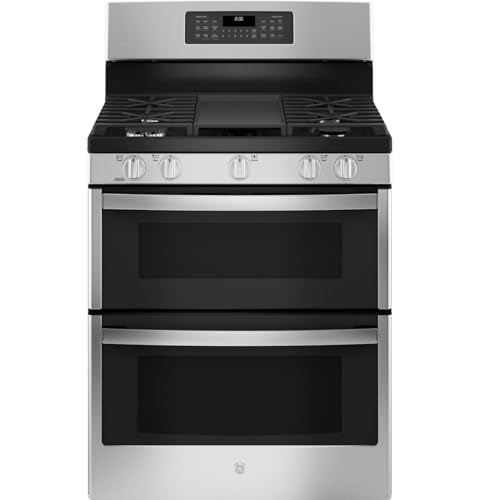
GE JB860SJSS Double Oven Electric Range
This freestanding double oven drops straight into a standard cooker space without cabinetry work, keeping installation costs down. Buyers get the two-cavity benefit without the premium features of the Profile line. Owners report it handles the fundamentals reliably.
Pros
- Drops into a standard opening
- Lower entry point for a double oven
- Straightforward to operate
Cons
- Upper cavity limited in height
- Basic cooktop element layout
How they compare
| # | Model | Configuration | Best for | Score | Price |
|---|---|---|---|---|---|
| 1 | GE Profile PB935YPFS Double Oven Electric Range | Slide in electric, two cavities | Best overall | 9.4 | Check price |
| 2 | Samsung NE63T8751SS Slide-In Electric Range with Flex Duo | Slide in electric with divider | Best for flexibility | 9.2 | Check price |
| 3 | LG LDE4413ST Double Oven Electric Range | Freestanding electric, two cavities | Best value | 9.0 | Check price |
| 4 | KitchenAid KFED500ESS Double Oven Electric Range | Slide in electric, two cavities | Best for baking | 8.7 | Check price |
| 5 | LG LDG4315ST Double Oven Gas Range | Freestanding gas, two cavities | Best gas option | 8.5 | Check price |
| 6 | Whirlpool WGE745C0FS Double Oven Electric Range | Freestanding electric, two cavities | Best simple controls | 8.3 | Check price |
| 7 | GE JB860SJSS Double Oven Electric Range | Freestanding electric, two cavities | Best budget | 8.0 | Check price |
Common questions
Is a double oven range worth it?
It is worth it for households that regularly cook two dishes at different temperatures or host large meals. For everyday cooking of one dish at a time, a single large cavity is often more practical.
How much smaller is the upper oven on a double range?
Substantially smaller, on most fixed-split designs. Check the individual cavity volume rather than the combined figure, since some upper ovens will not fit a standard roasting tin.
Do double oven ranges need a special electrical supply?
Electric models need a dedicated high-amperage circuit. Confirm the rating on the specification sheet against your existing home supply before ordering.
What is the difference between slide in and freestanding ranges?
Slide in models sit flush with worktops for a built-in look but need an accurate cutout. Freestanding models have finished sides and drop into a standard opening.
Can both ovens run at different temperatures at once?
Yes, that is the entire point of the format. Each cavity has independent temperature control, though total power draw rises when both run together.
Is gas or electric better for a double oven range?
Electric convection bakes more evenly, while gas gives more responsive cooktop control. Cooks who want both often look at dual fuel configurations instead.
What is a Flex Duo divider on a Samsung range?
A removable partition that splits one large cavity into two independently controlled zones, keeping full capacity available whenever it is needed.
How long do double oven ranges typically last?
Well over a decade with normal use, in most cases. Electronic control boards and door hinges are usually the first components to need attention.
What is the best double oven range for baking multiple trays?
The KitchenAid KFED500ESS uses an even-heat true convection system built for consistent results across several trays at once, which suits dedicated bakers.
The verdict
GE’s Profile PB935YPFS is the double oven range we would fit in most kitchens, since both cavities stay genuinely usable and the cooktop keeps pace with them. Samsung’s Flex Duo is the smarter choice for anyone who occasionally needs one very large oven, and the LG LDE4413ST covers the core benefit without the premium spend.