How to Choose a Drywall Sander for a Dust Free Finish
The WEN 6369 leads for its balance of reach, dust extraction and weight during occasional renovation work. Regular users should look at the PORTER-CABLE 7800 for durability, while the Makita XLS01T covers cordless patch jobs.
Renovators looking for one sander should start with the WEN 6369, since it reaches ceilings and captures dust without punishing your arms over a full room. Professionals sanding week after week get more mileage from the PORTER-CABLE 7800, and the Makita XLS01T solves cordless patch work specifically.
Spec sheets skip the number that decides whether you finish the job: effective weight at full extension overhead. Head articulation, pole length, motor placement, dust extraction design and speed range formed the comparison across seven current models, weighted toward tools owners report using overhead for an hour without switching hands constantly.
The best picks, ranked

WEN 6369 Variable Speed Drywall Sander
A five amp motor drives a pivoting head that follows wall contours well, while a fifteen foot hose and dust bag capture most of the debris. Variable speed from 600 to 1500 rpm lets you ease off on soft compound. At roughly nine pounds it stays manageable overhead for a room, though a support strap still helps on longer sessions.
Pros
- Strong dust capture out of the box
- Wide variable speed range
- Reasonable weight for ceiling work
Cons
- Head cannot reach fully into corners
- Bag fills quickly on large jobs
PORTER-CABLE 7800 Drywall Sander
A 4.7 amp motor with variable speed and a genuinely articulating head are why contractors keep buying this one, and the build tolerates dust ingress far better than budget units. It pairs with a shop vacuum instead of relying on a bag. Owners report the trade off is weight, so a hook or harness matters on long ceiling sessions.
Pros
- Durable enough for daily trade use
- Excellent head articulation
- Strong extraction with a shop vac
Cons
- Heavier than home grade sanders
- Vacuum needed for best results
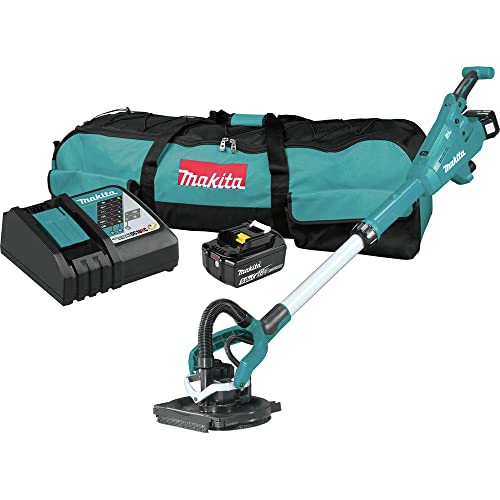
Makita XLS01T 18V LXT Drywall Sander
Brushless and battery powered, this suits patch repairs, tight rooms and anywhere dragging a cord and vacuum hose costs more time than the sanding itself. Its AWS feature starts a compatible Makita vacuum automatically. Runtime keeps it limited to touch ups rather than whole house work on a single battery.
Pros
- Complete freedom of movement
- LED ring reveals surface defects
- Very smooth brushless motor
Cons
- Battery limits sustained work
- Highest outlay in the ranking
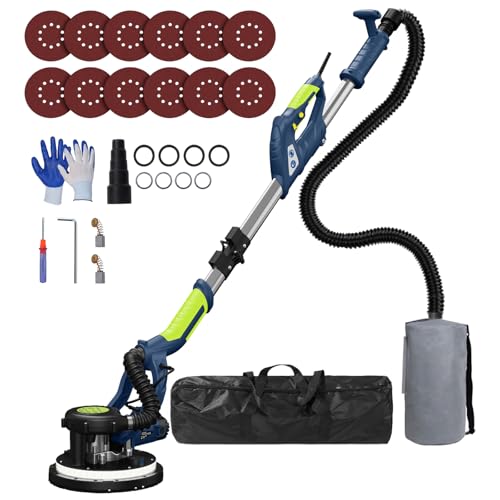
YATTICH YT-919 Drywall Sander
This kit bundles a seven amp motor, a detachable head for edge work, a dozen sanding discs and an LED light at a fraction of what the professional tools cost. A double deck brush design holds dust in reasonably well. Extra weight compared with the WEN and a plastic housing that feels less resilient over years are the compromises.
Pros
- Generous kit for the outlay
- Detachable head reaches edges
- Powerful motor
Cons
- Heavier than rivals
- Housing feels less durable

Ginour 750W Drywall Sander
Ginour’s head folds to work right up against the ceiling line, exactly where most sanders leave a band that needs finishing by hand. Six speed settings and a long hose come standard. Based on specifications, extraction runs less aggressive than the PORTER-CABLE with a shop vacuum attached.
Pros
- Reaches ceiling edges properly
- Six clear speed settings
- Good value bundle
Cons
- Extraction weaker than trade tools
- Folding hinge needs cleaning to stay smooth

ALEKO 690E Electric Drywall Sander
An extending aluminium pole gives the longest reach in this lineup, suiting high ceilings and stairwells without a platform. A large sanding disc covers open walls quickly. Owners report it tires the arms most of the group on extended overhead work, purely from pole length and balance.
Pros
- Longest reach in this ranking
- Covers large areas quickly
- Sturdy aluminium pole
Cons
- Tiring balance overhead
- Bulky to transport

POWER PRO 2100 Electric Drywall Sander
A single room or occasional repair is exactly what this covers, with variable speed, a dust hose and a swivelling head at the lowest outlay here. Included discs get the job started right away. Continuous use is not its strength, and owners report the dust seal is the first part they replace.
Pros
- Lowest outlay for a powered sander
- Variable speed included
- Fine for single room projects
Cons
- Not intended for continuous use
- Dust seal wears early
What matters most
What matters most when buying a drywall sander? Overhead sanding is punishing, and a tool that feels fine on a shop shelf can wear you out after twenty minutes at full extension. Motors mounted near the handle rather than at the head shift the balance backward and make a real difference. Plan for a support hook or a helper on a whole ceiling, since no sander in this category is genuinely light at reach.
Why does dust extraction matter so much? Joint compound dust stays airborne for hours and irritates airways badly. A vacuum connection captures far more debris than a bag, and pairing a sander with a shop vacuum fitted with a fine dust filter is the setup professionals rely on. Wear a properly fitted respirator regardless, and seal doorways with plastic, since even strong extraction leaves a visible haze.
How do I sand ceiling edges and corners? Pivoting or articulating heads follow wall surfaces without gouging, separating a flat finish from a series of dish shaped hollows. Round heads leave a band along ceiling edges and corners, so look for a detachable segment or a folding design if edge work matters to you. Expect to finish inside corners with a hand sponge regardless of which tool you buy.
What grit and speed should I use on drywall compound? Start around 120 to 150 grit for general compound and finish at 180 to 220 before priming. Lower speeds with light pressure keep the sander from cutting through compound into paper, the most common way a job goes backwards. Move the head in overlapping passes and let the abrasive do the work instead of leaning on the tool.
The lineup, side by side
| # | Model | Motor | Best for | Score | Price |
|---|---|---|---|---|---|
| 1 | WEN 6369 Variable Speed Drywall Sander | 5 amp | Best overall | 9.4 | Check price |
| 2 | PORTER-CABLE 7800 Drywall Sander | 4.7 amp | Best for professional use | 9.2 | Check price |
| 3 | Makita XLS01T 18V LXT Drywall Sander | 18V LXT battery, brushless | Best cordless | 9.0 | Check price |
| 4 | YATTICH YT-919 Drywall Sander | 7 amp | Best value | 8.8 | Check price |
| 5 | Ginour 750W Drywall Sander | 750 watt | Best for edge and corner work | 8.6 | Check price |
| 6 | ALEKO 690E Electric Drywall Sander | 690 watt | Best for large flat areas | 8.3 | Check price |
| 7 | POWER PRO 2100 Electric Drywall Sander | 710 watt | Best budget | 8.0 | Check price |
Common questions
Do I need a powered sander for just one room?
A hand sander or sanding sponge handles a single small patch fine. Once a full room or any ceiling is involved, a powered sander with extraction saves hours and enormous amounts of dust.
What grit should I use on drywall compound?
120 to 150 grit for general levelling and 180 to 220 for the final pass. Coarser grits cut through compound and scuff the paper face, which then shows through paint.
Can a drywall sander connect to a shop vacuum?
Most models here accept a standard vacuum hose, capturing far more dust than the supplied bag. Use a fine dust filter or a bag rated for drywall, since fine dust clogs standard filters quickly.
Are cordless drywall sanders powerful enough for real work?
Yes for patch repairs and small rooms. Battery runtime, not power, is the real limit, so whole house work is still better handled by a corded tool.
How do I avoid gouging drywall while sanding?
Use light pressure, keep the head flat and moving, and choose a lower speed. Most gouges come from pausing in one spot or tipping the head onto its edge.
Do I still need to hand sand corners with a powered sander?
Almost always. Round sanding heads cannot reach fully into inside corners, so finish those with a sanding sponge or an angled hand sander.
What safety gear should I wear when sanding drywall?
A properly fitted respirator rated for fine particulates, eye protection, and a hat or hood. Joint compound dust stays airborne long after sanding stops.
How long do drywall sanding discs last?
On fresh compound a disc typically covers a wall or two before it glazes over. Swap it as soon as cutting slows, since worn abrasive causes heat and swirl marks instead of removal.
Corded vs cordless drywall sander, which should I buy?
Corded tools deliver more sustained power for whole rooms and ceilings without a battery limit. Cordless models trade some runtime for freedom of movement, which suits quick patch jobs better than full renovations.
The verdict
The WEN 6369 earns the top spot by capturing dust well, offering a usable speed range and staying manageable overhead, the combination most renovation projects actually need. Professionals sanding regularly should step up to the PORTER-CABLE 7800 for its articulation and durability. Keep the Makita XLS01T in mind for patch work where a cord and hose cost more time than the sanding itself.