How Hose Diameter and Wall Design Affect Dust Collection
POWERTEC’s 70152V-P2 balances a 4-inch bore with 20 feet of steel-wire-reinforced PVC, the strongest all-around match for most home shops. Shop Fox’s W1815 suits single-tool setups on tight budgets. Anyone battling static shocks from fine sanding dust should ground the Rockler Dust Right hose to the collector body.
Three hoses lead this comparison for different reasons. POWERTEC’s 70152V-P2 pairs a 4-inch bore with 20 feet of steel-wire-reinforced PVC, so it resists collapse under a 2 HP collector or shop vac. Shop Fox’s W1815 covers the same 4-inch diameter in a shorter 10-foot run built for single-tool garages. Fine dust and static shocks push some owners toward the Rockler Dust Right hose instead, since its wire helix can ground to the collector body.
Static charge, wall thickness and port size complicate what looks like a simple hose purchase. Undersized diameter chokes airflow no matter how strong the collector motor rates on the box. Wire coils that lose their spring leave kinks that block the line entirely. We compared stated diameters, wall construction and available lengths across current listings, then weighed owner reports of collapsing walls, static shocks and clamp fit at both ends.
Before you buy
How to Match Hose Diameter to Your Dust Collector Most stationary collectors and cyclone systems pull through a 4-inch port, while shop vacs and many sanders use 2.5-inch or smaller fittings. Running a 4-inch hose off a shop vac motor drops air velocity below the level needed to carry heavy chips, so the line clogs. Check the port size stamped on your tool before ordering, since reducers add another leak point and restrict flow further. A mismatched diameter wastes suction regardless of the motor rating on the box.
Why Wall Construction Changes Airflow and Durability Wire-reinforced PVC dominates this category because the steel helix keeps the tube round under negative pressure, while thin unsupported vinyl collapses and pinches shut. Tighter coil spacing, like Peachtree’s PW7SC, resists crushing when a hose gets rolled over by a mobile base or dropped cart. Wider coil spacing flexes more easily around corners but sags over long horizontal runs. Owners running long trunk lines from a wall-mounted collector often favor tighter coils near floor level, where crushing risk runs highest.
Does Static Electricity Build Up in a Dust Collection Hose? Fine sanding dust and cold, dry air combine to build static charge inside a plastic hose, and that charge can deliver a real shock at the wand end. A groundable wire helix, like the one in the Rockler Dust Right hose, drains that charge once clamped to a bare metal spot on the collector body. Clear PVC hoses without a grounding path still generate static even though their internal wire mainly prevents collapse, not bonding. Shops running fine sanders or a cyclone separator benefit most from a properly grounded line.
Choosing Length and Clamps for Everyday Handling A 20-foot hose reaches machines scattered around a two-car garage without extra couplers, while a 10-foot length keeps one stationary tool connected with less slack underfoot. Clear-walled hoses like iVACUE’s let you spot a jammed offcut without disconnecting either end, though the wall scratches and yellows faster than opaque PVC. Budget hoses often ship without clamps, so factor in a pair of worm-gear clamps per connection point. Storing a hose coiled loosely extends its life more than jamming it into a tight bin.
The shortlist, ranked

POWERTEC 70152V-P2 4-Inch x 20-Foot Flexible PVC Dust Collection Hose
A steel wire helix runs inside heavy-gauge PVC on this 4-inch by 20-foot hose, holding its shape across long runs to a table saw or planer. Extra length reaches machines set away from the main trunk line without an extension coupler. Two hose clamps ship in the box for both ends.
Pros
- Wire helix resists crushing under vacuum pressure
- Twenty-foot reach covers machines far from the collector
- Coil stretches to route around tight corners
Cons
- Extra length adds weight and drag on portable tools
- Ships without a grounding strap for static control

WEN DC1022 4-Inch x 10-Foot Flexible Dust Collection Hose
WEN’s DC1022 matches the same 4-inch bore in a shorter 10-foot length, sized for one stationary tool like a bandsaw or jointer. Wire reinforcement lets the wall flex around corners without pinching shut. Owners report it mates directly with WEN collectors and most standard 4-inch ports.
Pros
- Mates with WEN collectors and most 4-inch ports out of the box
- Flexes around corners without collapsing
- Lighter than the 20-foot options here
Cons
- Ten feet falls short for machines far from the collector
- Some listings sell clamps separately
Shop Fox W1815 4-Inch x 10-Foot Flexible Dust Collection Hose
Shop Fox’s W1815 covers a 4-inch diameter across 10 feet at the lowest cost per foot in this lineup. A wire helix inside the PVC wall holds shape under light suction from benchtop tools. Garage shops running one machine at a time off a shop vac fit this hose well.
Pros
- Lowest cost per foot among the 4-inch hoses compared
- Wire helix holds shape under light suction
- Trims easily to shorter custom lengths
Cons
- Wall feels thinner than the POWERTEC or Rockler options
- Struggles under the higher static pressure of cyclone systems
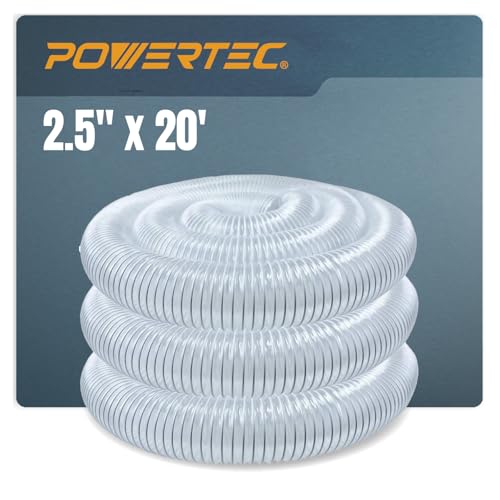
POWERTEC 70156 2-1/2-Inch x 20-Foot PVC Flexible Dust Collection Hose
This 2.5-inch bore version drops down from the 4-inch trunk size, matching shop vac hoses and small-port sanders instead. Airflow speed increases through the narrower tube, helping lift fine debris at a random-orbit sander. Twenty feet of length lets it reach a workbench across the garage.
Pros
- Bore matches shop vac and sander ports directly
- Twenty-foot length covers a full garage bay
- Higher air velocity lifts fine sanding dust
Cons
- Too narrow for table saws or planers needing 4-inch flow
- Clogs faster with wood chips than wider hoses
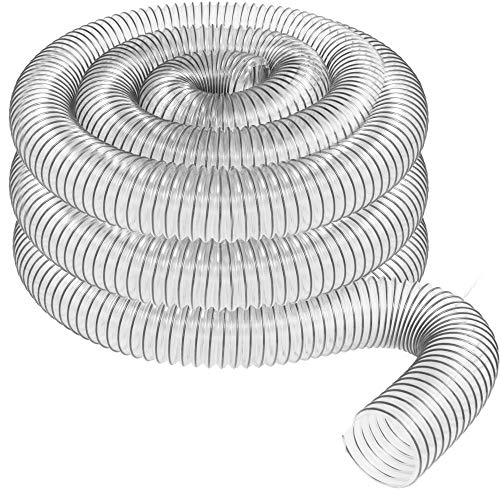
Peachtree Woodworking Supply PW7SC 4-Inch x 10-Foot Wire Reinforced Flexible Hose
A tight steel wire coil wrapped in reinforced PVC lets this hose spring back to round after sharp bends around a mobile tool base. Closer coil spacing resists crushing when a caster wheel rolls over a loop. Ten feet of length suits jointers and bandsaws that shift position during a project.
Pros
- Tight coil resists crushing under rolling casters
- Springs back to round after sharp bends
- Handles repeated repositioning on mobile bases
Cons
- Tighter coil adds slightly more airflow resistance
- Sold only in a 10-foot length
iVACUE 4-Inch x 10-Foot Clear PVC Flexible Dust Collection Hose
A clear PVC wall on this hose lets you watch for clogs and offcuts moving through the line without opening a coupler. Steel wire helix inside the transparent wall keeps the 4-inch bore from collapsing under suction. Ten feet suits a single tool positioned near the collector.
Pros
- Transparent wall shows clogs and jammed chips instantly
- Wire helix prevents collapse under vacuum pressure
- Helps troubleshoot airflow problems on the fly
Cons
- Clear PVC scratches and hazes with regular handling
- Shorter length limits reach to distant tools

Rockler Dust Right 4-Inch x 10-Foot Flexible Dust Collection Hose
Rockler keeps the same 4-inch by 10-foot format here but adds a wire helix rated for grounding to a metal collector body. Bonding the wire drains static charge that builds up in dry winter shops and shocks a hand near the wand. It threads onto Rockler’s own ports and most generic 4-inch fittings.
Pros
- Groundable wire helix cuts static shocks in dry conditions
- Fits Rockler ports and generic 4-inch fittings
- Consistent bore matches most collectors
Cons
- Grounding requires a separate clamp and ground wire kit
- Ten-foot length needs couplers for longer runs
How they stack up
| # | Model | Inside diameter | Best for | Score | Price |
|---|---|---|---|---|---|
| 1 | POWERTEC 70152V-P2 4-Inch x 20-Foot Flexible PVC Dust Collection Hose | 4 inches | Best overall | 9.4 | Check price |
| 2 | WEN DC1022 4-Inch x 10-Foot Flexible Dust Collection Hose | 4 inches | Best value | 9.1 | Check price |
| 3 | Shop Fox W1815 4-Inch x 10-Foot Flexible Dust Collection Hose | 4 inches | Best budget | 8.8 | Check price |
| 4 | POWERTEC 70156 2-1/2-Inch x 20-Foot PVC Flexible Dust Collection Hose | 2.5 inches | Best for shop vac and small-port tools | 8.5 | Check price |
| 5 | Peachtree Woodworking Supply PW7SC 4-Inch x 10-Foot Wire Reinforced Flexible Hose | 4 inches | Best for crush resistance | 8.3 | Check price |
| 6 | iVACUE 4-Inch x 10-Foot Clear PVC Flexible Dust Collection Hose | 4 inches | Best for visibility | 8.1 | Check price |
| 7 | Rockler Dust Right 4-Inch x 10-Foot Flexible Dust Collection Hose | 4 inches | Best for static control on fine dust | 8.0 | Check price |
Frequently asked questions
What size dust collection hose do I need?
Match the hose to your tool’s port, usually 4 inches for table saws, planers and jointers, or 2.5 inches for shop vacs and random-orbit sanders. Check the collar diameter stamped near the dust port before buying, since a mismatched hose either restricts airflow or won’t seal.
Is a 4-inch or 2.5-inch hose better for a shop vac?
Shop vacs generate lower air volume than a dedicated dust collector, so a 2.5-inch hose keeps velocity high enough to carry chips. A 4-inch hose on a shop vac motor slows airflow and drops fine dust along the line instead of into the bin.
Do dust collection hoses need to be grounded?
Grounding helps in dry conditions where fine dust builds static charge and delivers shocks at the wand. Clamp a bare wire from the hose’s internal helix to an unpainted metal spot on the collector body to bond the charge safely.
How long should a dust collection hose be?
Keep runs as short as practical, since every extra foot adds friction loss that the collector’s motor has to overcome. A 10-foot hose suits one stationary tool near the collector, while 20 feet reaches machines across a garage bay.
Can you cut a dust collection hose to a custom length?
Wire-reinforced PVC hoses cut cleanly with a utility knife or hacksaw through the coil. Trim a few inches past the mark, then clamp a hose end fitting over the cut edge to keep the wire from unraveling.
What is the best dust collection hose for a table saw?
A 4-inch hose with a steel wire helix, like the POWERTEC 70152V-P2 or WEN DC1022, matches most cabinet and contractor saw ports. Choose the 20-foot option if the saw sits far from the collector, or the 10-foot version for a closer connection.
Clear vs opaque dust collection hose, which is better?
Clear PVC hoses, like iVACUE’s, let you see clogs and jammed offcuts without disconnecting a coupler. Opaque wire-reinforced hoses resist scratching and UV yellowing better over years of use, though clogs stay hidden until airflow drops.
Why does a dust collection hose keep collapsing?
Collapse usually means the wire helix is too thin for the suction pressure, or a shop vac is pulling through an undersized hose diameter. Switch to a tighter-coil hose like Peachtree’s PW7SC, or confirm the hose diameter matches the tool’s rated port size.
Can one hose work for both a table saw and a random-orbit sander?
Only with a reducer fitting, since a 4-inch hose won’t seal onto a 2.5-inch sander port. Keep a short 2.5-inch adapter hose on hand rather than forcing one diameter to cover both tools.
Our pick
POWERTEC’s 70152V-P2 suits a 4-inch trunk line reaching machines across the shop, since its 20-foot length and steel helix handle daily use. Shop Fox’s W1815 fits tighter budgets running one tool at a time. Anyone fighting static shocks on fine sanding dust should ground the Rockler Dust Right hose to the collector body.