What Age Fits an Electric Ride On Car Best?
Power Wheels Dune Racer Extreme takes the top spot for its two speed settings and genuine off road capability on grass. Peg Perego John Deere Ground Force suits younger children with a trailer, and Radio Flyer Tesla Model Y stands out for detail and finish.
Power Wheels Dune Racer Extreme is the ride on to buy for a garden with grass and slopes, with Peg Perego John Deere Ground Force better suited to younger children and Radio Flyer Tesla Model Y winning on outright presentation.
Ride on cars are hard to judge from a listing, since the numbers that sell them rarely matter: a twelve volt badge means little if the vehicle has one driven wheel and hard plastic tyres that spin on a damp lawn. We compared published voltage, motor configuration, tyre material, weight limits and remote control features alongside consistent owner feedback about battery life and terrain, prioritizing traction, realistic runtime and the safety controls parents actually rely on.
What we recommend

Power Wheels Dune Racer Extreme
An open buggy frame with a wide track and monster traction tyres keeps this car moving on lawn and gravel where sleeker cars bog down. Two speed settings plus reverse let a younger child start slow, and a parent lockout guards the faster mode. Owners consistently describe it as durable enough to survive more than one child.
Pros
- Genuine traction on grass and loose surfaces
- High speed lockout for cautious starts
- Two seats and a robust frame that lasts
Cons
- No parent remote control
- Bulky to store in a small garage
Peg Perego John Deere Ground Force Tractor
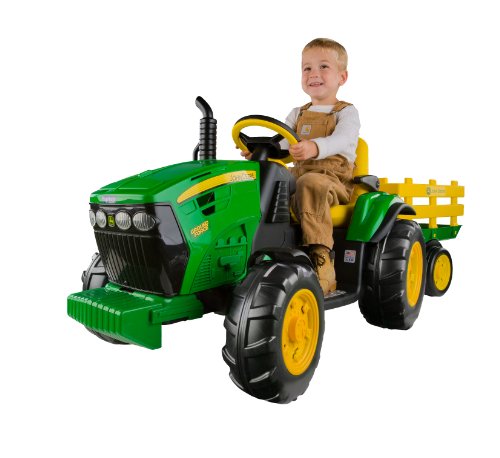
A low, stable tractor body pairs with a detachable trailer, turning driving in circles into actual hauling jobs around the garden. Peg Perego builds these in Italy with a reputation for long term parts availability, which matters once a wheel or gearbox eventually wears. Two forward speeds and an adjustable seat cover a wide age range.
Pros
- Stable low profile suits smaller children
- Trailer adds genuine play value
- Replacement parts available long term
Cons
- Single seat only
- Slower than the buggy style rivals

Radio Flyer Tesla Model Y for Kids
Working lights, a functioning boot, a sound system and a molded interior make this the most convincing looking car in the group. Underneath sits a sensible twelve volt platform with forward, reverse and a parent friendly speed limiter. Smooth surfaces like a driveway or path suit it far better than long grass.
Pros
- Outstanding detail and finish
- Working lights and audio add to the play
- Adjustable speed settings for growing confidence
Cons
- Smooth tyres struggle on grass
- Priced well above comparable ride ons

Peg Perego Polaris RZR 900
High clearance, aggressive tread and a roll cage make this the most capable machine here on genuinely uneven terrain. Two seats with belts and a rear cargo bed suit siblings playing together. Extra weight helps it hold a line on slopes, though moving it around becomes more of a chore.
Pros
- Twenty four volt system copes with slopes and grass
- Roll cage and belts for two riders
- Rear cargo bed for extended play
Cons
- Heaviest model here to move or store
- Highest outlay in this group

Kidzone 12V Licensed Mercedes-Benz Ride On Car
A proper parental remote overrides the pedal entirely, the feature that makes ride ons workable for toddlers who cannot yet steer and brake reliably. Soft start acceleration replaces an abrupt lurch, and lights, music and Bluetooth round out the package. Flat surfaces suit it best, since build quality sits at fair rather than premium.
Pros
- Remote override makes it usable from age two
- Soft start avoids sudden jerks
- Good feature list for the outlay
Cons
- Plastic tyres need smooth ground
- Lower weight limit shortens usable years
Best Choice Products 12V Ride-On Truck
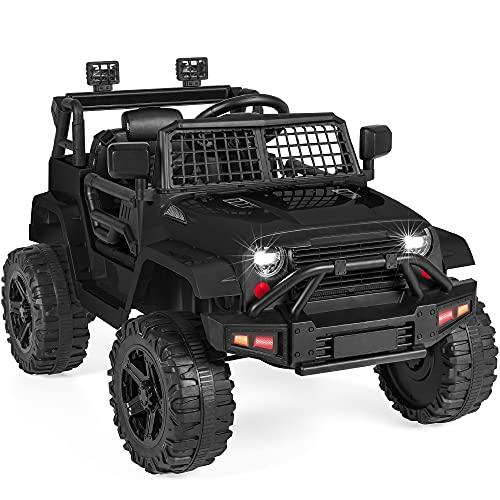
Remote control, three speed settings, LED lights, a media player and spring suspension pack into this truck well below the licensed premium models. Assembly runs longer than branded options, and instructions are the weak point. Owners report solid performance on driveways and patios, with the usual caveat about thick grass.
Pros
- Strong feature set for the price
- Remote plus three speed settings
- Spring suspension smooths bumpy paths
Cons
- Assembly instructions are poor
- Long term durability trails the premium brands

Power Wheels Barbie Dream Camper
A fold out camp area, storage compartments and seating for two make this as much a playset as a vehicle, so it keeps working even parked. Driving performance stays deliberately gentle, suited to younger children on flat ground. Real storage space becomes the main practical consideration given its size.
Pros
- Doubles as a stationary playset
- Two seats and plenty of storage nooks
- High speed lockout for younger drivers
Cons
- Very large footprint to store
- Best suited to flat smooth surfaces
The lineup, side by side
| # | Model | Battery | Best for | Score | Price |
|---|---|---|---|---|---|
| 1 | Power Wheels Dune Racer Extreme | 12 volt rechargeable | Best overall | 9.4 | Check price |
| 2 | Peg Perego John Deere Ground Force Tractor | 12 volt rechargeable | Best for younger children | 9.2 | Check price |
| 3 | Radio Flyer Tesla Model Y for Kids | 12 volt rechargeable | Best detailed replica | 9.0 | Check price |
| 4 | Peg Perego Polaris RZR 900 | 24 volt rechargeable | Best for rough ground | 8.8 | Check price |
| 5 | Kidzone 12V Licensed Mercedes-Benz Ride On Car | 12 volt rechargeable | Best with parent remote | 8.6 | Check price |
| 6 | Best Choice Products 12V Ride-On Truck | 12 volt rechargeable | Best value | 8.3 | Check price |
| 7 | Power Wheels Barbie Dream Camper | 12 volt rechargeable | Best for imaginative play | 8.0 | Check price |
Before you buy
What voltage actually tells you about performance Six volt models suit only the youngest children on flat indoor or patio surfaces, with speeds around two miles per hour. Twelve volt is the mainstream choice, handling a driveway, a path and short lawn if the tyres are up to it. Twenty four volt adds torque for slopes and rough ground with two children aboard. Higher voltage does not automatically mean faster, since manufacturers often use the extra power for pulling ability instead of speed.
Tyres and drive wheels decide grass performance Disappointment usually starts here. Hard plastic wheels on a single driven axle spin uselessly the moment a surface turns soft or damp. Rubber traction strips or, better, molded rubber tyres change that equation, and both rear wheels being driven matters as much as the tyre material itself. A twelve volt car with two driven wheels and rubber tread will outperform a twenty four volt car with one driven plastic wheel on any real lawn.
Battery life, charging and eventual replacement Expect roughly forty five minutes to two hours of mixed use per charge, less on grass or slopes and less again with two children aboard. Charging takes most of a day, which pushes many families toward a second battery for busy weekends. Charge after every use rather than leaving the pack flat, store it indoors above freezing over winter, and confirm replacement batteries stay available, since a discontinued pack turns the car into scrap.
Safety features worth insisting on A parent remote with full override helps most with children under four, since it lets you stop the car when they freeze at the pedal. A high speed lockout extends the toy’s useful life by letting a nervous three year old start slowly before unlocking full speed later. Seat belts earn their place on any two seat model, and soft start acceleration prevents the lurch that scares younger drivers. Supervision, distance from roads and water, and an honest read of the weight limit round out the basics.
Questions worth asking
What age is right for an electric ride on car?
Roughly one to three years for six volt models with a parent remote, three to six for twelve volt cars, and five to eight for twenty four volt models. A child needs to reach the pedal and understand stopping, or the remote needs to handle that instead.
How long does the battery last on a charge?
Typically forty five minutes to two hours depending on terrain, speed setting and load. Grass, slopes and a second passenger all shorten it considerably, and charging usually takes eight to twelve hours.
Will a ride on car work on grass?
Only with the right tyres and drive setup. Rubber tread strips or full rubber tyres paired with two driven wheels handle grass, while smooth plastic wheels spin on anything but short dry lawn regardless of voltage.
Do I need a parent remote control?
For children under about four, it is the feature that makes the toy usable, since it lets an adult steer and stop from behind. Older children who can steer and brake reliably rarely need it, though it stays reassuring on a sloped drive.
How much assembly is involved?
Most models need wheels, a steering wheel, a windscreen and decals fitted, taking anywhere from thirty minutes to a couple of hours. Premium brands generally ship clearer instructions, and the battery needs a full charge before first use regardless.
Can these be used in the rain or left outside?
No. Electronics are not sealed, and water damage is a common cause of failure. Store the vehicle under cover and bring the battery indoors, especially in freezing weather, since cold storage permanently reduces capacity.
What happens when the battery stops holding a charge?
Replacement batteries stay widely available for major brands, and swapping one is usually straightforward. Established brands are worth preferring for this reason, since generic packs sometimes become impossible to source within a couple of years.
Are two seat ride on cars worth the extra?
Yes for two children close in age, since taking turns in a single seater tends to cause more arguments than it solves. Check the combined weight limit rather than the per child figure, because two children reach it faster than expected.
Power Wheels versus Peg Perego, which brand is more durable?
Both hold up well, though Peg Perego’s Italian built gearboxes and long term parts availability give it an edge for multi year use. Power Wheels models like the Dune Racer Extreme trade some of that longevity for tougher off road traction.
Our pick
Power Wheels Dune Racer Extreme keeps working once the driveway runs out, and its speed lockout suits a child from three through six or seven. Peg Perego John Deere Ground Force fits a younger child who enjoys hauling more than racing, and Radio Flyer Tesla Model Y wins when looks matter as much as where the car can go.