Which Electric Water Heater Suits Your Household?
EcoSmart ECO 27 tops this list for whole-home tankless supply, provided the electrical panel can support its draw. Rheem RTEX-13 is the value pick for smaller households, and Bosch Tronic 3000 T handles one distant sink without any rewiring.
EcoSmart ECO 27 leads this roundup for whole-home use, assuming the electrical panel can supply what it draws, since self-modulating tankless heaters only make sense when supply matches demand. Rheem RTEX-13 offers better value where hot water demand stays modest. Bosch Tronic 3000 T answers a narrower problem, one distant sink that runs cold for a minute before warming.
Electric water heater buying goes wrong most often when it gets treated as a plumbing decision rather than an electrical one, since a whole-home tankless unit can draw more current than the rest of a house combined. We compared heating capacity, flow rate at realistic temperature rises, breaker and wire gauge requirements, tank volume and recovery, then weighed that against what owners report about winter performance and install cost.
How to choose
Tankless or tank starts with your electrical panel A whole-home electric tankless unit can demand more current than an entire small house is wired for, since it heats water instantly rather than storing it. That demand often means a service upgrade, a new subpanel and heavy-gauge wire. Tanks draw far less power because they heat slowly and hold the result. Have an electrician confirm what your panel supports before tankless enters the conversation.
Temperature rise decides the flow rate you actually get A flow rate figure means nothing without the temperature rise it assumes. Groundwater arrives much colder in northern regions during winter than in southern ones. The same heater delivering a comfortable shower in one climate produces a trickle in another. Find your coldest-month inlet temperature, work out the rise needed, then check the flow rate at that specific rise.
Sizing a tank to what your household actually uses First-hour rating tells you more than raw tank capacity, since it accounts for recovery speed while water is drawn down. Plan around a worst case, usually consecutive morning showers plus a running appliance. Undersizing leaves whoever showers last with cold water, while oversizing wastes energy keeping unused water hot. Mini tanks like the Bosch Tronic 3000 T solve a different problem, distance rather than volume.
What a real install requires beyond the unit Every water heater install needs a properly discharged temperature and pressure relief valve, correctly sized wiring and breaker, and often a permit and inspection. Tankless units also need adequate water pressure, plus a sediment filter in hard-water areas. Mini tanks that plug into a standard outlet skip most of that complexity. Anything hardwired still calls for a licensed electrician regardless of who handles the plumbing.
The top picks, ranked

EcoSmart ECO 27 Tankless Electric Water Heater
Self-modulating control draws only the power needed for the current flow rate, rather than running at full output constantly. That efficiency puts the ECO 27 at the top of the residential tankless range for cold-climate, whole-home use. Multiple double-pole breakers and heavy-gauge wire are the trade-off, since the electrical service has to match the demand.
Pros
- Endless hot water with no standby tank losses
- Modulating draw avoids constant full-power operation
- Frees the floor space a storage tank occupies
Cons
- Requires substantial electrical service capacity
- Electrical upgrade often costs more than the unit itself
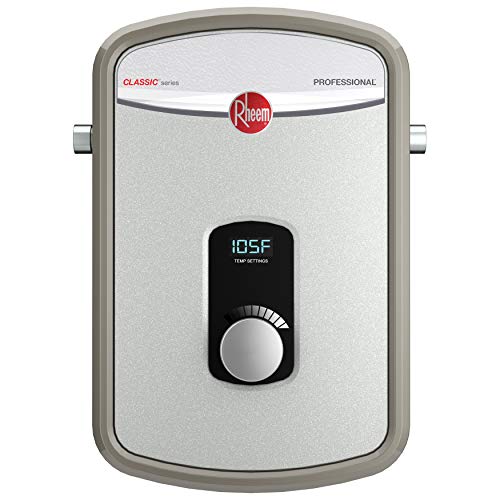
Rheem RTEX-13 Tankless Electric Water Heater
A single double-pole breaker covers this unit’s demand, keeping it within reach of a typical panel unlike whole-home tankless models. Digital control adjusts temperature in single-degree steps, unusually precise for its size. Cold-climate homes should treat it as a one-fixture solution rather than a whole-house answer.
Pros
- Modest electrical demand next to whole-home units
- Digital thermostat sets temperature precisely
- Elements are simple to service in the field
Cons
- Flow rate drops sharply with cold inlet water
- Not enough capacity for simultaneous fixtures

Stiebel Eltron Tempra 24 Plus Tankless Water Heater
Advanced flow control restricts flow slightly rather than letting output temperature drop when demand exceeds capacity. That is the difference between a shower running marginally weaker and one turning cold outright. Stiebel Eltron backs the Tempra with a strong warranty and near-silent operation, reasons it gets specified often.
Pros
- Holds set temperature instead of running cold
- Operates near silently compared with rivals
- Strong reputation for long-term reliability
Cons
- Priced at a premium against similar capacity
- Needs the same heavy electrical service as competitors
Bosch Tronic 3000 T Point of Use Water Heater
A four-gallon mini tank solves distance rather than volume, eliminating the long cold run from a distant water heater to a rarely used sink. Plugging into a standard outlet means no electrical work at install. Hot water arrives instantly at that one fixture, limited to the tank’s small stored volume.
Pros
- Plugs into a standard outlet, no rewiring needed
- Removes the wait at a distant sink
- Fits inside a standard vanity cabinet
Cons
- Small volume runs out with heavy use
- Standby heat loss while the tank sits idle

Ariston Andris Mini Tank Electric Water Heater
Ariston has built compact European-style water heaters for decades, and the Andris tucks neatly under a sink or into a utility cupboard. Foam insulation keeps standby losses modest for a tank this small. Workshop sinks, garages and wet bars suit it well, anywhere a new supply line makes little sense.
Pros
- Compact enough for tight cabinets
- Runs on a standard outlet, no dedicated circuit
- Foam insulation limits standby losses
Cons
- Not sized for shower use
- Recovery is slow after a heavy draw

Reliance Compact Electric Water Heater
Six gallons bridges the gap between a mini tank and a full-size unit, enough for washing up plus a short handwashing sequence rather than one fill. Small apartments, cabins and boats suit this size well. Wall or shelf mounting keeps it out of the way without needing dedicated floor space.
Pros
- More usable volume than a four-gallon mini tank
- Still fits where a full-size tank cannot
- Simple, serviceable single-element design
Cons
- May need a dedicated circuit depending on the model
- Insufficient volume for a full household

Camplux Mini Tank Electric Water Heater
Camplux includes the mounting bracket and relief valve that buyers often forget to order separately, at the low end of the mini tank market. Plugging into a standard outlet keeps installation simple for a sink or coffee station. Owners report the supplied fittings are the first thing worth upgrading over time.
Pros
- Lowest-cost route to point-of-use hot water
- Mounting hardware included in the box
- No electrical work required at install
Cons
- Supplied fittings are basic quality
- Shorter expected service life than premium tanks
The lineup, side by side
| # | Model | Type | Best for | Score | Price |
|---|---|---|---|---|---|
| 1 | EcoSmart ECO 27 Tankless Electric Water Heater | Tankless, whole home | Best overall | 9.4 | Check price |
| 2 | Rheem RTEX-13 Tankless Electric Water Heater | Tankless, point of use | Best value | 9.2 | Check price |
| 3 | Stiebel Eltron Tempra 24 Plus Tankless Water Heater | Tankless whole home | Best temperature stability | 9.0 | Check price |
| 4 | Bosch Tronic 3000 T Point of Use Water Heater | Mini tank, point of use | Best for a single sink | 8.8 | Check price |
| 5 | Ariston Andris Mini Tank Electric Water Heater | Mini tank | Best compact tank | 8.6 | Check price |
| 6 | Reliance Compact Electric Water Heater | Compact tank | Best for small spaces | 8.3 | Check price |
| 7 | Camplux Mini Tank Electric Water Heater | Mini tank | Best budget | 8.0 | Check price |
Good to know
Is an electric tankless water heater right for a whole house?
Only if the electrical service can supply it. Whole-home tankless units need multiple high-amperage circuits and heavy-gauge wire, and many older panels cannot handle that without an upgrade. Have an electrician assess the panel before choosing tankless over a tank.
What size water heater does a household actually need?
For a tank, first-hour rating matters more than raw gallons, sized to peak demand like consecutive morning showers. For tankless, work out the temperature rise from your coldest inlet water, then check flow rate at that rise. Both beat guessing from household size alone.
Why does a tankless heater struggle more in winter?
Incoming groundwater runs much colder in winter, so the unit must raise the temperature further for the same output, which drops flow rate. A heater performing well in summer can disappoint in January. Sizing decisions should always use the coldest month, not an average one.
What is a mini tank water heater actually for?
It solves distance, not volume. A sink far from the main water heater wastes time and water running cold before it warms. A mini tank installed under that sink, like the Bosch Tronic 3000 T, delivers hot water immediately from a small stored reserve.
Do electric water heaters need a dedicated circuit?
Most hardwired tank and tankless units do, sized to the manufacturer’s specification. Small mini tanks built to plug into a standard outlet, like the Camplux, are the exception. Always follow the wiring and breaker requirements in the manual, since undersized wiring is a real hazard.
How long do electric water heaters typically last?
Tanks commonly last around a decade, with anode rod condition and water hardness making a large difference. Tankless units often last longer since there is no tank to corrode, provided scale gets managed. Periodic descaling extends tankless life significantly in hard-water areas.
Tankless vs tank electric water heater, which needs less maintenance?
Tanks need an annual flush to clear sediment and periodic anode rod checks. Tankless units need descaling on a schedule tied to water hardness, plus a clean inlet filter screen. Both should have the relief valve checked as part of routine upkeep.
Can a homeowner install a water heater without a professional?
A plug-in mini tank is straightforward for a competent homeowner to install. Anything hardwired involves plumbing and electrical work together, usually a permit, and often an inspection. The electrical side in particular warrants a licensed professional given the current these units draw.
Our take
When the electrical service genuinely supports it, the EcoSmart ECO 27 delivers endless hot water without a tank’s standby losses, though wiring is often the larger expense. For a single shower or modest apartment, the Rheem RTEX-13 gets tankless performance within reach of an ordinary panel. When the real complaint is one distant sink running cold, the Bosch Tronic 3000 T solves it by plugging straight into the wall.