Which Extension Cord Gauge Do You Actually Need?
US Wire and Cable’s 74050 tops this list with 12 gauge copper and a jacket that stays flexible in cold weather. Southwire’s 2588SW0002 suits shorter outdoor runs at a lower cost. Amazon Basics’ 16/3 Outdoor Extension Cord covers light garden duty without overspending.
Twelve gauge copper across 50 feet keeps voltage drop low enough to run a circular saw or compressor, and that is why the US Wire and Cable 74050 leads this roundup. Its jacket also stays flexible when temperatures fall. Southwire’s 2588SW0002 makes more sense for shorter outdoor runs around a house, while Amazon Basics’ 16/3 Outdoor Extension Cord handles hedge trimmers, string lights, and other light loads at minimal cost.
Buying the wrong cord is costlier than it looks, since an undersized one starves a motor, runs hot, and can damage the tool it feeds. Gauge and length work against each other: a 16 gauge cord fine at 25 feet turns marginal at 100 feet on the same load. We compared wire gauge, conductor material, jacket rating, plug design, and strain relief, then weighed that against owner reports of jackets stiffening in winter and connector ends loosening after a season.
What to look for
How Do Gauge and Length Work Together? Lower gauge numbers mean thicker wire. As length increases, resistance rises and voltage at the far end falls, so motors run hot and lose power. A rough rule for 15 amp loads: 16 gauge up to about 25 feet, 14 gauge to about 50 feet, and 12 gauge beyond that. Circular saws, compressors, and pressure washers should step up to 12 gauge regardless of length.
What Do the Jacket Letters Mean? Letters printed on the jacket describe what a cord can survive. S means flexible service cord, J means junior service rated at 300 volts, T means thermoplastic, and W means suitable for wet locations and outdoor use. SJTW covers most outdoor household cords as a result. No W in the code means the cord stays indoors. Cold-weather versions carry a separate marking and stay pliable when a standard jacket goes stiff.
Is It Safe to Daisy Chain Extension Cords? Plugging two cords together adds resistance at every connection, effectively creating one longer, thinner run. It also puts a joint on the ground where water collects. Buying one cord of the length actually needed avoids the problem entirely. The same logic applies to running a power strip off an extension cord, which concentrates load at a point never built to carry it continuously.
How Do I Store an Extension Cord So It Lasts? Most extension cord failures start at the plug end, where repeated yanking pulls conductors loose inside the molding. Pull from the plug body rather than the cable, and coil loosely instead of wrapping tightly around an elbow, which stresses the copper. Check the pins occasionally for heat discoloration. Retire any cord with a cut jacket, exposed conductor, or missing ground pin instead of taping it.
The top picks, ranked

US Wire and Cable 74050 Extreme All Weather Extension Cord
Built for tools rather than lamps, this cord runs 12 gauge conductors across 50 feet in a jacket rated to stay flexible well below freezing. Molded ends grip firmly even with gloves on, and the bright color stays visible on a site. Heavy coiling is the tradeoff for that wire gauge.
Pros
- Handles demanding power tools with 12 gauge copper
- Stays flexible in cold conditions
- Heavy molded ends resist site damage
Cons
- Heavy and bulky to coil and store
- Longer than needed for indoor tasks

Yellow Jacket 2884 Heavy Duty Lighted Extension Cord
A lighted connector end tells you the circuit is live before you troubleshoot a dead tool, a genuine convenience on a jobsite. Construction runs 12 gauge inside a tough abrasion-resistant jacket, and contractor-grade ends grip firmly through repeated pulls. Plan for a reel, since 100 feet is a lot of cord to coil by hand.
Pros
- Lighted end confirms live power instantly
- Full 100-foot run without dropping to thinner wire
- Contractor-grade plug ends hold up to repeated pulls
Cons
- Needs a reel or it becomes a tangle
- Substantial weight over the full 100 feet

Southwire 2588SW0002 Outdoor Extension Cord
Twenty-five feet of 12 gauge covers the most common need: reaching from a garage outlet to a driveway or patio without hauling a hundred feet of copper around. Its SJTW jacket shrugs off sun, damp, and foot traffic. Southwire wire runs through plenty of houses already, so build quality here is unsurprising.
Pros
- Heavy gauge at a length most people actually need
- Coils and stores easier than 100-foot cords
- Weather-resistant jacket suits year-round use
Cons
- Too short for far corners of a large yard
- Single outlet end only

Iron Forge Cable 100 ft Outdoor Extension Cord
A job at the end of the garden needs enough voltage left at the tool, and this 100-foot 12 gauge run delivers it. Iron Forge wraps it in a bright orange SJTW jacket that stays visible in grass and leaves, cutting the odds of a mower running it over. Check the listed gauge carefully, since the range includes thinner versions at the same length.
Pros
- Full 100-foot reach without heavy voltage drop
- High-visibility jacket stands out in grass and undergrowth
- Grounded three-prong plug throughout
Cons
- Range includes thinner gauges, so verify before ordering
- Bulky to store without a reel
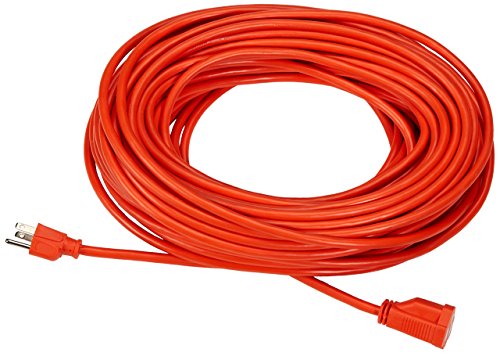
Amazon Basics 16/3 Vinyl Outdoor Extension Cord
String lights, a trickle charger, a fountain pump, or a hedge trimmer only need 16 gauge, and the lighter cord handles and coils far more easily. Its vinyl jacket suits seasonal outdoor use rather than permanent installation. Skip it for a table saw, since the gauge cannot carry that load.
Pros
- Cheap and light for seasonal jobs
- Coils easily for storage
- Grounded plug despite the low price
Cons
- Not suitable for high-draw power tools
- Jacket stiffens noticeably in cold weather

GE 3-Outlet Indoor Extension Cord
One outlet and three things to plug in is the usual indoor problem, and this solves it directly. A three-socket end and grounded plug cover lamps, chargers, and small appliances without jobsite bulk. Keep it indoors, since the jacket carries no outdoor rating.
Pros
- Three outlets from one wall socket
- Slim profile routes easily behind furniture
- Grounded rather than two-prong
Cons
- Indoor rating only, keep it out of the weather
- Light gauge limits it to small appliances

Cable Matters 3-Pack Flat Plug Extension Cord
A flat, rotating plug is the entire point here, letting a sofa or bed sit flush against the wall instead of bowing around a fat molded plug. Three cords in one pack cover several rooms at once. Treat these as convenience wiring for lamps and electronics, not anything with a motor.
Pros
- Flat plug lets furniture sit against the wall
- Three cords cover a whole room
- Grounded three-prong design
Cons
- Light duty, not for heaters or tools
- Indoor use only
How they stack up
| # | Model | Gauge and length | Best for | Score | Price |
|---|---|---|---|---|---|
| 1 | US Wire and Cable 74050 Extreme All Weather Extension Cord | 12/3, 50 feet | Best overall | 9.4 | Check price |
| 2 | Yellow Jacket 2884 Heavy Duty Lighted Extension Cord | 12/3, 100 feet | Best for jobsites | 9.2 | Check price |
| 3 | Southwire 2588SW0002 Outdoor Extension Cord | 12/3, 25 feet | Best value | 9.0 | Check price |
| 4 | Iron Forge Cable 100 ft Outdoor Extension Cord | 12/3, 100 feet | Best for long runs | 8.8 | Check price |
| 5 | Amazon Basics 16/3 Vinyl Outdoor Extension Cord | 16/3 | Best budget | 8.5 | Check price |
| 6 | GE 3-Outlet Indoor Extension Cord | Three grounded | Best for indoor use | 8.3 | Check price |
| 7 | Cable Matters 3-Pack Flat Plug Extension Cord | Flat, low profile | Best for tight spaces | 8.0 | Check price |
Frequently asked questions
What gauge extension cord do I need for power tools?
Use 14 gauge for runs up to about 50 feet on most 15 amp tools, and 12 gauge for anything longer or for high-draw equipment like compressors and pressure washers. Undersized cords run hot and lose power.
Can I use an indoor extension cord outside?
No. Indoor cords lack the moisture-resistant jacket and UV stabilizers that outdoor use requires, and the insulation degrades quickly in sun and damp. Look for a W in the jacket code, such as SJTW.
Is a longer extension cord less powerful?
Effectively yes. Voltage drops along the length of the cable, so the same gauge delivers less at the far end of a long run. Thicker wire, meaning a lower gauge number, compensates for extra length.
Why does my extension cord get warm?
Warmth usually means the load sits near or above what the gauge can handle, or the cord is coiled tightly so heat cannot escape. Uncoil it fully during use, and step up to a thicker gauge if it still warms noticeably.
Can I plug a space heater into an extension cord?
Manufacturers generally advise against it, since heaters draw high continuous current. If unavoidable, use a short, heavy-gauge cord rated well above the heater draw, never a thin household cord or a daisy-chained setup.
What does 12/3 mean on an extension cord?
The first number is the wire gauge, so 12 gauge, and the second is the conductor count, meaning three including the ground. A 16/2 cord has thinner wire and no ground connection.
Do I need a lighted end extension cord?
It is a convenience rather than a necessity. A lit connector confirms the circuit is live, saving a walk back to check a breaker when a tool goes dead. On a jobsite, that convenience adds up.
How long do extension cords last?
A well-stored cord can last for years. Replace it once the jacket is cut, the ground pin is missing or bent, the plug feels loose in the socket, or any part shows heat discoloration.
The verdict
Anyone running real tools should buy the US Wire and Cable 74050, since 12 gauge copper and a cold-flexible jacket keep motors happy through any season. Shorter needs closer to the house call for the Southwire 2588SW0002, which offers the same wire size at a far more manageable length. Keep an Amazon Basics 16/3 Outdoor Extension Cord on hand too, for lights, pumps, and other light seasonal loads.