Pick the Right External Drive Case for Your SSD or HDD
The ORICO 2599US3 leads for most external drives, since its tool-free tray and UASP chip push a SATA SSD near full USB speed. Sabrent’s EC-UASP nearly matches that for less money. Bare NVMe sticks fit the UGREEN M.2 NVMe SSD Enclosure best, thanks to its metal shell and thermal pad.
Three enclosures stand out for different needs. Tool-free trays and a UASP bridge chip let the ORICO 2599US3 push a SATA SSD close to its rated USB speed. Sabrent’s EC-UASP nearly matches that throughput for less money. Meanwhile, the UGREEN M.2 NVMe SSD Enclosure adds a metal body and thermal pad for bare NVMe sticks that would otherwise overheat.
Enclosures look interchangeable until the bridge chip inside becomes the real bottleneck. A cheap chipset can cap a fast SSD at half its rated speed. Bay size, cable type and even screw placement vary between 2.5 inch and 3.5 inch models, too. We compared listed chipsets, bay dimensions, cooling design and cable standards, then weighed owner reports of dropped connections, overheating and drive compatibility.
The top picks, ranked

ORICO 2599US3 2.5 Inch USB 3.0 Hard Drive Enclosure
A tool-free tray snaps a 2.5 inch SATA SSD or HDD into place without screws, up to 4TB. UASP support keeps SATA III speeds close to the USB 3.0 5Gbps ceiling. An aluminum top plate draws heat away from the drive without a fan.
Pros
- Tool-free tray secures a drive in seconds
- UASP keeps SSD speeds near the USB ceiling
- Aluminum top plate pulls heat away from the drive
Cons
- Fits only 2.5 inch drives, not 3.5 inch models
- Some listings arrive without a USB-C cable
![Sabrent USB 3.0 to SSD/2.5-Inch SATA Hard Drive Enclosure [EC-UASP]](https://m.media-amazon.com/images/I/311m+ah4SDL._SL500_.jpg)
Sabrent USB 3.0 to SSD/2.5-Inch SATA Hard Drive Enclosure [EC-UASP]
Sabrent’s aluminum shell fits 2.5 inch SATA drives and relies on UASP to skip the slowdown older USB bridges cause. Windows and macOS recognize SSDs and HDDs here without extra drivers, according to owner reports. A textured grip keeps the case from sliding off a desk.
Pros
- UASP avoids the common USB bridge slowdown
- Needs no extra drivers on Windows or macOS
- Compact aluminum body sheds heat passively
Cons
- Tray only fits 9.5mm and 7mm thick drives
- Bundled cable runs short for some desk setups

Inateck FE2011 2.5 Inch USB 3.0 Hard Drive Enclosure
Premium materials get skipped here, but the tool-free tray and UASP chipset that matter for speed stay intact. A lighter plastic shell suits a bag already carrying a laptop and charger. A small LED shows drive activity without demanding attention.
Pros
- Tool-free assembly matches pricier aluminum models
- Lighter plastic shell suits travel
- Ships with both USB-C and USB-A cables
Cons
- Plastic shell runs warmer than aluminum under sustained transfers
- No vented panel for extra airflow
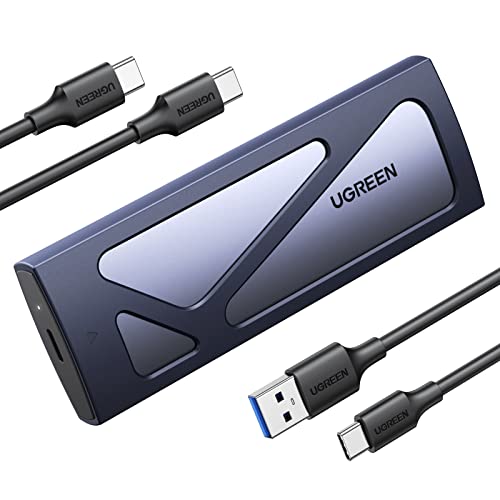
UGREEN M.2 NVMe SSD Enclosure Adapter, USB-C 10Gbps
M.2 NVMe sticks from 2230 through 2280 length slide into this enclosure, paired with a USB-C port rated for 10Gbps. A pre-applied thermal pad presses against the SSD to pull heat into the aluminum shell. SATA-based M.2 drives are not supported, so confirm the stick uses the NVMe protocol first.
Pros
- 10Gbps interface keeps pace with most consumer NVMe sticks
- Thermal pad cuts throttling on long transfers
- Tool-free latch secures the SSD without screws
Cons
- Does not support SATA-based M.2 drives
- Runs warm during sustained 4K video transfers
StarTech.com S3510BMU33 3.5 Inch USB 3.0 to SATA III Hard Drive Enclosure
Full-height 3.5 inch SATA drives up to 14TB fit this desktop-class case. A UASP bridge chip and external power adapter support the higher current a spinning 3.5 inch drive draws at startup. A tool-less latch opens the shell without a screwdriver.
Pros
- Handles high-capacity drives 2.5 inch cases cannot fit
- UASP keeps HDD speeds near their rated ceiling
- Vented shell helps manage heat from a spinning drive
Cons
- Needs a separate power adapter and outlet
- Larger footprint than 2.5 inch enclosures

TerraMaster D2-320 USB-C Dual Bay External Enclosure
Two 3.5 inch or 2.5 inch drives run independently here, or in RAID 0 for speed, or RAID 1 for a mirrored backup. A USB-C port rated for 10Gbps and a rear fan support sustained transfers across both bays. Included software manages the RAID mode without a separate controller card.
Pros
- RAID 1 mirrors data across two drives for backup redundancy
- Rear fan keeps two active drives cooler than fanless cases
- Mixed 2.5 and 3.5 inch drives fit the same unit
Cons
- Setup requires configuring RAID mode before first use
- Larger and louder than single-bay enclosures

OWC Mercury Elite Pro Dual USB-C Enclosure
OWC preformats this dual-bay enclosure for macOS and bundles SoftRAID utility for Time Machine backups. Two 3.5 inch or 2.5 inch bays support JBOD, RAID 0 or RAID 1 through one USB-C, 10Gbps port. A metal chassis and ongoing OWC firmware updates suit owners who keep a drive running for years.
Pros
- Preformatted for macOS with Time Machine support built in
- SoftRAID utility simplifies mirroring for backup redundancy
- Metal chassis and firmware updates support long-term use
Cons
- Windows users need to reformat before use
- Costs more than single-bay enclosures without RAID
How to choose
What Should You Look For in an External Drive Case? Bridge chipset matters more than looks or color. A hidden bridge chip translates SATA or NVMe signals into USB data, and older chips lack UASP, a command set that lets a drive queue multiple read and write requests at once. Without UASP, a fast SSD can drop to the speed of a slower spinning drive. Checking for UASP in the listing avoids the biggest performance trap before bay size or capacity even come into play.
How Do You Match Bay Size to Your Drive? 2.5 inch cases fit laptop-style SATA SSDs and HDDs up to about 9.5mm thick, and most pull power straight from the USB port. 3.5 inch cases house desktop drives instead, and they almost always need a separate power adapter, since spinning platters draw more current at startup. Buying the wrong size wastes both the enclosure and the drive, because neither format fits the other bay.
Do You Need an NVMe Enclosure Instead of a SATA Case? Bare M.2 NVMe sticks pulled from a laptop or upgraded desktop need a dedicated enclosure, not a SATA case. NVMe enclosures route data over PCIe through USB-C, reaching speeds a SATA bridge chip cannot match. Confirm the stick’s key notch and length code, such as 2280, match what the enclosure lists. A SATA-only M.2 stick will not work in an NVMe enclosure.
Is a Dual-Bay RAID Enclosure Worth It for Backup? Photographers and video editors who need redundant storage often skip single-bay cases for a two-drive enclosure running RAID 1, which mirrors data across both drives automatically. RAID 0 instead combines two drives into one faster volume, useful for large video files but riskier since one drive failure loses everything. Owners who only need backup redundancy should default to RAID 1 or JBOD rather than RAID 0.
The lineup, side by side
| # | Model | Bay size | Best for | Score | Price |
|---|---|---|---|---|---|
| 1 | ORICO 2599US3 2.5 Inch USB 3.0 Hard Drive Enclosure | 2.5 inch SATA | Best overall | 9.4 | Check price |
| 2 | Sabrent USB 3.0 to SSD/2.5-Inch SATA Hard Drive Enclosure [EC-UASP] | 2.5 inch SATA | Best value | 9.1 | Check price |
| 3 | Inateck FE2011 2.5 Inch USB 3.0 Hard Drive Enclosure | 2.5 inch SATA | Best budget | 8.8 | Check price |
| 4 | UGREEN M.2 NVMe SSD Enclosure Adapter, USB-C 10Gbps | M.2 NVMe, 2230-2280 | Best NVMe enclosure | 8.5 | Check price |
| 5 | StarTech.com S3510BMU33 3.5 Inch USB 3.0 to SATA III Hard Drive Enclosure | 3.5 inch SATA | Best for 3.5 inch HDD | 8.3 | Check price |
| 6 | TerraMaster D2-320 USB-C Dual Bay External Enclosure | 2 bays, 3.5 or 2.5 inch | Best for dual-bay backup | 8.1 | Check price |
| 7 | OWC Mercury Elite Pro Dual USB-C Enclosure | 2 bays, 3.5 or 2.5 inch | Best for Mac compatibility | 8.0 | Check price |
Questions worth asking
What is UASP and why does it matter for a drive enclosure?
UASP is a command set that lets a drive handle multiple read and write requests at once instead of one at a time. Enclosures without it can cap a fast SSD well below its rated speed. Checking the listing for UASP support is the fastest way to avoid a bottleneck.
Can any SSD or HDD go into an external enclosure?
Only if the drive’s interface and physical size match the enclosure. A 2.5 inch SATA SSD or HDD fits a 2.5 inch case, while a 3.5 inch desktop drive needs a 3.5 inch case with external power. Bare M.2 NVMe sticks need a separate NVMe-specific enclosure.
Which external drive case works best for a 3.5 inch hard drive?
The StarTech.com S3510BMU33 is built specifically for full-height 3.5 inch SATA drives up to 14TB. It includes an external power adapter, since spinning 3.5 inch drives draw more current than USB alone supplies.
Is an NVMe enclosure different from a SATA SSD enclosure?
Yes. NVMe enclosures connect to an M.2 slot and route PCIe signals through USB-C, reaching higher speeds than SATA. A SATA SSD enclosure uses a SATA connector instead and tops out around USB 3.0 speeds, even with UASP.
Do you need a powered enclosure for a desktop hard drive?
Most 3.5 inch enclosures need an external power adapter because a spinning platter draws more current than a USB port supplies, especially at startup. Nearly all 2.5 inch enclosures run entirely on USB bus power instead.
RAID 0 vs RAID 1 enclosure, which is better for backup?
RAID 1 mirrors the same data across two drives, so one drive can fail without losing files, making it the safer choice for backup. RAID 0 combines two drives for extra speed and capacity but loses everything if either drive fails.
Which external drive enclosure works best with a Mac?
The OWC Mercury Elite Pro Dual ships preformatted for macOS and includes SoftRAID for Time Machine backups. Single-bay UASP enclosures like the Sabrent EC-UASP also work on macOS after a quick reformat.
How much capacity can a 2.5 inch enclosure support?
Most current 2.5 inch enclosures list support up to 4TB, matching the largest 2.5 inch SATA SSDs and HDDs on the market. Larger capacities generally require a 3.5 inch enclosure instead.
Our pick
The ORICO 2599US3 makes a fast, tool-free home for a 2.5 inch SSD, since UASP keeps it near full USB speed. Working from a bare NVMe stick calls for the UGREEN M.2 NVMe SSD Enclosure instead, since its thermal pad prevents throttling. Anyone backing up a Mac with redundancy in mind should spend up on the OWC Mercury Elite Pro Dual for its SoftRAID support.