Landing Nets That Keep Fish Safe During Release
Frabill’s Conservation Series net protects slime coats better than any rival here through knotless coated mesh. PLUSINNO delivers most of that protection for less with a telescoping handle. Anglers switching between boat, kayak and bank work get the most from the EGO S2 Slider, since one handle swaps between several net heads.
Frabill’s Conservation Series net wins on fish safety, since its knotless coated mesh spares slime coats during release. PLUSINNO matches most of that protection at a lower price. Anglers who switch between boat, kayak and bank work gain the most from the EGO S2 Slider’s swappable heads.
Landing nets look interchangeable until a hoop turns out too small or a handle too short to reach the water. Knotted nylon mesh scrapes slime coats and snags trebles on nearly every cast. We compared mesh construction, hoop dimensions, handle reach and frame materials, then weighed owner reports on tangling, corrosion and how folding hinges hold up over a season.
The best picks, ranked
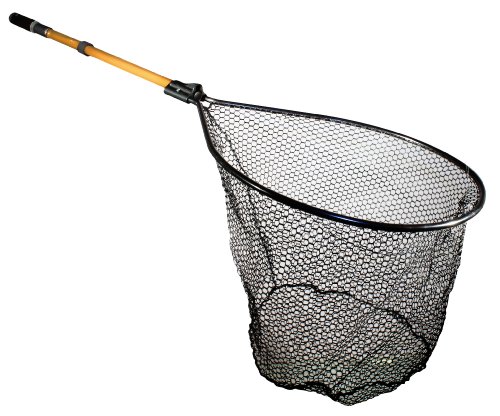
Frabill Conservation Series Landing Net
Knotless coated mesh is the headline feature, and it matters because ordinary knotted nylon scrapes the protective slime coat off fish you plan to release. Hooks slide free from the coated weave instead of tangling. Multiple hoop and handle sizes cover species from panfish to pike.
Pros
- Coated mesh sheds hooks instead of snagging them
- Slime coat protection suits catch and release anglers
- Available across several hoop and handle sizes
Cons
- Coated mesh costs more than plain nylon nets
- Larger hoop sizes crowd small boats
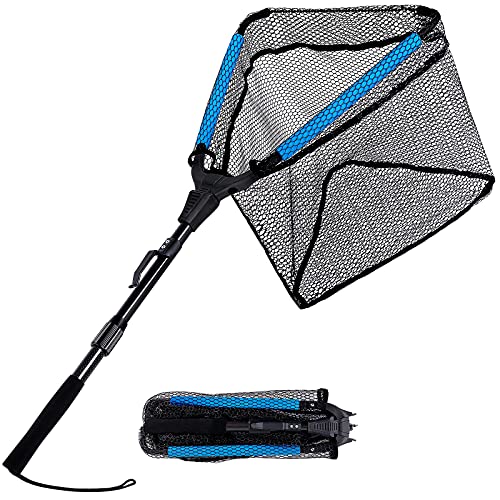
PLUSINNO Fishing Net Fish Landing Net
A telescoping handle locks at several lengths, switching easily between bank and boat use. Rubber coated mesh limits hook snagging without the price of conservation mesh. The hoop folds flat, so the whole net packs into a rucksack pocket.
Pros
- Telescoping handle adapts between bank and boat
- Rubber coating cuts down on hook tangles
- Folds compact enough for backpack carry
Cons
- Locking collar wears with heavy daily use
- Hoop size limits it to modest freshwater fish
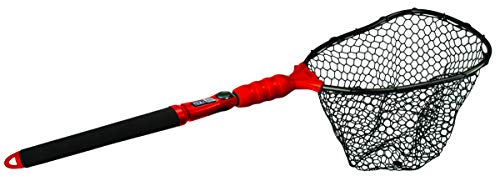
EGO S2 Slider Fishing Net
Handle and net head separate here, so one telescoping handle carries several interchangeable heads as the fishing changes. Reach extends far enough to clear a high gunwale. Owners report the modular system saves boat storage space compared with carrying multiple full nets.
Pros
- One handle serves several swappable net heads
- Extended reach clears deep sided boats easily
- Saves storage space compared with owning several nets
Cons
- Extra heads sell separately from the base kit
- Slider handle needs rinsing to keep sliding freely

KastKing Madbite Folding Landing Net
This net folds down small enough to live in a tackle pack rather than a boat locker. Rubberised mesh resists hook tangles better than bare nylon. Both hoop and handle collapse, which suits anglers who walk to the water.
Pros
- Folds down small for pack or bag storage
- Rubberised mesh reduces hook tangling
- Low cost way to always carry a net
Cons
- Folding hinges loosen under heavy repeated use
- Shallow bag struggles with larger fish

Fishpond Nomad Emerger Net
Carbon fibre and fibreglass keep this net light enough to hang from a vest for a full day. Rot and corrosion are not a concern with a composite frame. A shallow bag suits trout sized fish handled and released quickly.
Pros
- Very light frame for all day vest carry
- Clear rubber bag handles trout gently
- Composite build resists rot and corrosion
Cons
- Bag size limits it to trout class fish
- Costs more than a typical hand net

Bubba Carbon Fiber Landing Net
Salt destroys ordinary hardware quickly, so Bubba pairs a carbon fibre handle with corrosion resistant fittings for inshore work. The grip stays textured even when hands are wet. Rubberised knotless mesh suits catch and release handling.
Pros
- Corrosion resistant hardware suits saltwater exposure
- Textured grip holds firm with wet hands
- Light for its length given the handle strength
Cons
- Priced higher than comparable freshwater nets
- Hoop weighs more than dedicated fly nets
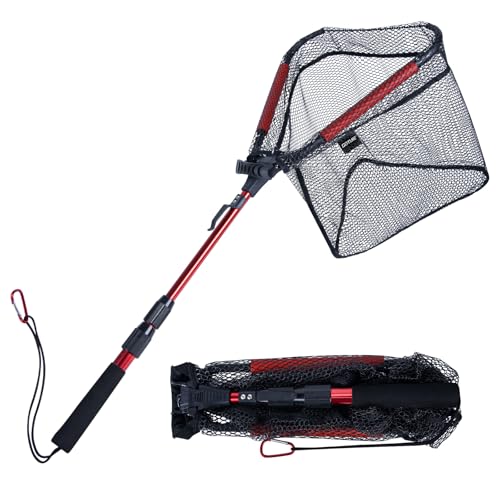
Goture Fishing Landing Net
Sitting low in a kayak calls for a short handle and a hoop manageable with one hand, which is the shape here. The frame folds to fit a tank well. Owners report short handled nets beat full length boat nets from a seated position.
Pros
- Sized correctly for seated kayak fishing
- Folds into limited kayak tank well storage
- One handed operation while still holding the rod
Cons
- Too short to reach from a high boat deck
- Hoop size stays modest for bigger species
Compared at a glance
| # | Model | Mesh | Best for | Score | Price |
|---|---|---|---|---|---|
| 1 | Frabill Conservation Series Landing Net | Knotless coated conservation mesh | Best overall | 9.4 | Check price |
| 2 | PLUSINNO Fishing Net Fish Landing Net | Rubber coated nylon | Best value | 9.2 | Check price |
| 3 | EGO S2 Slider Fishing Net | Interchangeable net heads | Best modular system | 9.0 | Check price |
| 4 | KastKing Madbite Folding Landing Net | Rubberised coating | Best budget | 8.8 | Check price |
| 5 | Fishpond Nomad Emerger Net | Carbon fibre and fibreglass composite | Best for fly fishing | 8.6 | Check price |
| 6 | Bubba Carbon Fiber Landing Net | Carbon fibre with non slip grip | Best for saltwater | 8.3 | Check price |
| 7 | Goture Fishing Landing Net | Short, kayak friendly length | Best for kayak anglers | 8.0 | Check price |
How to choose
What mesh type actually protects fish? Knotted nylon costs the least and does the most damage, since the knots scrape a fish’s protective slime coat and grab treble hooks constantly. Knotless mesh improves on that design. Rubber and coated mesh perform best of all, releasing hooks easily while doing the least harm to released fish. Clear rubber bags remain the standard among fly anglers, partly because they dry fast in a vest pocket.
How do I pick the right hoop size? Match hoop width to the biggest fish you realistically catch, not the one you dream about landing. An oversized hoop swings awkwardly and stores poorly. Bag depth matters just as much as width, since a shallow bag lets a fish flip straight back out. A hoop that accepts the fish head first with room to spare is the right call.
Which handle length suits your fishing platform? Bank anglers reaching over vegetation, and boat anglers netting alongside a high gunwale, need long or telescoping handles. Kayak anglers need the opposite, since a long handle is hard to control from a seated position. Fly anglers wading typically clip a short hand net to a vest instead. Buying for the wrong platform is the most common regret owners report.
What is the right way to handle a fish once netted? Wet the net before use, and keep the fish in the water inside the mesh while removing the hook. Support the body on larger species rather than lifting by the jaw alone. Rubber mesh speeds up unhooking, which shortens time out of water. Rinse with fresh water after saltwater trips, then let the net dry fully, since damp mesh rots and smells.
Good to know
What mesh is best for catch and release fishing?
Rubber or rubber coated knotless mesh works best. It preserves the fish’s slime coat, its primary defence against infection, and releases hooks easily so the fish spends less time out of the water.
What size landing net do I need?
Pick a hoop that comfortably accepts your largest regular catch, head first, with room to spare. Panfish and trout suit a small hoop, bass and walleye need a mid size hoop, and pike, musky or large saltwater species need a deep bag and a genuinely large hoop.
Are telescoping handle nets reliable?
Good ones are, though the locking collar is always the wear point. Rinse it with fresh water after saltwater use and avoid over extending it while lifting a heavy fish, since that is when locks slip.
Can one net work for both freshwater and saltwater?
Yes, provided it gets a thorough fresh water rinse after every saltwater trip. Corrosion resistant hardware and composite frames survive that routine far better than plain aluminium with steel fittings.
Why do hooks keep tangling in my net?
Knotted nylon mesh with an open weave is almost always the cause, since trebles catch on every knot. Switching to rubber or coated knotless mesh solves it more reliably than any technique change.
Do I need a landing net for kayak fishing?
Yes, and a short handled one specifically. Reaching over the side of a kayak with a long handle is awkward and destabilising, while a compact net stays controllable with one hand.
How do I stop a fishing net from smelling?
Rinse it after each trip and hang it to dry fully before storage. Odour comes from trapped moisture and residue in the mesh, and rubber bags shed water far faster than absorbent nylon.
Should I net a fish head first or tail first?
Always head first. A fish cannot swim backwards effectively, so leading with the head guides it into the bag. Chasing from behind pushes the fish away and is the most common reason one gets lost at the net.
How long a handle do I need for boat fishing?
A telescoping handle that extends well past the gunwale height works best, since reach matters more than most anglers expect. High sided boats need the longest options, while low sided jon boats manage with shorter fixed handles.
The bottom line
Frabill’s Conservation Series Landing Net earns the top spot because coated knotless mesh reduces tangles and protects fish you release, which improves both your day and their survival. PLUSINNO covers most of the same ground at a lower cost, and the EGO S2 Slider is the smart long term buy for anglers who fish several ways and want one handle to serve them all.


