Garden Lighting That Makes Your Yard Glow at Night
Philips Hue Lily Outdoor Spot Lights lead for anyone wanting colour control and reliable brightness all year. SUNVIE Low Voltage LED Landscape Spotlights are the value pick for a wired system, and Ring Solar Pathlights are the easiest way to light a path with no digging.
Philips Hue Lily Outdoor Spot Lights top this list, SUNVIE Low Voltage LED Landscape Spotlights offer the best value in a wired system, and Ring Solar Pathlights are the fastest route to a lit path without running any cable.
Garden lighting is deceptively hard to buy because solar lights are rated on a perfect summer day rather than a damp November one, and lumen figures are rarely comparable between brands. We ranked these on published output, ingress protection ratings, beam spread, expandability and what owners report about performance after a full year outdoors.
The best picks, ranked
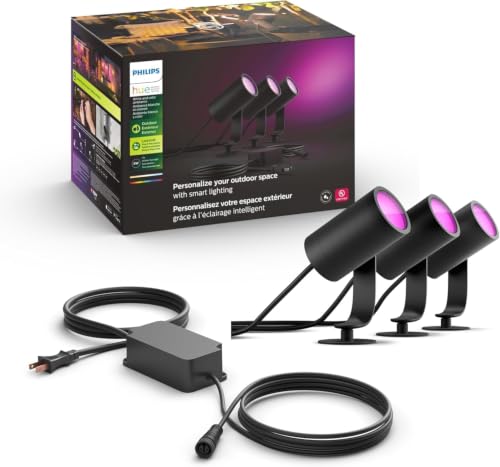
Philips Hue Lily Outdoor Spot Light
The Lily is the benchmark for smart garden lighting, with genuinely bright, fully adjustable colour output and a low voltage cable system that expands with extension kits. Being mains powered through a transformer, it does not fade in winter the way solar does. It needs the Hue Bridge and a nearby outdoor socket to work properly.
Pros
- Consistent brightness regardless of season
- Full colour and scheduling control
- Expandable with extension kits
Cons
- Requires a Hue Bridge and outdoor power
- Highest outlay per light on this list

SUNVIE Low Voltage LED Landscape Spotlights
A conventional 12 volt landscape spotlight in die cast aluminium with an adjustable head and a ground stake, sold in multi packs that make lighting a whole border affordable. Because it runs from a transformer, brightness is steady and unaffected by cloudy weather. You do need to bury cable and fit a transformer, which is an afternoon of work.
Pros
- Strong, consistent output for uplighting trees
- Metal housings last longer than plastic
- Cheap per fixture in multi packs
Cons
- Requires transformer and buried cable
- No smart control without an added timer

Ring Solar Pathlight
Ring’s pathlight links into the Ring ecosystem so it can trigger from motion detected by a doorbell or camera, which is a genuinely useful trick for a driveway. Solar charging keeps it running without cable, and the light output is well above the flimsy garden centre stakes. It needs a Ring Bridge to unlock the smart features.
Pros
- No cable to run anywhere
- Links to Ring cameras and doorbells
- Brighter than typical solar stakes
Cons
- Smart features need a Ring Bridge
- Winter run time shortens noticeably

Brightech Ambience Pro String Lights
Commercial grade string lights with shatterproof bulbs and a cable rated to stay outdoors year round, which is what separates these from seasonal decorative strings. The warm output is the right choice for dining and seating areas where spotlights would feel harsh. Strings need anchor points, so plan the run before ordering the length.
Pros
- Creates a genuinely inviting patio atmosphere
- Shatterproof bulbs survive weather and knocks
- Strings link together for long runs
Cons
- Needs sturdy anchor points or posts
- Mains cable must reach a protected socket

Govee Outdoor Ground Lights
Govee’s ground lights chain from a single power source and deliver bold colour effects, music sync and segment control, which makes them the fun option for a garden used for entertaining. Waterproofing is rated for permanent outdoor installation. Purists will find the effects less subtle than a warm white landscape scheme.
Pros
- Striking colour scenes and segment control
- One power source runs the whole chain
- Strong IP67 waterproof rating
Cons
- Colour effects can look busy in a small garden
- Cable runs are visible unless buried

GIGALUMI Solar Pathway Lights
Sold in large multi packs, these stainless stakes light a path edge for very little outlay and install in minutes with no tools. Output is modest, so treat them as wayfinding markers rather than illumination. Owners report the batteries are the limiting factor, with run time dropping after a couple of seasons.
Pros
- Very low cost per light
- Installs in minutes with no wiring
- Replaceable rechargeable batteries
Cons
- Marker level brightness only
- Run time falls off after a season or two

Beau Jardin Solar Pathway Lights
A step up from the cheapest solar stakes, with a sturdier metal and glass construction that survives strimmer knocks and winter better than thin plastic. Brightness sits at the higher end of the solar path light class, though still far below any wired fixture. Charging still depends entirely on how much winter sun the spot receives.
Pros
- Sturdier build than budget solar stakes
- Brighter than most solar path lights
- No wiring or running costs
Cons
- Winter performance depends heavily on siting
- Still far dimmer than low voltage fixtures
The lineup, side by side
| # | Model | Power | Best for | Score | Price |
|---|---|---|---|---|---|
| 1 | Philips Hue Lily Outdoor Spot Light | Low voltage, mains transformer | Best overall | 9.4 | Check price |
| 2 | SUNVIE Low Voltage LED Landscape Spotlights | 12V low voltage | Best value | 9.2 | Check price |
| 3 | Ring Solar Pathlight | Solar with rechargeable battery | Best solar path light | 9.0 | Check price |
| 4 | Brightech Ambience Pro String Lights | Mains plug in | Best for patios | 8.8 | Check price |
| 5 | Govee Outdoor Ground Lights | Mains with linked cable run | Best for colour effects | 8.6 | Check price |
| 6 | GIGALUMI Solar Pathway Lights | Solar with AA rechargeable | Best budget | 8.3 | Check price |
| 7 | Beau Jardin Solar Pathway Lights | Solar with rechargeable battery | Best solar for durability | 8.0 | Check price |
How to pick the right one
Solar, low voltage or mains: pick the constraint first Solar wins when digging is impossible or the spot is far from any socket, and it is the only option that costs nothing to run. Low voltage systems win on consistent brightness, since a transformer does not care about cloud cover, and they are safe to install without an electrician because the buried cable carries only 12 volts. Mains fixtures make sense for permanent architectural lighting but usually mean professional installation. Decide which constraint governs your garden before comparing individual lights.
Ignore lumen claims on cheap solar, read the IP rating instead Solar lumen figures are typically measured at full charge in ideal conditions, which bears little relationship to a wet January evening. What is more reliably comparable is the ingress protection rating. IP44 means splash resistant and is fine for a sheltered path stake, IP65 handles direct rain, and IP67 tolerates temporary submersion, which matters for ground lights in a border that floods. A higher IP rating is the single best proxy for how long an outdoor fixture will survive.
Layer the light rather than flooding it The gardens that look best at night use three layers: low path markers for safe walking, uplights aimed into trees and shrubs for depth, and a warm overhead source such as string lights over a seating area. Flooding the whole space evenly from one bright source flattens everything and creates glare. Warm white in the 2700K range flatters planting and brickwork, while cooler temperatures tend to make foliage look grey.
Plan for expansion before you buy the first fixture Almost everyone adds more garden lighting later. Low voltage systems handle this well if you size the transformer with spare wattage from the start, and smart ecosystems like Hue expand with extension kits up to a fixed limit per supply. Solar has no such constraint but also no shared control. Sketch where lights might eventually go, add up the wattage, and buy a transformer with at least a third more headroom than the initial installation needs.
Questions worth asking
Are solar garden lights bright enough to be useful?
For marking a path edge, yes. For lighting a face, illuminating a seating area or uplighting a tree, no. Those jobs realistically need a low voltage or mains fixture.
Do I need an electrician for low voltage landscape lighting?
Usually not for the buried cable and fixtures, since they carry 12 volts. The transformer does need a suitable outdoor rated socket, and installing that socket is electrical work in most jurisdictions.
What IP rating do garden lights need?
IP65 is the sensible minimum for anything exposed to direct rain. Choose IP67 for ground level fixtures that may sit in standing water after heavy rain.
How deep should landscape lighting cable be buried?
Low voltage cable is commonly laid a few inches below the surface, deep enough to avoid a lawn mower or spade. Check local guidance, and consider a conduit where cable crosses a bed you dig regularly.
Will solar lights work in winter?
They work but run for a shorter period each night, because the panel collects less energy in short, low angle winter days. Siting them where they get direct midday sun makes a large difference.
What colour temperature suits a garden?
Warm white around 2700K to 3000K flatters planting, stone and brick. Cooler white above 4000K reads as clinical outdoors and tends to make foliage look washed out.
Can garden lights be left out all year?
Fixtures rated IP65 or higher and described as suitable for permanent outdoor installation can stay out. Seasonal decorative strings and low IP rated units should come indoors over winter.
How many lumens do I need to uplight a tree?
Somewhere around 300 to 700 lumens per fixture covers most small and medium trees, with a narrow beam angle to concentrate light into the canopy rather than spilling it across the lawn.
The verdict
Philips Hue Lily Outdoor Spot Lights are the pick for anyone willing to run a transformer and wanting year round brightness with full control. SUNVIE Low Voltage LED Landscape Spotlights deliver most of that consistency for far less if you can live without an app, and Ring Solar Pathlights remain the simplest answer where running cable is not an option.