Golf Balls That Match Junior Swing Speeds and Budgets
The Callaway Supersoft is the best overall junior ball thanks to its very low compression and forgiving feel. The Wilson Duo Soft is the softest option for slower swings, while the Srixon Soft Feel offers the best mix of distance and short game control for improving players.
For young players the standout balls are the Callaway Supersoft, the Wilson Duo Soft, and the Srixon Soft Feel. All three use low compression cores that a junior swing can actually compress, which is where the distance difference comes from.
Ball choice for juniors is confusing because most marketing targets adult swing speeds and tour spin numbers, neither of which applies. We compared compression ratings, cover construction, and how each ball behaves at slower speeds, since a firm premium ball a young player cannot compress travels shorter and feels harder than an inexpensive soft one.
How to choose
Compression is the number that matters Compression describes how much a ball deforms at impact. A junior swinging a driver at 60 miles per hour cannot meaningfully compress a tour ball rated near 100, so the ball feels like a rock and loses distance. Balls rated in the 30s and 40s, such as the Supersoft and Duo Soft, spring off a slow swing properly. This single factor outweighs almost everything else for young players.
Two piece or three piece for juniors Two piece balls have a large core and a durable cover, giving distance and long life at a low outlay. Three piece balls add a mantle layer that increases short game spin, which only becomes useful once a player is genuinely controlling wedge shots. For most juniors under twelve, a soft two piece ball is the right answer.
Visibility saves money and frustration Junior rounds involve a lot of searching. Yellow, orange, and matte finishes are noticeably easier to follow in flight and spot in rough, which keeps pace of play reasonable and tempers intact. It also means fewer balls lost per round, which quietly offsets a slightly higher cost per ball.
Do not buy premium tour balls yet A tour ball is engineered for high swing speeds and rewards precise strike with spin control. Give one to a young player and they get a firmer feel, shorter distance, and a cover that scuffs quickly. Save the premium boxes until swing speed climbs and the player is genuinely shaping shots, then let them try a sleeve before buying a dozen.
What we recommend

Callaway Supersoft Golf Balls
The Supersoft has one of the lowest compression ratings of any mainstream ball, so a junior swing compresses it properly and gets the full spring off the face. Parents report noticeably longer drives compared with firmer balls, and the soft cover still gives some feel around the green.
Pros
- Low compression suits slower swings
- Soft feel off the putter face
- High visibility colours available
Cons
- Limited greenside spin for advanced juniors
- Cover scuffs with heavy wedge use
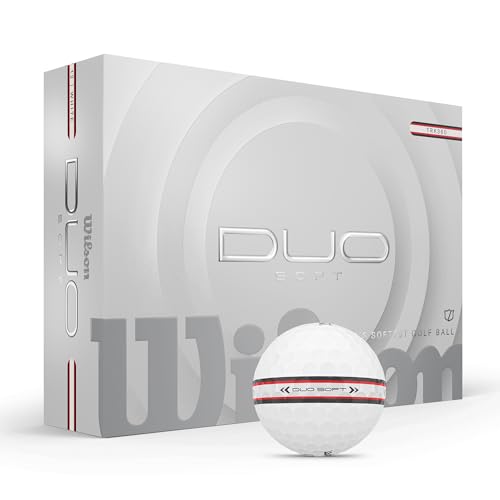
Wilson Duo Soft Golf Balls
Wilson markets the Duo Soft as one of the softest balls on the market, and for a young player that translates into a ball that launches easily without much clubhead speed. It is also priced sensibly, which matters when balls go missing regularly.
Pros
- Easiest ball here to compress
- Very soft feel builds confidence
- Sensible value for a lost ball budget
Cons
- Less control on full wedge shots
- Softer cover marks more easily

Srixon Soft Feel Golf Balls
The Soft Feel sits slightly firmer than the softest options, which suits juniors whose swing speed is climbing toward adult range. Srixon’s cover gives more greenside grab than most two piece balls, so a teenager working on short game gets useful feedback.
Pros
- More short game control than rivals
- Grows with an improving player
- Consistent flight in wind
Cons
- Too firm for very young beginners
- Slightly less soft off the putter

Titleist TruFeel Golf Balls
TruFeel is Titleist’s softest ball and brings recognisable brand quality control to a low compression construction. Juniors who care about putting feel often prefer it, and the consistency between balls in a box is a genuine advantage.
Pros
- Excellent putting feel for the category
- Very consistent from ball to ball
- Reliable straight flight
Cons
- Firmer than the softest junior balls
- Costs more than budget options

TaylorMade Soft Response Golf Balls
Soft Response is built around getting the ball airborne easily, which addresses the most common junior problem of low weak ball flight. The three piece construction adds a little more spin control than pure two piece designs.
Pros
- Helps young players get the ball airborne
- Three piece build adds control
- Soft feel on all shots
Cons
- Higher flight can suffer in wind
- More expensive than two piece rivals

Volvik Vivid Golf Balls
The Vivid uses a matte colour finish that young players find far easier to track in the air and locate in rough. That sounds trivial until you count how many balls a junior round loses, and the low compression core suits their swing speed too.
Pros
- Genuinely easier to see and find
- Fun colours keep juniors engaged
- Decent distance for the compression
Cons
- Matte finish shows dirt quickly
- Firmer than the softest options here

Pinnacle Rush Golf Balls
Pinnacle Rush comes in large packs aimed at players who lose balls, which describes most juniors learning the game. Feel is firmer than the soft options, but for a beginner hitting into water and trees the value equation makes sense.
Pros
- Very low cost per ball in bulk
- Durable cover survives cart paths
- Good distance for beginners
Cons
- Firm feel on and around the green
- Little spin control on approach shots
The lineup, side by side
| # | Model | Compression | Best for | Score | Price |
|---|---|---|---|---|---|
| 1 | Callaway Supersoft Golf Balls | Very low, around 38 | Best overall | 9.4 | Check price |
| 2 | Wilson Duo Soft Golf Balls | Extremely low, around 35 | Best value | 9.1 | Check price |
| 3 | Srixon Soft Feel Golf Balls | Low, around 60 | Best for improving players | 8.9 | Check price |
| 4 | Titleist TruFeel Golf Balls | Low, around 60 | Best for feel around the green | 8.7 | Check price |
| 5 | TaylorMade Soft Response Golf Balls | Low, around 35 to 40 | Best for higher launch | 8.5 | Check price |
| 6 | Volvik Vivid Golf Balls | Low, around 70 | Best for visibility | 8.3 | Check price |
| 7 | Pinnacle Rush Golf Balls | Mid, around 70 | Best budget option | 8.0 | Check price |
Frequently asked questions
What compression should a junior golfer use?
Look for balls rated below around 60, and ideally in the 30s or 40s for younger children. Lower compression matches the slower clubhead speeds juniors generate.
Are junior specific golf balls necessary?
Not really. A few brands market junior balls, but a mainstream low compression ball like the Callaway Supersoft does the same job with better quality control.
Do coloured golf balls perform differently?
The colour itself makes no meaningful performance difference. Matte finishes can feel marginally different off the putter, but the real advantage is tracking the ball in flight.
How many balls should a junior carry?
Six or more per round is realistic while they are learning. This is exactly why value packs like the Pinnacle Rush make sense early on.
When should a junior switch to a firmer ball?
Once driver swing speed climbs past roughly 85 miles per hour, or when the player consistently controls wedge distances. Until then a soft ball goes further.
Do soft balls really add distance?
For slow swings, yes, because the player can compress the core. For fast swings the effect reverses, which is why adult low handicappers use firmer balls.
Are used or refurbished balls fine for juniors?
Lake balls are a reasonable option for practice, though water damage affects performance unpredictably. For competitive rounds a fresh soft ball is more consistent.
Does the ball matter more than the clubs?
The clubs matter more overall, particularly shaft flex and length. But the ball is the cheapest single change that produces a noticeable improvement in distance and feel.
The verdict
The Callaway Supersoft is the ball to hand a junior golfer, because its very low compression turns a slow swing into real distance without feeling harsh. Choose the Wilson Duo Soft for the youngest and slowest swings, and move up to the Srixon Soft Feel once the player starts caring about what happens around the green.


