GPS Navigation Units Compared: Screens, Maps, Alerts
The Garmin DriveSmart 76 is our top GPS navigation unit, pairing a bright 7 inch screen with voice control and live traffic. The Garmin Drive 53 is the sensible value pick for everyday driving, and the TomTom GO Discover is the strongest alternative if you prefer TomTom mapping.
The Garmin DriveSmart 76 is the GPS navigation unit we would fit in most cars, with the Garmin Drive 53 as the value option and the TomTom GO Discover for drivers who prefer TomTom’s routing. Each keeps working where phone signal does not, which is still the main reason to own one.
The choice is trickier than it looks because the units split by vehicle type rather than by price. A car unit will happily route a 13 foot high motorhome under an 11 foot bridge, and a trucking unit adds regulations a car driver will never need. We ranked these on screen size and readability, offline map coverage, how traffic data arrives, vehicle profile support and what owners report about mount stability.
Our top picks
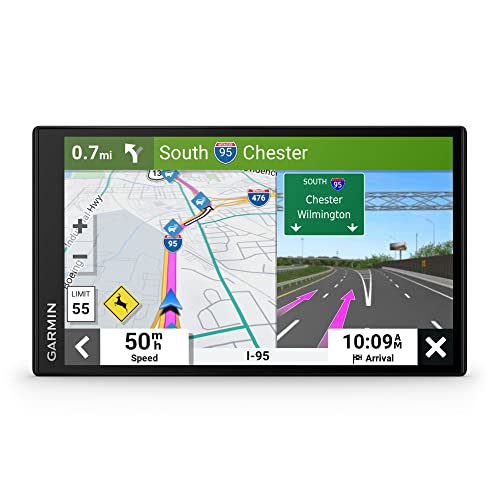
Garmin DriveSmart 76
The DriveSmart 76 is the balanced choice: a 7 inch high resolution display that stays readable in daylight, voice control so you can set a destination without touching it, and live traffic through the Garmin Drive app on your phone. It also pushes driver alerts for sharp curves, speed changes and school zones. Owners report the larger screen is the single upgrade they notice most over a 5 inch unit.
Pros
- Large, bright display that beats a phone mount
- Voice control works without touching the unit
- Free lifetime map updates
Cons
- Needs a paired phone for live traffic
- 7 inch body takes real windscreen space

Garmin Drive 53
The Drive 53 strips away voice control and Bluetooth calling but keeps the things that matter for daily driving: preloaded maps, a clear 5 inch display, driver alerts and TripAdvisor points of interest. It is the unit to buy if you want reliable offline navigation and nothing else. Based on specifications it covers the same map region as units costing considerably more.
Pros
- Straightforward and quick to learn
- Compact enough for a small windscreen
- Free map updates included
Cons
- No voice control or hands-free calling
- 5 inch screen is small for older eyes
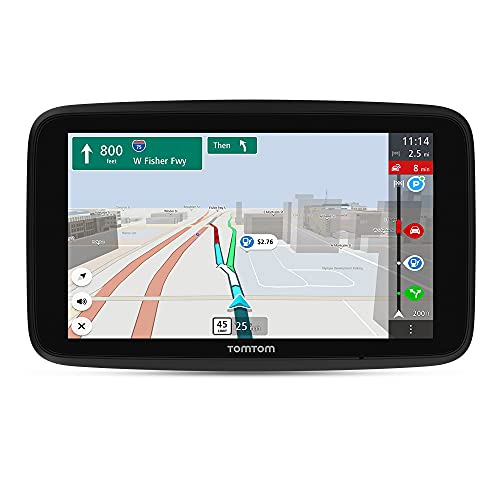
TomTom GO Discover
The GO Discover updates maps and software over its own Wi-Fi connection rather than a computer, which removes the most annoying part of owning a GPS unit. TomTom Traffic is well regarded for accurate arrival times, and the interface uses larger tap targets than Garmin’s. Owners report the world map option is useful for anyone who drives across borders.
Pros
- Updates over Wi-Fi with no computer needed
- Strong traffic and arrival time accuracy
- Large, legible interface
Cons
- Traffic service renews after the included period
- Fewer vehicle-specific profiles than Garmin
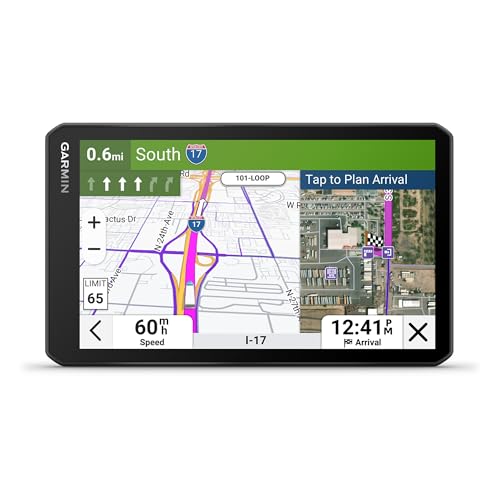
Garmin dezl OTR700
The dezl OTR700 routes by truck profile, accounting for height, weight, length and hazardous load restrictions, and adds a directory of truck-friendly stops and load-to-dock guidance. A 7 inch screen and custom truck alerts for bridge heights and sharp curves make it a working tool rather than a car accessory. Owners report the truck parking database is the feature they use daily.
Pros
- Routing respects legal truck restrictions
- Extensive truck stop and service data
- Clear warnings for low clearances
Cons
- Overkill for ordinary car drivers
- Truck data needs regular updating

Garmin RV 795
The RV 795 takes your motorhome or trailer dimensions and routes around low bridges, tight turns and weight-restricted roads, which a car unit will never do. It includes campground directories from major RV networks plus a driving-and-arrival planner for long trips. Based on specifications it is the safest choice for anyone driving anything taller than a van.
Pros
- Avoids clearance and weight hazards
- Built-in campground listings
- Voice control included
Cons
- A bigger outlay than an equivalent car unit
- Profile must be set accurately to be useful

Garmin DriveCam 76
The DriveCam 76 is essentially the DriveSmart 76 with an integrated dash cam, which removes a second device and a second power cable from the windscreen. It records loop footage, saves incident clips automatically and adds forward collision and lane departure warnings. Owners report the combined unit is neater but that a dedicated dash cam still records better night footage.
Pros
- One mount and one cable instead of two
- Automatic incident clip saving
- Full DriveSmart navigation feature set
Cons
- Night video trails dedicated dash cams
- Camera angle is tied to navigation viewing angle

Garmin Overlander
The Overlander is built for tracks rather than tarmac, with a rugged housing, topographic mapping, public land boundaries and offline trail data for overlanding and remote travel. It handles on-road navigation too, including RV size profiles, so it doubles as a highway unit between trailheads. This is a specialist tool with a specialist outlay, so it only makes sense if you genuinely leave paved roads.
Pros
- Genuinely useful off pavement
- Rugged, water resistant build
- Works as a road unit as well
Cons
- Highest outlay in this group
- Feature set is wasted on pure road drivers
The lineup, side by side
| # | Model | Screen | Best for | Score | Price |
|---|---|---|---|---|---|
| 1 | Garmin DriveSmart 76 | 7 inch capacitive touchscreen | Best overall | 9.4 | Check price |
| 2 | Garmin Drive 53 | 5 inch touchscreen | Best value | 9.2 | Check price |
| 3 | TomTom GO Discover | 6 or 7 inch HD touchscreen by version | Best alternative mapping | 9.0 | Check price |
| 4 | Garmin dezl OTR700 | 7 inch touchscreen | Best for truck drivers | 8.8 | Check price |
| 5 | Garmin RV 795 | 7 inch touchscreen | Best for RVs and towing | 8.6 | Check price |
| 6 | Garmin DriveCam 76 | 7 inch touchscreen | Best with a dash cam | 8.3 | Check price |
| 7 | Garmin Overlander | 7 inch rugged glass touchscreen | Best for off-road use | 8.0 | Check price |
How to choose
Pick the unit that matches your vehicle first The single biggest mistake is buying a car unit for a tall or heavy vehicle. Car navigation has no idea your motorhome is 12 feet high or your rig weighs 40 tons, and it will route you into a bridge strike or a weight-restricted road. If you drive an RV, tow a tall trailer or drive commercially, start with the dezl or RV models and treat everything else as out of scope.
Screen size changes the experience more than any spec sheet feature Owners consistently report the jump from a 5 inch to a 7 inch display is the upgrade they notice, because junction views, lane guidance and street names become readable at a glance. Balance that against windscreen real estate and local laws on obstruction. A 6 inch unit is a good compromise in a smaller car.
Understand how maps and traffic actually get updated Garmin units generally update maps through a computer or the Garmin Drive app, and free lifetime map updates are common. TomTom’s GO Discover downloads over its own Wi-Fi, which many owners find simpler. Live traffic varies too: some units use a paired phone’s data connection, others use a built-in receiver. Check which method suits how you drive before buying.
A GPS unit earns its place where phones struggle Phone navigation is excellent with signal and a charged battery. A dedicated unit wins in rural dead zones, on long drives where the phone is needed for calls, in vehicles where you want the phone out of reach, and for anything needing size-aware routing. Buy one for those reasons, not because it does something a phone cannot do in a city.
Good to know
Do GPS navigation units still work without internet or cell service?
Yes, and that is their main advantage. Maps are stored on the device and positioning comes from satellites, so routing works in canyons, deserts and rural areas with no signal at all. Only live traffic, weather and search suggestions need a data connection.
Are lifetime map updates really free?
On most current Garmin car units, yes, for the useful life of the device. Traffic services and speed camera databases are more often subscription based, and TomTom typically includes a traffic period that renews later. Read the specific listing rather than assuming, because terms differ by model.
How accurate are the arrival time estimates?
With live traffic connected, both Garmin and TomTom are usually within a few minutes on a typical commute. Without traffic data, estimates are based on posted speed limits and will run optimistic in rush hour. TomTom in particular is well regarded by owners for arrival accuracy.
Can I use a car GPS unit in an RV?
You can, but you should not rely on it. A car unit does not know your height, weight or length, so it will route under low bridges and down roads too tight to turn. The Garmin RV 795 exists precisely because that gap causes real damage.
Suction mount or adhesive mount?
Suction cups are the norm and work fine on clean glass, though they let go in extreme heat or cold. Owners who have that problem switch to a dashboard adhesive disc or a friction-weighted dash mount. Clean the glass with alcohol before mounting and press firmly, which fixes most complaints.
Do these units get speed camera and red light warnings?
Many do, either built in or as a database you subscribe to. Availability and legality vary by region, so check local rules. Driver alerts for school zones, sharp curves and sudden speed limit drops are standard on the Garmin picks here regardless.
Is a combined navigation and dash cam unit a good idea?
It is tidy, and the Garmin DriveCam 76 does both competently. The trade is that the camera has to point where the navigation screen is comfortable to view, and dedicated dash cams still record better in low light. If dash cam footage matters for insurance, keep them separate.
How long do these devices last?
Owners commonly report five to eight years of use, with the internal battery being the first thing to weaken. That matters little since the unit runs from vehicle power anyway. The bigger limit is when the manufacturer stops publishing map updates for that model generation.
Our pick
For everyday car use the Garmin DriveSmart 76 is the unit to buy, with a screen and voice control that make it easier to live with than a phone on a vent mount. The Garmin Drive 53 covers the same core job for less, and the TomTom GO Discover is worth a look for its Wi-Fi updates. Anyone driving an RV or a truck should skip the car units entirely and go straight to the RV 795 or the dezl OTR700.


