What Heater Keeps a Greenhouse Warm All Winter?
The Bio Green Palma is the overall pick because it is built for damp greenhouse air and moves heat evenly. Smaller hobby houses do well with the Vornado VH200. Growers with no power run to the plot should choose the Mr. Heater MH9BX Buddy instead.
A frost-free greenhouse needs a heater built for humid growing spaces, not a dry living room, which is why the Bio Green Palma leads this list. Small hobby houses with a nearby socket do well with the Vornado VH200. Plots with no electricity at all should look at the Mr. Heater MH9BX Buddy.
Heating a greenhouse differs from heating a room because the enclosure is poorly insulated, constantly damp, and full of surfaces that scorch easily. A heater fine in a bedroom can corrode within a season, and an undersized unit runs nonstop without ever catching up on a cold night. We compared seven widely available heaters on output, thermostat control, moisture and safety design, and what growers report after a full winter of use.
The top picks, ranked

Bio Green Palma Greenhouse Heater
Few heaters are actually designed for greenhouse conditions, but this one carries a splash-protected housing and a stainless steel element built to tolerate constant humidity. Fan-only operation circulates air in warmer months, reducing fungal problems, then switches to heating when the thermostat calls for it. Growers report it holds a set temperature closely, which matters more than peak output.
Pros
- Designed for humid greenhouse air
- Fan only mode circulates air year round
- Accurate thermostat holds temperature well
Cons
- Needs a proper outdoor rated power supply
- Costs more than a general purpose heater

Vornado VH200 Whole Room Heater
Vortex airflow circulates an entire small greenhouse’s volume of air instead of blasting a hot spot at nearby leaves. Automatic safety shutoff and a cool-touch case make it safer around plastic sheeting and trays. Growers report 1500 watts only stretches so far, so this suits compact hobby houses rather than large or leaky structures.
Pros
- Circulates air rather than creating hot spots
- Cool touch housing near plastic and trays
- Quiet enough for an attached greenhouse
Cons
- Not moisture rated, needs a dry raised position
- Underpowered for larger structures
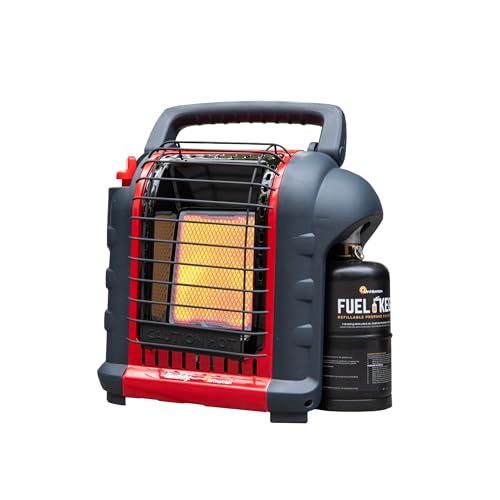
Mr. Heater MH9BX Buddy Portable Propane Heater
Propane is the practical answer for allotment greenhouses with no power run, and this remains the most widely used portable unit of its type. An oxygen depletion sensor and tip-over shutoff back a one-pound cylinder or a larger tank via hose kit. Growers report it warms a small space quickly, though combustion adds moisture and needs deliberate ventilation.
Pros
- Works where there is no electricity
- Heats a small space quickly
- Proven safety cut offs built in
Cons
- Combustion adds humidity and needs ventilation
- Fuel must be monitored and replaced

Lasko 754200 Ceramic Space Heater
Low cost and easy replacement explain why this small ceramic heater ends up in so many hobby greenhouses. An adjustable thermostat, two heat settings and overheat protection fit into a body light enough for a bench shelf. Growers report it keeps very small structures above freezing, though it lacks moisture protection and needs splash-free placement.
Pros
- Very affordable entry point
- Small enough to fit on a shelf
- Simple dial control with no menus
Cons
- No moisture protection at all
- Thermostat is approximate rather than precise
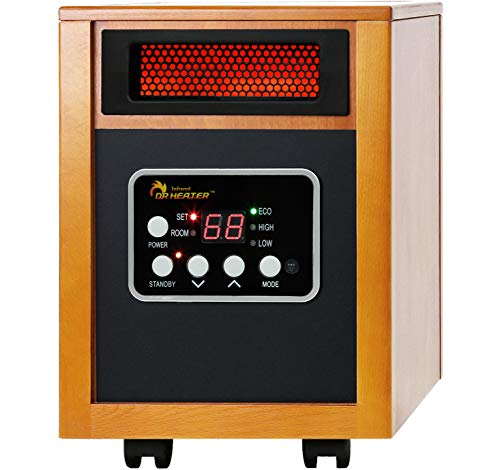
Dr. Infrared Heater DR-968 Portable Space Heater
Infrared and convection heating combine with a large low-speed fan, producing gentler and more even warmth than a small ceramic heater running flat out. A digital thermostat holds its set point closely while the cabinet stays cool to the touch. Growers report good results in attached or well-sealed greenhouses, though the wood-effect cabinet is not built for wet environments.
Pros
- Even warmth without a harsh hot spot
- Accurate digital thermostat
- Quiet at its usual running speed
Cons
- Cabinet is not suited to damp conditions
- Bulkier than the other electric options

Comfort Zone CZ220 Fan-Forced Ceramic Heater
A wide oscillating spread distributes warmth across a bench rather than concentrating it in one corner. Overheat protection and a tip-over switch cover the basic safety requirements for this fan-forced ceramic unit. Growers report it works as a reasonable stopgap for seedlings on marginal nights, but not through a sustained hard freeze.
Pros
- Oscillation spreads heat along a bench
- Takes up very little bench space
- Inexpensive to add as a second heater
Cons
- Basic thermostat with limited precision
- Fan noise is noticeable in a small space

Simple Deluxe 1500W Ceramic Space Heater
Two smaller heaters positioned at opposite ends of a greenhouse often even out temperature better than one large unit, and this model is cheap enough to serve as that second heater. Two heat levels, a fan-only mode and adjustable thermostat control fit a compact housing. Growers report it handles supplementary heating well, provided each unit sits on a circuit that can carry the load.
Pros
- Cheap enough to run as a paired unit
- Fan only mode useful in shoulder seasons
- Light and easy to reposition
Cons
- Build quality is basic
- Two units on one circuit will trip a breaker
The lineup, side by side
| # | Model | Output | Best for | Score | Price |
|---|---|---|---|---|---|
| 1 | Bio Green Palma Greenhouse Heater | Up to 1500 watts | Best overall | 9.4 | Check price |
| 2 | Vornado VH200 Whole Room Heater | 1500 watts | Best for small greenhouses | 9.2 | Check price |
| 3 | Mr. Heater MH9BX Buddy Portable Propane Heater | 4000 to 9000 BTU | Best without power | 9.0 | Check price |
| 4 | Lasko 754200 Ceramic Space Heater | 1500 watts | Best budget | 8.8 | Check price |
| 5 | Dr. Infrared Heater DR-968 Portable Space Heater | 1500 watts | Best for even warmth | 8.6 | Check price |
| 6 | Comfort Zone CZ220 Fan-Forced Ceramic Heater | 1500 watts | Best compact option | 8.3 | Check price |
| 7 | Simple Deluxe 1500W Ceramic Space Heater | 1500 watts | Best backup heater | 8.0 | Check price |
How to pick the right one
Size the heater to volume and glazing, not floor space Greenhouse volume, the temperature gap you need to maintain, and how much heat the glazing loses all factor into the right output. Single-layer glass or thin polythene loses heat far faster than twin-wall polycarbonate, so identically sized houses can need very different wattage. A 1500 watt electric heater suits small hobby greenhouses; larger structures usually need higher output, two heaters positioned apart, or a propane system.
Electric or propane comes down to power access Electric heaters run cleaner, produce no moisture, and can be left unattended behind a thermostat, making them the default wherever a safe outdoor-rated supply exists. Propane units like the Mr. Heater MH9BX answer the question for plots with no electricity, but combustion produces water vapor and consumes oxygen, so ventilation is never optional. An unvented combustion heater should never run in a sealed greenhouse.
Moisture is what kills ordinary space heaters High humidity, regular watering and condensation define greenhouse conditions, and standard living room heaters have no protection against any of it. Corrosion inside the element or controls is the usual failure mode. General-purpose units like the Lasko or Vornado should sit raised on a dry shelf, clear of the watering line, and run from a GFCI-protected outdoor-rated circuit.
Thermostat accuracy beats maximum output Holding a minimum temperature matters more in most greenhouses than producing peak heat. A precise thermostat cycles on and off around the set point and uses far less power over a season than a powerful unit with a vague dial that overshoots. A separate plug-in thermostat upgrades heaters with basic controls cheaply, and a max/min thermometer confirms whether the setting is actually working.
Frequently asked questions
What temperature should a greenhouse stay at in winter?
It depends on what is being overwintered. Keeping a house just frost free, around 40 degrees Fahrenheit, protects dormant plants at the lowest running cost. Tender plants and active growing usually need 50 degrees or more, which raises costs considerably because the temperature gap being maintained grows larger.
How many watts does a greenhouse heater need?
A single 1500 watt heater often serves small hobby greenhouses of roughly 6 by 8 feet in a mild climate. Larger houses, poorly sealed frames or severe winters need more. Doubling the glazing with bubble insulation reduces the requirement significantly, usually more cheaply than buying a bigger heater.
Is it safe to run a propane heater in a greenhouse?
Only with deliberate ventilation. Propane combustion consumes oxygen and produces water vapor and carbon monoxide, so a unit like the Mr. Heater MH9BX needs a vent or opening exactly as the manufacturer specifies. It should never run overnight in a sealed structure, and a carbon monoxide alarm is worth installing.
Can a normal indoor space heater work in a greenhouse?
Many growers do use one, with precautions. Keeping the unit off the ground and away from watering, using a GFCI-protected outdoor-rated supply, and accepting a shorter lifespan from damp air are the tradeoffs. Purpose-built units like the Bio Green Palma seal against splashes and last much longer in that environment.
Should a greenhouse heater run all night?
Not continuously, if the thermostat is working correctly. It should cycle on when temperature falls to the set point and off once it recovers. A heater running nonstop on a normal cold night signals it is undersized for the space, or that the greenhouse is losing heat faster than it should.
Does insulating a greenhouse reduce heating costs?
Substantially. Lining the inside with bubble insulation, sealing gaps around doors and vents, and adding thermal mass like water barrels all cut how often the heater runs. Insulation is generally the cheapest available improvement, and it lowers running costs every winter rather than once.
Where is the best spot to place a greenhouse heater?
Off the floor where possible, away from direct watering, and positioned so airflow crosses the length of the house rather than blowing straight onto plants. Leaves sitting directly in a hot airstream dry out and scorch. Keep clearance around the unit per its manual, and route the cord away from standing water.
Do greenhouse heaters need a special power supply?
They need an outdoor-rated, GFCI-protected circuit sized for the load. A 1500 watt heater draws around 12.5 amps at 120 volts, most of a standard household circuit, so two on one circuit will trip the breaker. Extension leads should be heavy duty and outdoor rated.
Best greenhouse heater for a plot with no electricity?
The Mr. Heater MH9BX Buddy is the practical choice for off-grid plots, running on propane cylinders instead of a power line. Ventilation still needs planning into the setup from day one, since combustion heaters add humidity and consume oxygen.
The verdict
The Bio Green Palma is worth choosing for any greenhouse used seriously through winter, since it is built for damp air and holds a set temperature rather than swinging around it. Small hobby houses with power nearby get even warmth for less from the Vornado VH200. Growers without electricity should plan around the Mr. Heater MH9BX Buddy and build ventilation into the setup from the start.


