How to Pick a Grill Thermometer That Reads Fast and True
ThermoWorks Thermapen ONE tops this list for one second reads and tight accuracy. Long, unattended cooks favor the MEATER Plus, since its wireless probe stays in the meat without a cable. Budget-focused grillers get most of that speed from the ThermoPro TP19H at a fraction of the outlay.
ThermoWorks Thermapen ONE leads these seven picks, with the MEATER Plus built for unattended long cooks and the ThermoPro TP19H covering everyday grilling on a modest outlay. Together they cover the two real jobs a griller has: spot checking and monitoring.
This category gets confusing because brands quote accuracy and speed under lab conditions a hot grill lid never matches. A probe reading two degrees high will overcook a steak every time. We compared published tolerances, response times, probe construction and owner reports to rank these seven.
What to look for
Instant read or leave-in probe: which do you need? Most serious grillers eventually own both tools. An instant read thermometer is for spot checking, so speed and accuracy matter most while the lid stays open a few seconds. A leave-in probe stays in the meat for hours, reporting to a display or phone, which suits a brisket or pork shoulder. Buying the wrong type for the job is the most common mistake in this category.
How much does read speed actually matter? A thermometer that takes ten seconds to settle means ten seconds of open lid and lost heat. Fast units use thin thermocouple tips that respond almost instantly. Slower thermistor probes cost less to build but lag behind. Checking several spots on a large cut before the temperature shifts is the real benefit of speed.
How accurate and well-calibrated does a probe need to be? Stated tolerances usually fall between half a degree and two degrees Fahrenheit. That number only holds if the probe is calibrated, and probes drift with age. An ice water test is the simple check: a slush of ice and water should read close to freezing. A reading off by more than a degree or two means food safety decisions are resting on bad data.
What limits wireless thermometer range at the grill? Bluetooth models need you fairly close, and thirty to fifty meters in open air shrinks fast through walls. Fully wireless probes, like the MEATER family, lose signal through the metal of the grill itself, which is why a charging block doubles as a repeater. Monitoring a cook from inside the house calls for a model with a dedicated bridge or wifi, not plain Bluetooth.
The top picks, ranked

ThermoWorks Thermapen ONE
A reading appears in about one second, tighter and faster than anything else in this group. Accuracy is rated within 0.5 degrees Fahrenheit, which explains its presence in professional kitchens. The backlit display rotates automatically and wakes as soon as the probe unfolds.
Pros
- Fastest, most accurate reads here
- Genuinely splash and dust resistant
- Holds calibration over years of use
Cons
- Premium outlay for a spot check tool
- No logging or remote monitoring

ThermoPro TP19H Instant Read Thermometer
A thermocouple probe reads in two to three seconds, just behind the premium pick. Accuracy is rated within 0.9 degrees Fahrenheit, plenty close for grilling decisions. A magnetic back and hanging hook keep it within reach at the grill.
Pros
- Near-premium performance for far less
- Magnet keeps it stuck to the grill lid
- Bright backlight suits evening cooks
Cons
- Slightly slower than the Thermapen ONE
- Battery door feels fiddly

Lavatools Javelin PRO Duo
An oversized backlit screen sits on a compact body, readable at arm’s length through grill smoke. The folding stainless probe locks firmly, with no flex when pushed through a thick roast. A built-in magnet holds it to metal surfaces near the grill.
Pros
- Largest readout in this group
- Solid probe hinge with no play
- Compact enough for an apron pocket
Cons
- Not as fast as the top-rated pick
- Splash resistant rather than fully sealed

MEATER Plus Wireless Meat Thermometer
A single stainless probe houses the entire sensor, so no cable trails out from under the lid. Internal and ambient sensors both report to a phone app, which estimates remaining cook time. A wooden charging block extends Bluetooth range between probe and phone.
Pros
- No cable running under the grill lid
- Works in a rotisserie or oven
- App gives a useful cook time estimate
Cons
- One probe tracks one piece of meat at a time
- Range drops through brick and metal walls
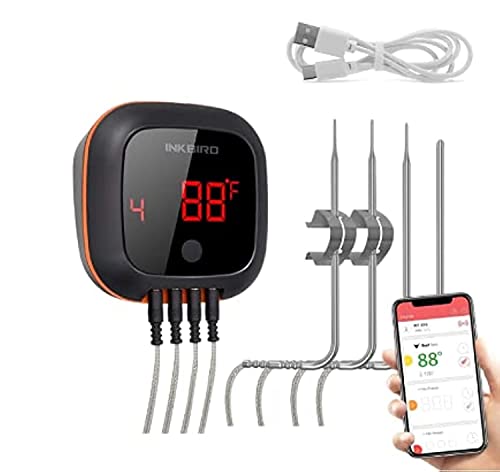
Inkbird IBT-4XS Bluetooth Thermometer
Four probe ports track two cuts of meat and the grill chamber at once, matching how most low and slow cooks actually run. A rechargeable battery and magnetic body keep it fixed to a smoker for hours. App alarms fire per channel when a target temperature is reached.
Pros
- Monitors several probes simultaneously
- Rechargeable battery instead of disposables
- Configurable alarms on each channel
Cons
- Bluetooth only, so range is limited
- Probe cables need careful routing

Weber iGrill 2 Bluetooth Thermometer
A magnetic mount holds this unit to a Weber lid, feeding four probe channels into the Weber app. An LED ring on the device shows progress without unlocking a phone. Standard AA batteries power it through a full season of weekend cooking.
Pros
- Neat integration with Weber grills
- Progress visible without opening the phone app
- Long battery life on standard AA cells
Cons
- App experience ties to one brand ecosystem
- Bluetooth range is modest

Govee Bluetooth Meat Thermometer
Dual probes, app alarms and preset doneness targets sit at the low end of the monitoring category. Accuracy suits roasts and smoked cuts rather than precision steak work. AAA batteries power the unit, and it stores compactly between cooks.
Pros
- Lowest outlay for app-based monitoring
- Presets help newer cooks judge doneness
- Compact and easy to store
Cons
- Accuracy trails the premium options
- Bluetooth range is short indoors
Side by side
| # | Model | Read time | Best for | Score | Price |
|---|---|---|---|---|---|
| 1 | ThermoWorks Thermapen ONE | About one second | Best overall | 9.4 | Check price |
| 2 | ThermoPro TP19H Instant Read Thermometer | Two to three seconds | Best value | 9.2 | Check price |
| 3 | Lavatools Javelin PRO Duo | Two to three seconds | Best display | 9.0 | Check price |
| 4 | MEATER Plus Wireless Meat Thermometer | Fully wireless single probe | Best wireless probe | 8.8 | Check price |
| 5 | Inkbird IBT-4XS Bluetooth Thermometer | Four channel capacity | Best for multiple probes | 8.6 | Check price |
| 6 | Weber iGrill 2 Bluetooth Thermometer | Four channel capacity | Best for Weber owners | 8.3 | Check price |
| 7 | Govee Bluetooth Meat Thermometer | Two channels | Best budget monitor | 8.0 | Check price |
Questions worth asking
What temperature should chicken reach on the grill?
Poultry needs a safe internal temperature throughout, commonly cited as 74 degrees Celsius or 165 Fahrenheit in the thickest part, away from bone. Check more than one spot on a whole bird.
How do you calibrate a grill thermometer?
Fill a glass with crushed ice, top with water, stir, and let it sit a minute. A probe inserted without touching the sides should read close to zero Celsius or 32 Fahrenheit. Some models allow an offset adjustment; others just confirm whether the reading can be trusted.
Can an instant read thermometer stay in the meat while it cooks?
No. Instant read units are not built for sustained grill heat, since the electronics sit right behind the probe. A dedicated leave-in probe is designed for that job instead.
Are wireless thermometers accurate enough for smoking?
Yes, for long cooks where you are tracking a trend over hours rather than a single precise moment. Many cooks still confirm the final temperature with an instant read probe before pulling the meat.
Where should a probe go in a thick cut of meat?
Aim for the thickest part of the muscle, away from bone, fat pockets and the grill grate. Bone conducts heat differently and gives a misleading reading, usually higher than the surrounding meat.
Can grill thermometers go in the dishwasher?
Almost never. Probes and bodies should be wiped clean by hand, since dishwasher heat and detergent damage seals and shorten probe life even on water resistant models.
How many probes do you actually need?
Two is enough for most cooks: one in the meat, one tracking grill chamber temperature. Four channels start to matter when several cuts with different target temperatures share one smoker.
Do grill thermometers work for oven roasting and deep frying too?
Instant read models handle both, and many list an upper range well above frying temperature. For deep frying, a long probe or clip keeps your hand away from hot oil.
Instant read vs wireless probe: which suits a quick weeknight grill session?
An instant read thermometer like the ThermoPro TP19H suits quick sessions best, since there is no app setup or pairing involved. Wireless probes earn their keep on longer, unattended cooks instead.
The bottom line
The ThermoWorks Thermapen ONE is worth owning outright, since a one second accurate read changes how confidently you cook everything. Long smoke sessions call for a leave-in probe instead, and the MEATER Plus handles those without a cable through the lid. A first thermometer on a modest outlay should be the ThermoPro TP19H.


