Which Pedalboard Fits Your Rig and Pedal Count?
For most players, the Pedaltrain Classic JR balances pedal count against tabletop footprint. Compact rigs and travel setups suit the Pedaltrain Nano+ instead. Players assembling a first board on a tight budget should start with the Donner DB-2. Mounting style and case type differ across all three, so match dimensions to your pedal count first.
Pedal count and leftover cable space decide whether a board earns its price. Most rigs land well with the Pedaltrain Classic JR, which balances both. Compact and travel setups fare better with the Pedaltrain Nano+, and the Donner DB-2 covers a first build without heavy spending.
Board listings state dimensions in inches, yet pedal footprints vary enough that a ten pedal rating might only fit six oversized units. We compared stated dimensions, mounting systems and owner reports on cable routing and case durability to rank these seven boards.
The best picks, ranked

Pedaltrain Classic JR
Aircraft-grade aluminum keeps this 24 by 12.5 inch board light for its pedal capacity. Up to ten standard compact pedals fit across the hook and loop top surface. A padded soft tour case with backpack straps ships in the box for transport.
Pros
- Raised frame leaves clearance for a power supply underneath
- Aircraft-grade aluminum keeps total weight low for the footprint
- Backpack straps on the tour case simplify carrying to gigs
Cons
- Hook and loop top wears down after frequent pedal swaps
- Soft case offers no hard shell protection for checked travel

Pedaltrain Nano+
Four to six compact pedals fit this 17 by 9 inch aluminum rail board, depending on pedal size. Two underside rails let a small power supply zip tie out of sight. A padded soft case with a shoulder strap ships along with the board.
Pros
- Compact footprint slides into a backpack alongside other gear
- Underside rails hide a small power supply from view
- Low overall weight suits carry on air travel
Cons
- Limited space rules out larger multi-effects units
- No room remains for a second pedal row
Donner DB-2
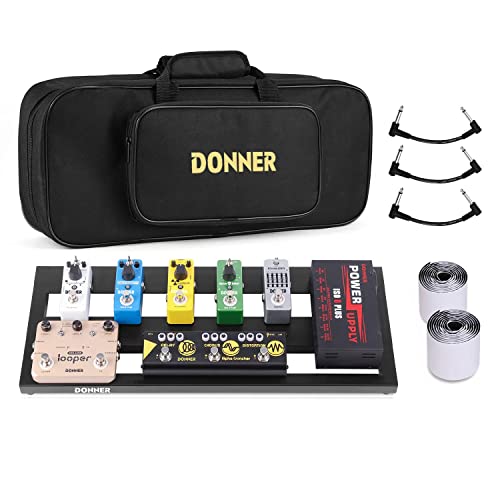
Aluminum alloy construction targets players assembling a first pedal chain. Hook and loop strips across the top mount up to six pedals. A zippered carrying bag ships in the box at no added cost.
Pros
- Low cost of entry for a first pedalboard
- Zippered bag included without a separate purchase
- Light enough to carry beside a guitar case
Cons
- Smaller surface than boards built for larger rigs
- Bag padding offers little protection against impact

Boss BCB-60
Fixed spacing on this board matches Boss compact pedal footprints exactly, holding up to six pedals. A hard shell case doubles as the base and closes over the pedals for transport. Internal cable channels route patch cables out of sight.
Pros
- Hard shell base protects pedals during transport
- Internal channels keep patch cables tidy and hidden
- Layout matches Boss compact pedal spacing exactly
Cons
- Fixed layout limits pedals from other brands
- Heavier than open frame aluminum boards

Temple Audio Design Trio 28
Removable mounting plates replace adhesive Velcro, so pedals bolt on instead of sticking down. Rearranging the board never wears through a top surface this way. An aluminum honeycomb deck spans 28 by 12.6 inches, with cable ports along the edge routing wiring underneath.
Pros
- Plate mounting survives frequent pedal rearranging
- Edge cable ports route wiring underneath the deck
- Honeycomb deck sheds weight without losing rigidity
Cons
- Case is sold separately and adds to the cost
- Plate system costs more than adhesive hook and loop boards
RockBoard DUO 2.0
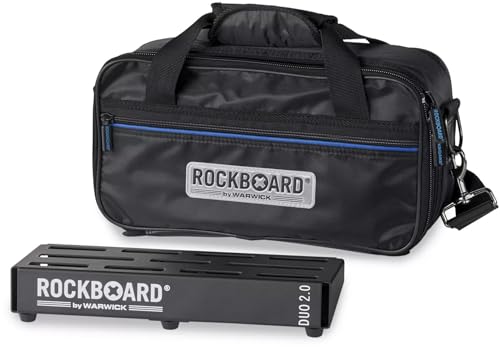
Two riser tiers separate front and rear pedal rows so every knob stays reachable. Hook and loop strips secure pedals across both levels. A padded flight style gig bag with backpack straps ships in the package.
Pros
- Tiered risers keep every pedal knob accessible
- Included gig bag matches the board size exactly
- Powder coating resists scuffs during regular use
Cons
- Tiered design adds height compared to flat boards
- Gap between risers can trap loose cable slack

Mono Pedalboard Small with Stealth Case
A rigid Stealth case wraps around this small format board, built for gear checked as luggage. A shelf underneath the deck holds a power supply out of the signal path. Interior straps keep the board secure once the case closes for transport.
Pros
- Rigid case withstands baggage handling on flights
- Underneath shelf hides the power supply completely
- Interior straps stop the board shifting in transit
Cons
- Rigid case adds noticeable weight over soft bags
- Bulkier profile than open frame travel boards
Compared at a glance
| # | Model | Board Material | Best for | Score | Price |
|---|---|---|---|---|---|
| 1 | Pedaltrain Classic JR | Aircraft-grade aluminum | Best overall | 9.4 | Check price |
| 2 | Pedaltrain Nano+ | Aluminum rail frame | Best for small setups and travel | 9.2 | Check price |
| 3 | Donner DB-2 | Aluminum alloy | Best budget | 8.9 | Check price |
| 4 | Boss BCB-60 | Molded hard shell base | Best for Boss compact pedal chains | 8.6 | Check price |
| 5 | Temple Audio Design Trio 28 | Aluminum honeycomb deck | Best tool free mounting system | 8.3 | Check price |
| 6 | RockBoard DUO 2.0 | Powder-coated aluminum | Best value with included gig bag | 8.1 | Check price |
| 7 | Mono Pedalboard Small with Stealth Case | Aluminum deck with rigid outer case | Best for touring protection | 8.0 | Check price |
Before you buy
How do you choose the right pedalboard size? Start with pedal count, not a board name on a shelf. A five pedal chain, such as tuner, overdrive, delay, reverb and volume, fits a board in the 12 by 6 inch range. Modulation, loopers and multiple drives need 24 inches or more of surface length. Riser tiers, like those on the Pedaltrain Classic JR, add a second row without extending the footprint.
Hook and loop plates vs adhesive Velcro: which mounting lasts longer? Adhesive hook and loop strips grip well at first, then lose hold after repeated pedal swaps, especially in heat. Temple Audio Design boards swap that setup for bolt-on mounting plates, so pedals attach to a plate rather than the board surface. That system costs more upfront but survives more rearranging over time. Standard Velcro boards stay the cheaper, faster option for players who rarely change their signal chain.
Do you need a hard case or a soft gig bag for a pedalboard? Hard cases, like the one bundled with the Mono Pedalboard, protect against baggage handling and stacked gear in a van. Soft gig bags, included with boards like the RockBoard DUO 2.0, cut weight and cost but absorb less impact. Local gigs and home practice rarely need more than a padded soft case. Touring musicians checking gear as luggage benefit from a rigid shell instead.
Which pedalboard works best for small setups and travel rigs? A four or five pedal travel rig benefits from a compact frame under two pounds, such as the Pedaltrain Nano+. Boss only chains fit neatly on purpose built boards like the BCB-60, matched to Boss compact pedal spacing. Larger aluminum frame boards add unused space and extra weight for a small pedal count. Match board size to pedal count first, then leave room for future additions.
Questions worth asking
What size pedalboard do I need for 5 pedals?
Five standard compact pedals plus a tuner typically fit a board around 12 by 6 inches. Add a few extra inches of length if one pedal is an oversized multi-effects unit.
Is a hard case pedalboard worth the extra weight?
For air travel or shared van transport, a hard case guards against crushing and drops. Home or local gig use rarely justifies the added bulk.
Can a power supply fit under a pedalboard?
Many raised frame boards, including the Pedaltrain Classic JR, leave clearance underneath for a power supply. Low profile boards may need the supply mounted on top or beside the board instead.
Pedaltrain vs RockBoard: which is better for most players?
Pedaltrain boards favor a simple aluminum rail frame with a hook and loop top. RockBoard boards add tiered risers and often bundle a padded gig bag at a similar size.
How much weight can a pedalboard hold?
Aluminum frame boards typically support a full pedal chain plus a power supply without sagging. Check the listed pedal capacity rather than a weight rating, since most manufacturers spec by pedal count.
Do pedalboards come with patch cables included?
Most boards ship with mounting hardware and a case but not patch cables. Cables are sold separately and sized to the gap between each pedal.
What is hook and loop mounting on a pedalboard?
Hook and loop mounting uses a Velcro style top surface, so pedals attach and detach without screws. Temple Audio boards use a plate based variant that bolts to the board instead.
Are budget pedalboards durable enough for regular gigging?
Aluminum alloy budget boards, like the Donner DB-2, hold up to regular transport when packed in their included bag. Owners report the frame outlasting cheaper plastic boards under similar use.
The bottom line
Pedal count and board dimensions matter more than brand name when picking a pedalboard. The Pedaltrain Classic JR covers most home and gigging rigs, the Nano+ suits travel setups, and the Donner DB-2 works for a first budget build. Match mounting style and case type to how often the rig travels.