Guitar Tuners That Nail Pitch on a Loud Stage
The Snark ST-8 covers most players with a bright, fast clip-on display. Gigging guitarists switching between instruments want the Boss TU-3 pedal for its rugged true bypass. For setup level precision, the Peterson StroboClip HD reads pitch to a fraction of a cent.
The Snark ST-8 fits most players, clipping to the headstock with a bright screen that tracks a plucked string quickly. Gigging guitarists who swap between guitar and bass mid set do better with the Boss TU-3 pedal, which mutes the signal through a rugged true bypass. Anyone dialing in intonation on a workbench wants the Peterson StroboClip HD, whose strobe reads pitch far finer than a needle display.
Tuners diverge on accuracy, how they mount, and whether stage volume confuses them. Clip-on models read string vibration through the headstock, so they ignore surrounding noise, while pedals sit in the signal chain for silent stage tuning. We compared rated accuracy in cents, display readability under lights, calibration range and mounting, then weighed owner feedback on speed and durability.
What to look for
What to look for in a guitar tuner Three things decide the pick: accuracy, how it senses pitch, and where you use it. Accuracy is measured in cents, and most clip-on tuners land within a cent or so, which is fine for playing. Setup work wants a strobe like the Peterson, accurate to a fraction of a cent. A clip-on reads vibration and ignores noise, while a pedal sits in the signal path for silent stage tuning, so choose by setting.
Best tuners for the stage Live playing rewards two traits: silence and visibility. A pedal like the Boss TU-3 mutes your signal so the audience hears nothing while you tune between songs, and its bright LED cuts through stage lights. If you prefer a clip-on on stage, a low profile model such as the D’Addario NS Micro hides behind the headstock, keeping the look clean while still reading pitch reliably.
Tuners for practice, students and multiple instruments A player at home or in lessons benefits from a combined tuner and metronome like the Korg TM60, which builds timing while it checks pitch. Households with a guitar, bass, ukulele and violin want a wide calibration range and multiple modes, as the KLIQ UberTuner offers. For a quick full check before playing, a polyphonic tuner shows every off string in one strum.
Accuracy, calibration and when it matters For everyday playing, any accurate chromatic tuner keeps a guitar in tune with itself and the band. Adjusting intonation at the bridge is where fine resolution counts, since you are chasing tiny pitch errors up the neck, and a strobe tuner exposes them clearly. A wide calibration range also helps if you play alongside a piano or orchestra tuned to a reference other than 440 Hz.
What we recommend

Snark ST-8 Super Tight Clip-On Tuner
The ST-8 clips to the headstock and reads vibration through a piezo sensor, so background noise never fools it. A full color rotating screen stays readable from any playing angle, and it tracks a plucked string almost instantly. It handles guitar, bass and other stringed instruments, with a tap tempo metronome built in.
Pros
- Rotating screen readable at any angle
- Piezo sensor ignores room noise
- Fast lock on plucked strings
Cons
- Battery drains if left clipped on
- Clamp can loosen over heavy use

Boss TU-3 Chromatic Tuner Pedal
Housed in Boss’s famed metal chassis, the TU-3 sits on a pedalboard and mutes the signal for silent stage tuning. A bright 21 segment LED bar stays visible in daylight or under stage lights. It powers other pedals through its output and survives the abuse of constant touring, which is why it stays a stage standard.
Pros
- Silent muted tuning on stage
- Bright LED visible under lights
- Nearly indestructible metal housing
Cons
- Takes a pedalboard slot and power
- Less handy for quick acoustic tuning

Peterson StroboClip HD Tuner
This clip-on strobe tuner resolves pitch to a tenth of a cent, far finer than needle style tuners. Its high definition strobe display shows exactly how sharp or flat a string sits, ideal for setting intonation. Built in sweetened tunings compensate for the quirks of specific instruments, a feature techs and precise players rely on.
Pros
- Reads pitch to a tenth of a cent
- Sweetened presets suit specific instruments
- Ideal for intonation and setup work
Cons
- Strobe display takes practice to read
- Priciest option in this lineup

TC Electronic PolyTune Clip Tuner
Strum all six strings and the PolyTune Clip shows which ones are off at a glance, then switches to a precise chromatic mode for fine tuning. Its display auto orients to left or right handed guitars. A high quality piezo and bright screen make it a favorite for players who want a quick full check before a song.
Pros
- Polyphonic mode checks all strings fast
- Display flips for lefty guitars
- Precise chromatic mode for fine tuning
Cons
- Polyphonic mode needs an even strum
- Costs more than basic clip-ons
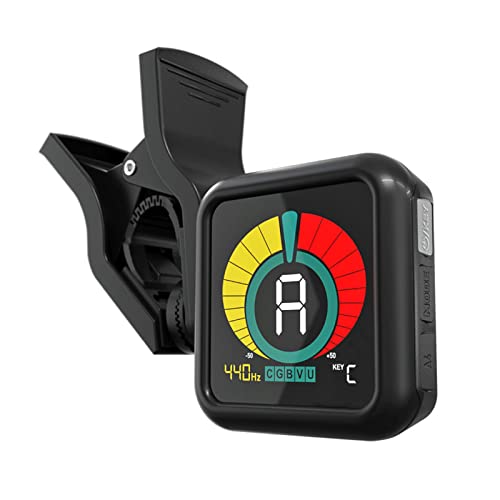
KLIQ UberTuner Clip-On Tuner
The UberTuner offers responsive tracking and a wide 410 to 480 Hz calibration range at a budget price. A full color display swivels 360 degrees for any viewing angle. It covers guitar, bass, violin, ukulele and chromatic modes, making it a flexible pick for a multi instrument household without a large outlay.
Pros
- Wide calibration and multiple modes
- Swiveling screen for any angle
- Strong accuracy for the price
Cons
- Plastic clamp less rugged than metal
- Auto off can cut mid tune
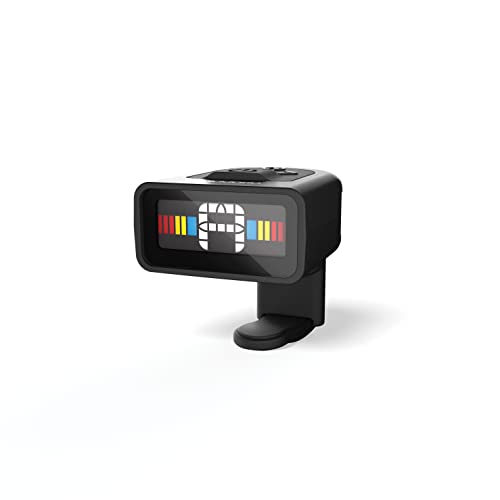
D’Addario NS Micro Clip-On Tuner
This tiny tuner mounts on the back of the headstock so it stays out of the audience’s view during a performance. Despite its size, a color display and piezo sensor deliver reliable tuning. Acoustic players who dislike a visible clip on stage favor how nearly invisible it looks from the front.
Pros
- Hides behind the headstock on stage
- Piezo sensor ignores room noise
- Very light and unobtrusive
Cons
- Small screen harder to read
- Tiny buttons fiddly to press

Korg TM60 Tuner Metronome
The TM60 combines a chromatic tuner and a metronome in one handheld unit, useful for students and orchestral players. A built in mic and input jack tune acoustic or plugged in instruments, while the metronome runs simultaneously. Its large display and simple layout make it a common recommendation for practice rooms and lessons.
Pros
- Tuner and metronome in one unit
- Mic and jack cover any instrument
- Runs both functions at once
Cons
- Mic tuning picks up room noise
- Not as fast as a clip-on for guitar
Side by side
| # | Model | Type | Best for | Score | Price |
|---|---|---|---|---|---|
| 1 | Snark ST-8 Super Tight Clip-On Tuner | Clip-on chromatic | Best overall | 9.2 | Check price |
| 2 | Boss TU-3 Chromatic Tuner Pedal | Pedal chromatic | Best for gigging | 9.1 | Check price |
| 3 | Peterson StroboClip HD Tuner | Clip-on strobe | Best for precision setups | 9.0 | Check price |
| 4 | TC Electronic PolyTune Clip Tuner | Clip-on polyphonic and chromatic | Best for fast strumming checks | 8.8 | Check price |
| 5 | KLIQ UberTuner Clip-On Tuner | Clip-on chromatic | Best value | 8.6 | Check price |
| 6 | D’Addario NS Micro Clip-On Tuner | Clip-on chromatic | Best low profile | 8.4 | Check price |
| 7 | Korg TM60 Tuner Metronome | Handheld tuner and metronome | Best for practice and lessons | 8.2 | Check price |
Frequently asked questions
What type of guitar tuner is most accurate?
Strobe tuners like the Peterson StroboClip HD are the most accurate, reading pitch to about a tenth of a cent. That precision matters most for setting intonation, while a standard clip-on is accurate enough for everyday tuning.
Are clip-on tuners good for electric guitar?
Yes. A clip-on reads string vibration through the headstock, so it works on electric guitars unplugged and ignores room noise. On a loud stage, a pedal tuner is often preferred for silent muted tuning.
Do I need a pedal tuner or a clip-on?
For home and casual play, a clip-on is cheaper and more convenient. For gigs, a pedal like the Boss TU-3 mutes your signal for silent tuning and survives touring, which is why stage players lean toward it.
What does chromatic tuner mean?
A chromatic tuner detects all twelve notes, not just standard guitar strings, so it handles alternate tunings, capos and other instruments. Nearly every tuner here is chromatic.
Can one tuner handle guitar and bass?
Most chromatic tuners cover both. Clip-ons like the Snark ST-8 and pedals like the Boss TU-3 read low bass notes fine, though a few very cheap tuners struggle with the lowest strings.
What is a polyphonic tuner?
A polyphonic tuner, such as the PolyTune Clip, lets you strum all strings at once and shows which ones are off in a single glance, then switches to a precise mode for fine tuning individual strings.
What is the standard tuning reference frequency?
Standard concert pitch is A at 440 Hz. Tuners with a calibration range let you shift that reference to match an orchestra or a piano tuned slightly differently.
Why does my guitar go out of tune quickly?
New strings stretch, temperature and humidity shift the neck, and worn nut slots can bind strings. Stretching new strings in and checking these factors helps more than blaming the tuner.
Do clip-on tuners work through a loud band?
Yes, because they sense vibration rather than sound, so surrounding volume does not confuse them. That is a key advantage of clip-on and pedal tuners over mic based ones in loud settings.
Our pick
The Snark ST-8 is the tuner most players should buy, pairing fast, noise proof tracking with a screen you can read at any angle for a modest price. Gigging guitarists should choose the Boss TU-3 pedal for silent stage tuning and touring durability, while anyone adjusting intonation needs the Peterson StroboClip HD, whose strobe exposes the tiny pitch errors a needle display hides.