What Makes a Hacksaw Cut Straight Through Metal?
Stanley FatMax high tension hacksaw wins for a rigid frame that holds real blade tension. Klein Tools 702-12 suits tradespeople cutting conduit overhead daily. Milwaukee’s compact hacksaw reaches tight spaces no full frame saw can enter. Each fills a different jobsite role.
Stanley FatMax high tension hacksaw, Klein Tools 702-12, and Milwaukee’s compact hacksaw stand out from this lineup for different reasons. One works as an all-purpose bench saw, one holds up to daily trade use, and one reaches spaces a full frame cannot.
Hacksaws look like commodity items, but frame stiffness determines how much tension a blade holds, and tension determines whether a cut runs straight or wanders. We compared frame rigidity, tensioning mechanisms, handle comfort under load, and whether each saw angles its blade for flush cuts, since those details decide how much effort a cut takes.
The best picks, ranked

Stanley FatMax High Tension Hacksaw
A stiff frame holds very high blade tension without flexing, keeping cuts tracking straight through steel bar. Spare blades store inside the frame itself, and a 45 degree blade position handles flush work. Grip comfort holds up well through longer cutting sessions.
Pros
- Rigid frame holds tension well
- Onboard spare blade storage
- Comfortable grip for long cuts
Cons
- Bulkier than compact models
- Tension knob needs a firm hand
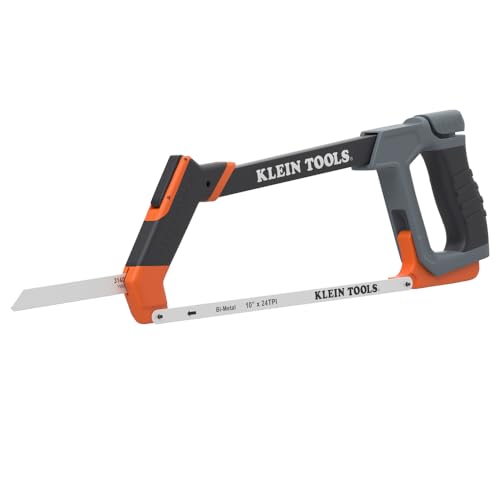
Klein Tools 702-12 Hacksaw
Electricians cutting conduit and threaded rod at awkward angles rely on this saw daily. A frame that resists twisting under load matters more on a working day than overall weight. Grip stays secure even with gloves on, according to owner reports.
Pros
- Built for daily jobsite abuse
- Secure grip even with gloves
- Frame resists twisting on awkward cuts
Cons
- Heavier than lightweight frames
- No onboard blade storage

Milwaukee Compact Hacksaw
Cutting depth gives way to access here, letting this saw reach into stud bays, under sinks, and behind pipework. A standard 12 inch blade still tensions properly, unlike the flimsy mini saws it competes against. One-handed use stays comfortable during short cuts.
Pros
- Reaches spaces a full frame cannot
- Tensions properly unlike cheap mini saws
- Comfortable in one hand
Cons
- Limited depth of cut
- Awkward for long straight cuts

DEWALT 5-in-1 Multi Function Hacksaw
Full frame, compact frame, and jab saw configurations all fold into a single tool here, covering several jobs at once. A van or home toolbox saves space carrying one saw instead of two. Extra moving parts come with that flexibility, though tool-free blade changes stay quick.
Pros
- Several tools in one frame
- Fast tool free blade changes
- Useful jab saw mode for cutouts
Cons
- More moving parts to wear
- Slightly less rigid than fixed frames

Bahco 325 Hacksaw
Bahco’s long reputation in cutting tools shows in this noticeably lighter frame that still tensions well. Anyone making frequent short cuts benefits more from this reduced fatigue than from raw rigidity. A 55 degree blade angle option handles flush cutting too.
Pros
- Light enough for repeated overhead cuts
- Reliable Bahco build quality
- Angled blade option for flush cutting
Cons
- Less rigid than heavyweight frames
- Wing nut tensioning is slower to adjust

Lenox Tools High Tension Hacksaw
Lenox designs this frame around its own blades, reaching very high tension that keeps thin blades from wandering in hard material. Stainless and hardened stock cut more predictably as a result. Setting that tension takes more effort than lighter frames require.
Pros
- Holds exceptional blade tension
- Keeps cuts straight in hard metals
- Pairs well with bi metal blades
Cons
- Firm tensioning takes effort to set
- Less common in local stores

IRWIN Tools ProTouch Hacksaw
Basic tensioning and a comfortable handle cover what a home toolbox actually needs from a hacksaw. Cutting a bolt to length once a month suits this saw fine. Daily professional use will find the frame flexing under heavier tension.
Pros
- Low outlay for a functional saw
- Comfortable handle for the price bracket
- Widely available
Cons
- Frame flexes under heavy tension
- Not built for daily professional use
How they compare
| # | Model | Blade tension | Best for | Score | Price |
|---|---|---|---|---|---|
| 1 | Stanley FatMax High Tension Hacksaw | High tension tensioning system | Best overall | 9.4 | Check price |
| 2 | Klein Tools 702-12 Hacksaw | 12 inch | Best for trade use | 9.1 | Check price |
| 3 | Milwaukee Compact Hacksaw | Compact frame hacksaw | Best for tight spaces | 8.9 | Check price |
| 4 | DEWALT 5-in-1 Multi Function Hacksaw | Full frame, compact and jab modes | Best for versatility | 8.7 | Check price |
| 5 | Bahco 325 Hacksaw | 12 inch | Best lightweight frame | 8.5 | Check price |
| 6 | Lenox Tools High Tension Hacksaw | High tension mechanism | Best for blade tension | 8.3 | Check price |
| 7 | IRWIN Tools ProTouch Hacksaw | 12 inch | Best budget option | 8.0 | Check price |
Before you buy
Why frame rigidity decides your cut A hacksaw blade is thin and cuts straight only when pulled tight in a rigid frame. Flex in the frame during tensioning lets the blade wander, bind, and eventually snap. High tension frames from Stanley and Lenox exist specifically to prevent that. A hacksaw that never tracked straight almost always had a flexing frame behind it.
What TPI blade do you need for metal? Teeth per inch, written as TPI, must match material thickness. Keep at least three teeth in contact with the material at all times as a general rule. Use 18 TPI for thick solid stock, 24 TPI for general work and tubing, and 32 TPI for thin sheet and small pipe. Too coarse a blade on thin metal snags and tears teeth off.
Which direction do hacksaw blade teeth face? Hacksaw blades cut on the push stroke, so teeth should point away from the handle. Long, steady strokes across the full blade length work better than short jabs. Apply pressure on the push and release on the return, keeping blade speed slow. Fast sawing generates heat that dulls teeth without cutting any faster.
Full frame, compact, or multi-position hacksaw? A full frame gives the deepest cut and the most stable stroke at a bench. Compact saws sacrifice depth to reach confined spaces, such as under a sink or between studs. Multi-position saws like the DEWALT try to cover both roles, a sensible compromise for a van provided you accept slightly less rigidity.
Questions worth asking
Which way should hacksaw blade teeth face?
Away from the handle, since a hacksaw cuts on the push stroke. Fitting a blade backwards is the most common reason a new saw barely seems to cut.
What TPI blade do you need for a hacksaw?
Use 18 TPI for thick solid metal, 24 TPI for general purpose work, and 32 TPI for thin sheet and small pipe. Keep three teeth engaged with the material at all times.
Why do hacksaw blades keep breaking?
Too little tension, twisting the saw mid-cut, or too coarse a blade catching in thin material usually causes it. Tighten properly and keep the stroke straight to avoid it.
Can a hacksaw cut hardened steel?
It struggles. Bi-metal blades handle hardened bolts to a point, but genuinely hardened stock needs an abrasive cutting disc or a bandsaw instead.
Is a compact hacksaw a replacement for a full-size one?
No. It works as a companion for tight spaces, since its shallow frame limits cutting depth. A full frame saw stays the primary tool for most jobs.
How do you get a straight cut with a hacksaw?
Tension the blade fully, start with a file notch or a guided first stroke, and keep the frame square to the work. Use the whole blade length rather than short jabs.
Do you need to oil a hacksaw blade?
A little cutting fluid helps on stainless and thick steel by reducing heat and extending blade life. Quick cuts on mild steel or plastic pipe do not need it.
Can a hacksaw cut plastic pipe and wood?
Yes, though fine teeth clog quickly in wood. Plastic pipe cuts cleanly with a hacksaw, especially with a finer blade that avoids tearing the edge.
Hacksaw vs reciprocating saw, which cuts metal better?
A hacksaw gives more control and a cleaner edge on smaller stock, while a reciprocating saw cuts faster through larger material. Jobsite trades often carry both for different tasks.
What is the best hacksaw for tight spaces?
A compact hacksaw like the Milwaukee reaches under sinks and between studs where a full frame cannot fit. It still tensions a standard blade properly, unlike cheaper mini saws.
Our take
Stanley FatMax high tension hacksaw suits general use best, since its rigid frame holds real tension and keeps cuts tracking straight. Tradespeople cutting conduit daily will prefer the tougher Klein Tools 702-12, and anyone working under sinks or between studs should keep a Milwaukee compact hacksaw close by.