Which Hand Saw Actually Belongs in Your Toolbox?
The Irwin 2011201 Universal Hand Saw is the most useful single saw for general work, cutting fast in both directions of the grain. The Suizan Ryoba pull saw is the pick for joinery and clean shoulders, while the Craftsman CMHT20880 covers occasional DIY jobs without fuss.
If you want one hand saw that copes with most jobs, the Irwin 2011201 Universal is the sensible answer, with the Suizan Ryoba for fine joinery and the Craftsman CMHT20880 for light household use.
Choosing a hand saw is confusing because the important differences sit in tooth geometry rather than anything visible on the packaging. We compared teeth per inch, tooth set, whether the teeth are induction hardened or resharpenable, and push versus pull cutting action, then weighed those specifications against what owners report about tracking, binding and blade flex.
The top picks, ranked

Irwin Tools 2011201 Universal Hand Saw 15-Inch
Irwin grinds a triple ground tooth that cuts on both the push and the pull stroke, so the saw removes wood quickly without demanding perfect technique. At 15 inches it is short enough to control in tight spots yet long enough for framing lumber. Owners report it tracks a line well once started, which is the main thing that separates a good general saw from a frustrating one.
Pros
- Cuts fast across and along the grain
- Short blade is easy to control
- Comfortable moulded handle
Cons
- Hardened teeth cannot be resharpened
- Leaves a coarser finish than a fine trim saw

Suizan Japanese Ryoba Pull Saw 9.5 Inch
A ryoba carries rip teeth on one edge and crosscut teeth on the other, so a single blade covers both directions of the grain. Because it cuts on the pull stroke the blade stays in tension and can be much thinner, which means a narrow kerf and very little tearout. Owners report a short learning curve if you are used to pushing a Western saw.
Pros
- Very clean cut with minimal tearout
- Two tooth patterns on one blade
- Replaceable blade on the standard handle
Cons
- Thin blade kinks if you force it
- Not suited to rough framing lumber

Bahco 244-22-U7/8-HP Hand Saw
The Bahco 244 has a long standing reputation among tradespeople for chewing through construction timber quickly. Its hardpoint teeth stay sharp far longer than traditional soft steel, and the 22 inch blade lets each stroke do more work. Based on specifications it is the most aggressive cutter here, which is exactly what you want in framing stock and least useful in delicate trim.
Pros
- Removes wood very quickly
- Long blade suits wide boards
- Holds an edge through heavy use
Cons
- Too coarse for finish carpentry
- Long blade is awkward in confined spaces

Stanley 15-334 FatMax Hand Saw
Stanley builds the FatMax with an induction hardened tooth line and a thickened blade back that resists the flexing which causes a saw to wander. The 20 inch length is a familiar compromise between stroke length and control. It is the saw many people already own and rarely regret keeping in the truck.
Pros
- Stiff blade tracks a line well
- Handle doubles as an angle guide
- Widely available replacement
Cons
- Handle rivets loosen over years of hard use
- Teeth are not resharpenable

Shark Corp 10-2312 Carpentry Saw
This is a Japanese style pull saw built for carpenters who need clean cuts in moulding, casing and dowels. The fine tooth pitch leaves an edge that often needs no sanding before assembly. Owners report it is the saw they reach for when a cut will be visible in the finished job.
Pros
- Leaves a very clean cut face
- Narrow kerf wastes little material
- Replaceable blade extends the handle life
Cons
- Slow going in thick stock
- Fine teeth clog in wet or resinous wood
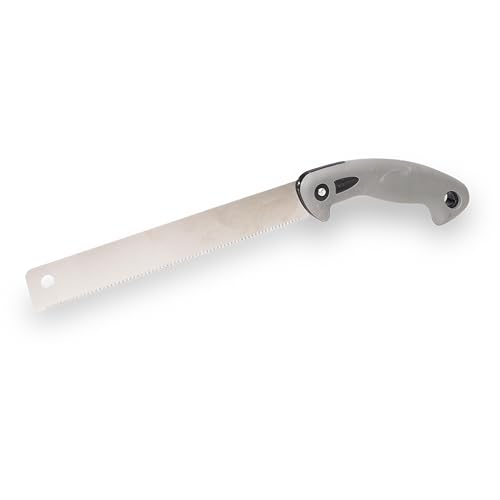
Vaughan Bear Saw BS240D Pull Stroke Saw
The Bear Saw combines the pull stroke action with a coarser tooth pitch, so it clears damp fibrous wood that would clog a finish saw. That makes it a favourite for garden work, rough framing and cutting in awkward positions. It is far less refined in dry hardwood than the finer Japanese saws here.
Pros
- Clears damp and green wood without clogging
- Light and easy to use overhead
- Cuts quickly for its size
Cons
- Rough finish on visible cuts
- Short blade limits cut depth
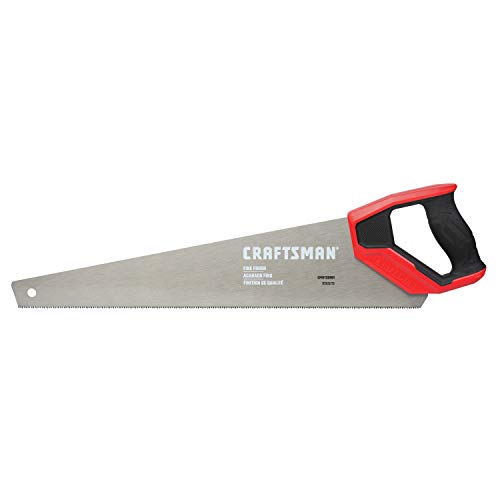
Craftsman CMHT20880 15-Inch Hand Saw
For the drawer that gets opened a few times a year, this Craftsman covers plywood, softwood and the occasional trimmed shelf without asking much. The 15 inch blade and moulded handle keep it manageable for people who do not saw by hand often. Owners report it is fine within light DIY limits and outclassed by the trade saws above on long cuts.
Pros
- Easy to handle for occasional users
- Compact enough for a small toolbox
- Hardened teeth stay usable for years of light work
Cons
- Blade flexes in long cuts
- Slower than a dedicated framing saw
Before you buy
Teeth per inch decides speed against finish A low tooth count of around seven or eight per inch removes wood fast and leaves a rough edge, which is what framing and rough carpentry need. Twelve to fifteen teeth per inch cuts slowly but leaves a face clean enough for visible joinery. If you only buy one saw, something around eight or nine per inch sits in the middle and handles most household jobs acceptably.
Push saws and pull saws behave differently Western saws cut on the push stroke, which puts the blade in compression and requires a thicker plate to stop it buckling. Japanese style saws cut on the pull stroke, keeping the blade in tension so it can be much thinner. That thin plate gives a narrower kerf and a cleaner cut, but it also kinks if you push hard or twist mid cut, so the technique is genuinely different.
Hardened teeth versus resharpenable teeth Almost every saw sold today has induction or impulse hardened teeth, visible as a darker band along the cutting edge. They stay sharp several times longer than traditional soft steel but cannot be filed, so the saw or the blade is replaced rather than serviced. Traditional resharpenable saws still make sense for woodworkers who file their own teeth and want a specific rake and set.
Getting a cut started straight Most wandering cuts go wrong in the first inch. Start with the blade at a shallow angle, use your thumb knuckle as a fence and draw the saw backwards a few times to score a kerf before applying pressure. Once the kerf is established, let the saw weight do the cutting and keep the strokes long, since short choppy strokes are what heat the blade and cause binding.
How they stack up
| # | Model | Blade length | Best for | Score | Price |
|---|---|---|---|---|---|
| 1 | Irwin Tools 2011201 Universal Hand Saw 15-Inch | 15 inches | Best overall | 9.4 | Check price |
| 2 | Suizan Japanese Ryoba Pull Saw 9.5 Inch | 9.5 inches | Best for fine joinery | 9.2 | Check price |
| 3 | Bahco 244-22-U7/8-HP Hand Saw | 22 inches | Best for fast rip cuts | 9.0 | Check price |
| 4 | Stanley 15-334 FatMax Hand Saw | 20 inches | Best value | 8.8 | Check price |
| 5 | Shark Corp 10-2312 Carpentry Saw | 12 inches | Best for trim and finish work | 8.6 | Check price |
| 6 | Vaughan Bear Saw BS240D Pull Stroke Saw | 9.5 inches | Best for green wood and pruning | 8.3 | Check price |
| 7 | Craftsman CMHT20880 15-Inch Hand Saw | 15 inches | Best budget | 8.0 | Check price |
Questions worth asking
What is the difference between a rip saw and a crosscut saw?
Rip teeth are filed like tiny chisels and cut along the grain, clearing long fibres efficiently. Crosscut teeth are filed to knife points that sever fibres across the grain. A ryoba style saw carries both patterns on opposite edges, which is why it is such a useful single purchase.
Do I still need a hand saw if I own a circular saw?
Most people find they do. A hand saw needs no power, makes no dust cloud, works in spaces a circular saw cannot reach and is safer for quick one off cuts. It is also the tool of choice for trimming dowels, cutting flush and any cut where setting up a power tool takes longer than making the cut.
Why does my saw keep binding in the cut?
Binding usually means the kerf is closing behind the blade. Support the offcut so it does not pinch, keep the saw vertical rather than twisting it, and check that the tooth set has not worn flat. A small wedge in the back of a long cut solves it on wide boards.
Can hardpoint saw teeth be sharpened?
Not practically. The hardened band is far harder than a saw file, so filing ruins the file without restoring the edge. These saws are designed to be replaced, which is why replaceable blade designs like the Japanese pull saws here are a good long term choice.
Which hand saw is best for cutting plywood?
A finer tooth count of twelve or more per inch reduces splintering on the face veneer. Scoring the cut line with a knife first and cutting with the good face upward on a push saw, or downward on a pull saw, makes a bigger difference than the saw itself.
How long should a hand saw blade be?
Longer blades cut faster because each stroke removes more material, but they are harder to control and useless in confined spaces. Twenty to twenty two inches suits framing and wide boards, while fifteen inches or less is easier for general household work and awkward angles.
Are pull saws harder to learn?
Owners report it takes an hour or two to stop pushing out of habit. The main rule is to let the saw glide back on the return stroke without pressure, since forcing a thin blade forward is what bends it. After that adjustment most people find pull saws easier to start accurately.
How should a hand saw be stored?
Keep the teeth off other tools with a plastic tooth guard or a slot in the toolbox, and wipe the plate with a light oil or paste wax if the workshop is damp. Rust on the plate causes drag long before it damages the teeth.
Our pick
For one saw that covers most work, the Irwin 2011201 Universal Hand Saw cuts fast in both grain directions and stays easy to control. Add the Suizan Ryoba if your work includes joinery or visible cuts, and consider the Bahco 244 if you spend most of your time in framing lumber.


