Which Wall Scanner Actually Finds Studs and Wires?
The Franklin Sensors ProSensor M150 is our overall pick because its multi sensor row shows stud edges instantly with no calibration. The Bosch GMS 120 is the most versatile for metal and live wires, and the Walabot DIY 2 gives the clearest picture of what sits behind drywall.
The Franklin Sensors ProSensor M150 tops our ranking of wall scanners, with the Bosch GMS 120 close behind for mixed material detection and the Walabot DIY 2 leading for visual imaging. Zircon and Stanley cover the budget end.
Wall scanners are tricky because every wall is different. Plaster thickness, foil backed insulation, moisture and metal mesh all confuse cheap sensors, and a scanner that reads perfectly on new drywall can wander badly on an older wall. We compared published detection depths, sensor counts, warning modes and what owners report about false positives, then ranked on reliability rather than feature lists.
The top picks, ranked

Franklin Sensors ProSensor M150
The M150 uses a row of independent sensors that light up together, so you see the full width of a stud in one placement rather than sweeping back and forth. There is no calibration step, which removes the most common source of user error. Owners report it finds doubled studs and headers that single sensor units miss entirely.
Pros
- Shows stud width and centre at a glance
- No calibration means fewer false readings
- Very fast for marking a whole wall
Cons
- No dedicated live wire display mode
- Bulkier than pocket sized scanners

Bosch GMS 120
The GMS 120 switches between wood, ferrous metal and live wire detection, with a ring light around the marking hole that changes colour as you approach a target. That marking hole is genuinely useful because you pencil the spot without moving the tool. Owners report it is dependable on plaster as well as drywall.
Pros
- Separate modes for wood, metal and live wires
- Marking hole keeps your pencil mark accurate
- Solid build with a rubber grip
Cons
- Needs a calibration hold before each sweep
- Signal ring is hard to read in bright sun

Walabot DIY 2
The Walabot DIY 2 clips to an Android phone and uses radio imaging to draw studs, pipes and wires on screen rather than beeping. Seeing the layout is a different experience from tracking a single beep, particularly when joists run at odd angles. Owners report a learning curve, then real confidence once the image makes sense.
Pros
- Visual map rather than a single beep
- Deepest detection in this group
- Pan mode helps trace pipe runs
Cons
- Android only, no iPhone support
- Takes practice to interpret the image
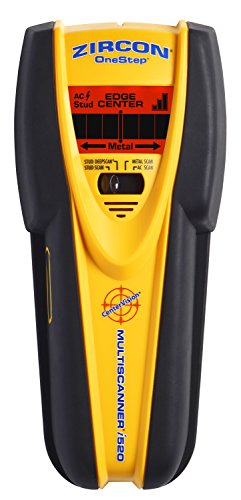
Zircon MultiScanner X85 OneStep
The X85 covers stud edges, centres, metal and live AC wiring in one unit, and the OneStep function skips the usual hold and wait calibration. The backlit display spells out what it has found instead of leaving you to decode beeps. Owners report it is a sensible upgrade from an entry level edge finder.
Pros
- Clear written display rather than beep counting
- Deep scan mode helps on thick plaster
- Detects live wiring and metal separately
Cons
- Can drift if you start over a stud
- Plastic body feels light for the price bracket

Franklin Sensors ProSensor 710+
The 710+ is the wider sibling of the M150, adding a metal and live wire indicator to the same multi sensor LED strip. Because thirteen sensors read at once, you can spot two adjacent studs without moving the tool. Owners report it is the one they hand to helpers because it is almost impossible to use wrongly.
Pros
- Widest read area of any scanner here
- Instant on with no hold step
- Reliable on layered drywall
Cons
- Large body is awkward in tight corners
- Live wire indicator is basic compared to Bosch

Zircon StudSensor e50
The e50 does one job, finding stud edges in standard drywall, and it does it cheaply. A pivot pointer and audible tone tell you when you cross an edge, and the SpotLite beam marks the spot on the wall. Owners report it is fine for hanging shelves and pictures but less confident on plaster or panelled walls.
Pros
- Very light and easy to store in a drawer
- Straightforward for occasional jobs
- Beam marking is handy above head height
Cons
- Edges only, so you calculate the centre
- Needs recalibration if it starts on a stud

Stanley STHT77404 Stud Sensor 300
The Stud Sensor 300 is an entry level unit that flags wood and metal studs up to three quarters of an inch deep with an LED and tone. It is the sort of tool that lives in a kitchen drawer and gets used twice a year. Owners report it is accurate on flat drywall provided you sweep slowly and start clear of a stud.
Pros
- Cheapest way to stop drilling blind
- Small enough for any toolbox
- Simple two button operation
Cons
- Shallow detection depth
- No live wire warning
How to pick the right one
Multi sensor beats single sensor Traditional scanners read one point and ask you to sweep until the tone changes, which means you infer the stud rather than see it. Multi sensor arrays read across several inches at once and light up the whole stud. Based on specifications and owner reports, that difference is the single biggest predictor of whether a scanner frustrates you.
Know your wall before you trust the reading Foil backed insulation, wire mesh in old plaster, tile backer board and damp patches all skew capacitive sensors. If your wall is anything other than plain drywall, look for a deep scan mode or a radar imaging unit. Cross checking from both sides of a suspected stud is a good habit regardless of price.
Live wire detection has limits AC detection only finds wiring that is energised and reasonably close to the surface. Cable inside metal conduit, behind foil, or on a tripped breaker may not register at all. Treat the warning as an extra safety net rather than proof that a cavity is clear, and switch off the circuit before cutting.
Calibration is where most errors start Any scanner that asks you to hold it still first is learning the wall density under it. Start that hold over a stud and every later reading shifts. Scanners with no calibration step remove this problem entirely, which is why they dominate the top of our ranking despite simpler displays.
How they compare
| # | Model | Detection depth | Best for | Score | Price |
|---|---|---|---|---|---|
| 1 | Franklin Sensors ProSensor M150 | Up to 1.5 inches | Best overall | 9.4 | Check price |
| 2 | Bosch GMS 120 | Up to 1.5 inches | Best for mixed materials | 9.2 | Check price |
| 3 | Walabot DIY 2 | Up to 4 inches | Best for seeing behind the wall | 9.0 | Check price |
| 4 | Zircon MultiScanner X85 OneStep | StudScan, DeepScan, Metal, AC | Best all rounder for the money | 8.8 | Check price |
| 5 | Franklin Sensors ProSensor 710+ | Up to 1.5 inches | Best for wide stud marking | 8.6 | Check price |
| 6 | Zircon StudSensor e50 | Up to 0.75 inches | Best budget stud finder | 8.3 | Check price |
| 7 | Stanley STHT77404 Stud Sensor 300 | Up to 0.75 inches | Best for occasional DIY | 8.0 | Check price |
Good to know
How deep can a wall scanner detect?
Consumer capacitive scanners typically reach three quarters of an inch to one and a half inches, which covers standard drywall and most plaster. Radar imaging units such as the Walabot reach around four inches. Metal detection modes usually read deeper than wood detection on the same tool.
Why does my scanner beep everywhere?
Constant beeping usually means the calibration started over a stud, the battery is low, or the wall has foil backing or metal mesh. Move at least a foot sideways, recalibrate, and sweep again slowly. If the readings still make no sense, the wall material is likely defeating the sensor.
Can a wall scanner find plastic water pipes?
Not reliably. Capacitive scanners see density changes, so a plastic pipe full of water may read like a stud, while an empty one often disappears. Radar imaging gives a better chance. Where pipes are a real risk, drill shallow and check before committing.
Do I still need a magnet based finder?
A simple magnetic finder locates drywall screws, which sit on stud centres, and it never runs out of battery. Many owners keep one as a cross check against an electronic scanner. It is slow across a whole wall but useful for confirming a single suspect point.
Which scanner works best on plaster and lath?
Deep scan modes help, but plaster with wire mesh is genuinely difficult for capacitive sensors. The Bosch GMS 120 in metal mode and the Walabot DIY 2 tend to cope best because they are not relying purely on density change. Expect to confirm with a small pilot hole.
Should the scanner touch the wall flat?
Yes. Keep the full base flat against the surface and move at a steady slow pace. Tilting lifts part of the sensor array and produces edges that are not there. Painted textured walls may need a thin card under the scanner to glide smoothly.
How do I find the stud centre from edges?
Mark both edges as the tone triggers, then measure the midpoint. Standard framing is usually sixteen or twenty four inches on centre, so once you find one stud you can predict the next and confirm it. Multi sensor scanners show the centre directly and skip the arithmetic.
Are phone app scanners any good?
Apps that use the phone magnetometer alone only find metal fixings and are easily fooled. Hardware attachments such as the Walabot DIY 2 are a different proposition because they add a real sensor. Judge by the sensor, not the app.
The bottom line
The Franklin Sensors ProSensor M150 is the wall scanner we would put in most toolboxes because it removes calibration and shows the whole stud at once. Step up to the Bosch GMS 120 if you regularly deal with metal studs or live wiring. The Walabot DIY 2 is worth the learning curve when you need to know what is really behind the surface.


