Stud Finders That Locate Studs Without Guessing
The Franklin Sensors ProSensor 710 is our best overall stud finder for its wide multi-sensor display and accuracy. The Zircon MultiScanner is the most versatile for detecting metal and live wires, while the CH Hanson Magnetic is the simplest reliable budget pick.
The Franklin Sensors ProSensor 710 is the best stud finder for most people because its 13-sensor array lights up the full width of a stud at once, so you stop guessing about edges. For metal, plumbing, and live wires, the Zircon MultiScanner is more versatile, and the CH Hanson Magnetic is the most foolproof budget choice.
Stud finders are trickier than they look because plaster, lath, textured paint, and thick drywall all confuse cheap single-sensor units, and calibration errors send you drilling into empty space. To choose, we compared multi-sensor accuracy, scan depth ratings, live-wire and metal detection, and how forgiving each model is for first-time users, based on published specifications and what owners consistently report.
Our top picks

Franklin Sensors ProSensor 710
The ProSensor 710 uses a row of 13 sensors that light up across the entire width of a stud at once, which removes the slow back-and-forth sweeping that makes single-sensor tools frustrating. Owners report it handles standard drywall reliably and needs no calibration button before each scan. It struggles on very thick plaster, but for everyday walls it is hard to beat.
Pros
- Shows full stud width instantly
- No fiddly calibration step
- Very consistent on standard drywall
Cons
- Less effective on thick plaster
- No live-wire warning indicator
Zircon MultiScanner
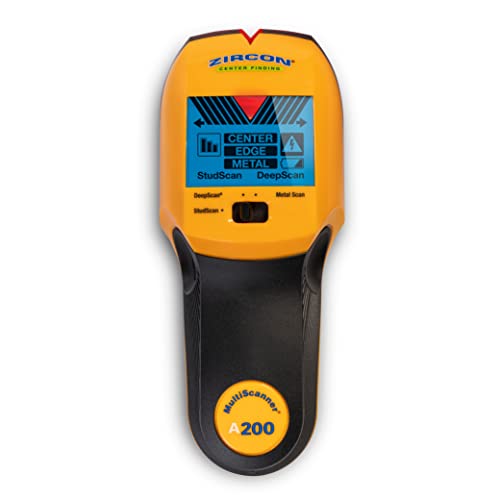
The Zircon MultiScanner switches between wood-stud, deep-scan, and metal modes, and it flags live AC wiring, which makes it a safer choice for kitchen and bathroom work. Owners note the deep-scan mode reaches farther than most single-mode tools. It does require careful calibration on each pass, so rushing it can produce false edges.
Pros
- Detects metal and live wiring
- Deep-scan mode for thicker walls
- Clear directional LCD
Cons
- Needs recalibration each scan
- False readings if placed over a stud at start

Bosch GMS120
The Bosch GMS120 is a multi-mode detector built for tradespeople who need to locate wood, ferrous and non-ferrous metal, and live wiring in one tool. Based on specifications it offers three distinct detection modes with an audible signal and center-find indicator. It costs more than hobby-grade units, which is the main reason casual users may look elsewhere.
Pros
- Locates deep metal and rebar
- Three dedicated detection modes
- Durable pro-grade build
Cons
- Higher cost than DIY tools
- Learning curve for the modes

Tavool Stud Finder
The Tavool is a popular budget electronic finder with four scanning modes and a large HD LCD that shows depth and a center-find arrow. Owners report it works well on standard drywall once they learn to calibrate it against a blank section of wall first. Accuracy drops on textured or uneven surfaces, as with most tools in this price range.
Pros
- Big easy-to-read screen
- Four modes at a low price
- Auto power-off saves battery
Cons
- Sensitive to textured walls
- Calibration must be exact

CH Hanson 03040 Magnetic Stud Finder
The CH Hanson uses rare-earth magnets to lock onto the screws or nails in a stud, with no batteries and nothing to calibrate. It hangs on the wall when it finds metal, freeing your hands to mark the spot. It locates fasteners rather than the stud body, so it is slower for mapping a whole wall, but it never gives a false electronic reading.
Pros
- No batteries or calibration
- Cannot give false positives
- Hangs hands-free while marking
Cons
- Finds fasteners, not stud edges
- Slower to map a full wall

StudBuddy Magnetic Stud Finder
The StudBuddy is a lightweight magnetic finder shaped to sit flat against the wall and hold onto nails and screws hands-free. Owners like keeping it in a toolbox or pocket for quick jobs like hanging a picture frame. Like all magnetic tools it depends on finding metal fasteners, so it can miss studs held by glue or hidden behind thick plaster.
Pros
- Pocket-friendly and cheap
- No power or calibration
- Reliable on screwed drywall
Cons
- Relies on metal fasteners
- Weak on thick plaster walls

Vivreal Stud Finder
The Vivreal is an inexpensive electronic finder with stud, metal, and AC-wire modes and a simple LCD that signals when it reaches a stud center. It is a reasonable starter tool for occasional wall projects, and owners report solid results on clean drywall. It is more affected by user technique than premium units, so a steady, slow sweep matters.
Pros
- Low entry price
- Three useful scan modes
- Simple one-button operation
Cons
- Technique-sensitive readings
- Basic build quality
Side by side
| # | Model | Sensors | Best for | Score | Price |
|---|---|---|---|---|---|
| 1 | Franklin Sensors ProSensor 710 | 13-sensor array | Best overall | 9.4 | Check price |
| 2 | Zircon MultiScanner | StudScan, DeepScan, Metal, AC | Best for mixed materials | 9.1 | Check price |
| 3 | Bosch GMS120 | Wood, metal, live wire | Best for professionals | 8.9 | Check price |
| 4 | Tavool Stud Finder | Stud, Deep, Metal, AC wire | Best value electronic | 8.6 | Check price |
| 5 | CH Hanson 03040 Magnetic Stud Finder | Magnetic, dual rare-earth | Best magnetic | 8.4 | Check price |
| 6 | StudBuddy Magnetic Stud Finder | Magnetic fastener finder | Best pocket carry | 8.2 | Check price |
| 7 | Vivreal Stud Finder | Stud, Metal, AC wire | Best entry-level multi-mode | 8.0 | Check price |
How to pick the right one
Magnetic vs electronic stud finders Magnetic finders like the CH Hanson and StudBuddy detect the metal screws and nails inside a stud, so they never need batteries or calibration and cannot give an electronic false positive. The tradeoff is that they locate fasteners rather than the full stud, which is slower for mapping a wall. Electronic finders read changes in wall density to map the whole stud, which is faster but demands correct calibration on a blank patch of wall first.
Why wall type changes everything The single biggest source of frustration is the wall itself. Standard half-inch drywall is easy, but thick plaster and lath, textured paint, wallpaper, and double-layer walls all confuse density-based sensors. If your home has plaster walls, prioritize a deep-scan mode like the Zircon or a magnetic tool that reads the fasteners directly. Always test on a spot you know, such as beside an outlet, before trusting a reading.
Live wire and metal detection If you are drilling near a kitchen, bathroom, or switch, a live-wire warning is worth the extra cost. The Zircon MultiScanner and Bosch GMS120 both flag AC wiring and metal pipes, which helps you avoid an expensive or dangerous mistake. Owners report these alerts are guidance, not a guarantee, so still cut power at the breaker before opening a wall.
How we chose these stud finders We compared multi-sensor accuracy, published scan-depth ratings, live-wire and metal detection, and how forgiving each tool is for a first-time user. We leaned on manufacturer specifications and the patterns owners report over months of use rather than any single quick trial. The goal was a ranked list that fits real situations, from a quick picture hang to framing and remodel work.
Frequently asked questions
Are magnetic or electronic stud finders more accurate?
It depends on your wall. Electronic finders map the full stud faster on standard drywall, while magnetic finders are more foolproof because they lock onto real metal fasteners and cannot give a false electronic reading. On plaster walls, magnetic tools often win.
Why does my stud finder give false readings?
The most common causes are skipping calibration, starting the scan directly over a stud, or scanning textured, plaster, or double-layer walls. Always calibrate on a blank section first and sweep slowly and steadily for consistent results.
Do I need a stud finder that detects live wires?
If you plan to drill near kitchens, bathrooms, or switches, yes. Models like the Zircon MultiScanner and Bosch GMS120 flag AC wiring, which reduces the risk of hitting a cable. Still switch off the breaker before opening any wall.
What is the best stud finder for plaster walls?
Plaster and lath confuse density sensors, so a deep-scan electronic model or a strong magnetic finder tends to work better. The Zircon deep-scan mode and magnetic tools like the CH Hanson are common choices for older homes.
How deep can a stud finder scan?
Most consumer models scan around 0.75 to 1.5 inches for studs. Metal-detection modes on tools like the Bosch GMS120 can reach several inches for pipes and rebar. Deeper walls need a deep-scan setting or a magnetic approach.
Do stud finders work through wallpaper or tile?
Thin wallpaper is usually fine, but foil-backed wallpaper, tile, and textured surfaces can block or distort electronic sensors. In those cases a magnetic finder that reads fasteners is often more reliable.
How do I calibrate an electronic stud finder?
Place the tool flat on a section of wall you believe is empty, then press and hold the power button until it signals it is ready. Starting on a stud during calibration is the top cause of wrong readings.
Can a stud finder detect pipes?
Multi-mode tools with a metal mode, like the Zircon MultiScanner and Bosch GMS120, can flag metal pipes. They may not distinguish a pipe from a nail plate, so treat any metal alert as a reason to proceed carefully.
Is a more expensive stud finder worth it?
For occasional picture hanging, a budget magnetic or electronic tool is plenty. If you frame walls, remodel, or work near wiring often, the accuracy and live-wire alerts of a Franklin, Zircon, or Bosch pay off in fewer mistakes.
Final word
For most people the Franklin Sensors ProSensor 710 is the best stud finder because its multi-sensor display shows the whole stud at once with no fussy calibration. Choose the Zircon MultiScanner if you need metal and live-wire detection for kitchen or bathroom work, or the CH Hanson Magnetic if you want a foolproof, battery-free tool for simple jobs.