Which Car Lunch Warmer Actually Heats Food Evenly?
HOTLOGIC Mini leads with slow, even heating through an insulated pouch that suits rice, pasta, and casseroles. Crock-Pot Lunch Crock favors soups and stews through its slow-cooker well. KUUZO’s tri-voltage design covers 12V, 24V, and 110V outlets for drivers rotating between vehicles. Heating method separates these picks more than size does.
HOTLOGIC Mini fits most commuters, using a slow insulated pouch that warms rice, pasta, and casseroles without scorching the edges. Its main limit is a wall adapter sold separately, so home use costs extra. Crock-Pot Lunch Crock switches to a mini slow-cooker well instead, better suited to soup and stew than a flat pouch. KUUZO covers three voltages, 12V, 24V, and 110V, useful for anyone rotating between a car and a work truck.
A car warmer looks simple until heating method and voltage support decide which foods actually work. We compared heating method, voltage range, and container material across current listings, then weighed owner reports on uneven heat and battery drain.
What matters most
What to look for in a heated car lunch box Heating method decides which foods actually work well inside. A slow insulated pouch suits rice and casseroles; a fast electric coil can scorch edges instead. Voltage compatibility should match real use, whether that means only a 12V outlet or also a 110V home plug. Stainless steel containers handle a dishwasher better than a fabric pouch does. Heat-up time ranges from around 25 minutes to nearly an hour, depending on the design.
Insulated pouch warmers vs electric coil boxes HOTLOGIC Mini and Wagan Tech’s EL2601 both heat slowly through an insulated pouch, avoiding hot spots near the edges. YISSVIC and Toogel instead use an electric coil, which heats faster but can warm unevenly close to the element. Pouch designs generally require non-metal containers, while coil warmers usually ship with their own stainless insert. Picking between them comes down to whether even heat or faster warm-up matters more for a given routine.
Best warmers for soups, stews, and liquid meals A slow-cooker style well, like Crock-Pot’s Lunch Crock, holds liquid food more securely than a flat pouch or shallow coil tray. Sauced rice and pasta dishes also do better in a well that traps moisture instead of drying it out. Sandwiches and other dry foods don’t need this shape and work fine in flatter warmers. Container shape should outrank voltage flexibility for anyone packing soup regularly.
Best warmers for drivers switching between vehicles Truckers or anyone alternating between a personal car and a work truck need voltage flexibility beyond standard 12V. KUUZO’s tri-voltage design spans 12V, 24V, and 110V in a single unit, removing the need for a second warmer. Dual-voltage options like YISSVIC or Beautlead cover car and home combinations but skip the 24V support truckers specifically need. Matching voltage to the actual vehicles in rotation matters more here than container material or heat speed.
The top picks, ranked

HOTLOGIC Mini Personal Portable Oven
A low-wattage element warms food slowly through an insulated pouch, sidestepping the scorched edges electric coils can cause. Plugging into a 12V car outlet covers daily commuting, though a wall adapter for home use costs extra. Heat-up runs 25 to 45 minutes depending on what’s inside.
Pros
- Slow, even heat avoids the scorched edges coil warmers can leave
- Handles a wide range of foods, from rice to full casseroles
- Insulated pouch tolerates being packed next to other bag items
Cons
- Metal containers cannot go inside the pouch
- Home use requires a separately sold wall adapter

Wagan Tech EL2601 Personal Portable Oven
Wagan Tech builds a similar insulated pouch warmer, but skips dual-voltage support to focus on 12V car outlets. Low wattage draw lets it run through a full commute without a noticeable dent in battery charge. Drivers who eat lunch inside the car, rather than carrying a warmed meal in, get the most use from it.
Pros
- Low wattage draw suits a long commute without battery strain
- Built specifically around car outlet voltage rather than dual use
- Pouch retains warmth for a while after the outlet is unplugged
Cons
- No 110V option for home outlet use
- Same non-metal container limit as other pouch warmers

Crock-Pot Lunch Crock Food Warmer
Crock-Pot shrinks its familiar slow-cooker shape into a lunch-sized well, a better match for liquid food than a flat pouch. Either a 12V car outlet or a standard wall outlet works, with both cords included. Soup, rice, and pasta hold their texture better here than in a coil-heated flat tray.
Pros
- Slow-cooker well suits soup and stew better than flat warmers
- Car and home cords both ship in the box
- Removable insert makes cleanup after liquid meals simple
Cons
- Dry foods like sandwiches fit less naturally in a well shape
- Shape runs bulkier than flat insulated pouch designs

YISSVIC Electric Lunch Box Portable Food Warmer
A stainless steel container splits into two compartments here, heated from below by an electric coil. Both 12V car and 110V home power work with the included cords. Heat-up beats insulated pouch designs on speed, though edges near the coil can warm unevenly.
Pros
- Two compartments keep separate foods from mixing during heating
- Stainless container goes straight into the dishwasher
- Costs less than dedicated insulated pouch warmers
Cons
- Coil heat can run uneven near the container edges
- Less gentle on delicate food than slow pouch heating
KUUZO Electric Lunch Box
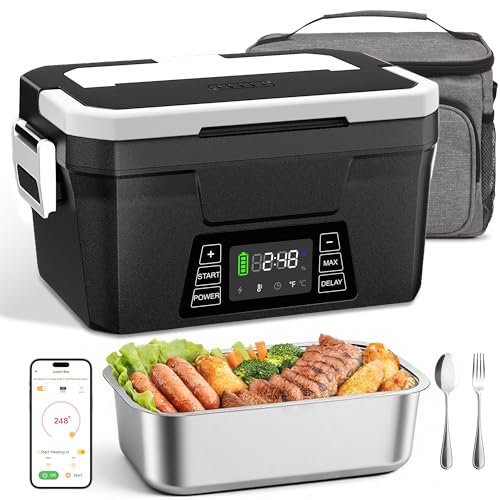
Three voltage options, 12V, 24V, and 110V, let one unit cover a car, a larger truck, and a home kitchen. A stainless container sits inside a carry bag that adds a layer of insulation. Drivers who switch between a personal car and a work truck benefit most from that range.
Pros
- Tri-voltage support covers cars, trucks, and home outlets alike
- Stainless container holds up to regular daily use
- Carry bag included adds both insulation and portability
Cons
- Bulkier overall than single-voltage warmers
- 24V truck outlets heat slower than the 12V car setting
Toogel Electric Lunch Box
Cost stays low here through a plastic outer shell wrapped around a stainless steel inner container. Both car and home power work, undercutting stainless-only competitors on price. Occasional use suits it better than a daily heavy commute routine.
Pros
- Lower cost than premium stainless-only warmers
- Works on both car and home power
- Stainless inner container wipes clean easily
Cons
- Plastic outer shell feels less durable over time
- Not built for daily heavy-duty commuting
Beautlead Electric Lunch Box
Both inner and outer shells use stainless steel, skipping the plastic housing some competitors rely on. Dual voltage covers car and home outlets, and a carry bag with utensils rounds out the set. That all-metal build adds noticeable weight next to plastic-shelled options.
Pros
- All-stainless build skips the plastic housing wear points
- Carry bag and utensils included add everyday convenience
- Dual voltage covers both car and home outlets
Cons
- Heavier than plastic-shell alternatives
- Metal exterior can get hot to the touch while heating
Side by side
| # | Model | Heating method | Best for | Score | Price |
|---|---|---|---|---|---|
| 1 | HOTLOGIC Mini Personal Portable Oven | Insulated pouch, low-wattage element | Best overall | 9.3 | Check price |
| 2 | Wagan Tech EL2601 Personal Portable Oven | Insulated pouch | Best for daily car commuting | 9.0 | Check price |
| 3 | Crock-Pot Lunch Crock Food Warmer | Slow-cooker well | Best for soups and stews | 8.7 | Check price |
| 4 | YISSVIC Electric Lunch Box Portable Food Warmer | Electric coil under stainless container | Best value | 8.4 | Check price |
| 5 | KUUZO Electric Lunch Box | 12V, 24V, and 110V | Best multi-voltage | 8.2 | Check price |
| 6 | Toogel Electric Lunch Box | Electric coil under stainless insert | Best budget | 8.0 | Check price |
| 7 | Beautlead Electric Lunch Box | Stainless steel, inner and outer | Best stainless steel container | 8.0 | Check price |
Frequently asked questions
Do heated lunch boxes actually work while driving?
Yes. Most plug into a 12V car outlet and warm food during a commute, with heat-up running anywhere from about 25 minutes to nearly an hour.
Can a heated lunch box go in the dishwasher?
Stainless containers, like those in YISSVIC or Beautlead, typically go in the dishwasher. HOTLOGIC Mini’s fabric pouch should instead be wiped clean by hand.
How long does a car lunch warmer take to heat food?
Insulated pouch warmers generally need 25 to 45 minutes. Electric coil warmers with a stainless container can heat somewhat faster, depending on food density.
Do these lunch boxes need water added like a steamer?
No. Every model here heats through direct low-wattage warming rather than steam, so no water goes in before use.
Is it safe to leave a heated lunch box running for hours?
Extended low-wattage operation is what these are designed for during a commute or workday. Food safety guidelines still limit how long a meal should sit at warming temperature, regardless of the appliance.
Which lunch box warmers run on both 12V and 110V power?
Crock-Pot’s Lunch Crock and YISSVIC’s warmer both include a car and a home cord. Wagan Tech’s EL2601, by contrast, only supports 12V.
What foods work best in a slow-heating pouch warmer?
Rice, pasta, and casserole-style dishes hold up well in a slow pouch warmer. Broth-based soup fares better in a well-style warmer like Crock-Pot’s Lunch Crock.
Does an electric lunch box drain a car battery with the engine off?
Any 12V accessory draws down a car battery once the engine stops running. Most owners limit these warmers to accessory mode or while the engine runs.
Our take
HOTLOGIC Mini covers the widest range of daily commuters with gentle, even heat across most food types. Anyone packing soup or stew regularly should reach for Crock-Pot’s Lunch Crock instead, built around a well-style container. Drivers alternating between a car and a larger truck should skip both for KUUZO’s tri-voltage design, since it removes the need for a second warmer.