Horse Watering Accessories That Survive Winter Barns
The Farm Innovators HB-60P heated flat back bucket is our overall pick for stall use in freezing weather. The Little Giant FB160 flat back bucket is the best everyday value, and the API FL-1000 floating de-icer is the simplest way to keep a large stock tank open all winter.
For stalls in cold climates the Farm Innovators HB-60P heated flat back bucket is the accessory that saves the most labour, the Little Giant FB160 flat back bucket is the sensible everyday workhorse, and the API FL-1000 floating de-icer keeps a shared stock tank drinkable without heating the whole trough.
Horse watering gear is deceptively tricky because the failure modes are seasonal. A bucket that works fine in September splits when the water in it freezes solid, a cheap de-icer trips a breaker on a wet night, and an unprotected cord is an obvious hazard around a curious horse. We compared seven widely available options on capacity, element and cord protection, mounting, material thickness and what barn owners report after a full winter of use.
Before you buy
Work out your freeze problem before buying anything The right accessory depends entirely on where the water sits. Stall buckets in a barn that stays near freezing are best solved with a thermostat controlled heated bucket like the Farm Innovators HB-60P. A shared outdoor stock tank is a different job, and a floating de-icer such as the API FL-1000 keeps a drinking hole open far more efficiently than trying to warm the whole volume. Insulated tank walls, as on the Rubbermaid structural foam tank, reduce how hard either has to work.
Cord safety is not optional around horses Every heated product here introduces an electrical cord into a wet environment with an animal that chews and paws. Use a GFCI protected outlet without exception, route cords out of reach through conduit or an anti chew sleeve, and inspect the insulation at the start of every cold season. A cord that has been nicked over summer is the single most common cause of a de-icer failing or tripping a breaker in January.
Capacity should match consumption, not ambition A horse typically drinks somewhere between five and ten gallons a day, more in heat or on a dry hay diet. Oversizing a trough for a small group means water sits long enough to go stale and grow algae, which discourages drinking. It is generally better to run a tank you empty and refill every couple of days than a huge one that never turns over, unless a float valve keeps fresh water flowing in continuously.
Material choice decides how the gear ages Rigid polyethylene buckets like the Little Giant FB160 are cheap, light and easy to clean, but they crack when ice expands inside them. Flexible rubber blends such as Fortiflex tolerate both kicks and frozen contents at the cost of weight. For tanks, UV stabilised poly is the baseline and structural foam is the upgrade. Whatever you pick, a smooth interior with no sharp corners is what makes daily scrubbing quick enough that you actually do it.
The top picks, ranked
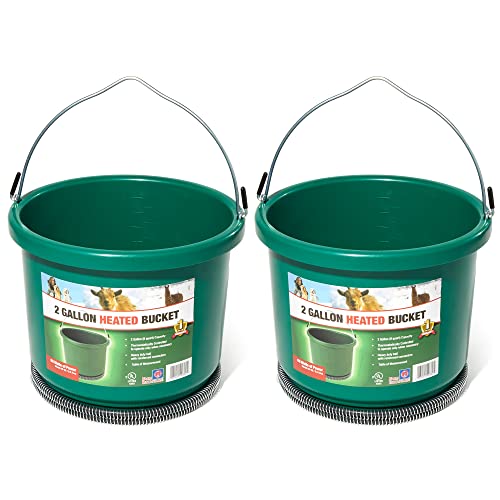
Farm Innovators HB-60P Heated Flat-Back Bucket
This is the bucket most barns end up standardising on for winter stalls. A concealed 60 watt element with a built in thermostat only runs when the temperature approaches freezing, so it does not cook water or waste power on mild days. The flat back sits properly against a stall wall and the cord runs through an anti chew protector, which owners report is the detail that makes it last more than one season.
Pros
- Thermostat means it only heats when needed
- Flat back mounts flush to stall walls
- Concealed element is easy to scrub around
Cons
- Needs a nearby GFCI outlet in every stall
- Cord protection still requires sensible routing

API FL-1000 Floating Pond and Stock Tank De-Icer
Rather than heating an entire trough, the FL-1000 floats and keeps an opening in the surface ice so horses can always drink. It is thermostatically controlled, so it cycles rather than running constantly, and the floating design means it can be moved between tanks as the herd shifts fields. Owners report it works reliably in deep cold, though it should never be used dry or in a plastic tank without checking the manufacturer’s guidance.
Pros
- Keeps large tanks open in hard freezes
- Moves between tanks easily
- Cycles off automatically above freezing
Cons
- High wattage needs a properly rated circuit
- Must be checked for damage before each season

Little Giant FB160 Flat Back Plastic Bucket
The FB160 is the plain sixteen quart flat back bucket you see hanging in most stalls, and there is a reason it has not changed much. The moulded plastic is thick enough to take knocks, the flat side stops it swinging against the wall, and the reinforced handle takes a double end snap without deforming. Owners report they last for years provided you empty them before a hard freeze rather than letting ice expand inside.
Pros
- Inexpensive enough to buy several
- Flat back reduces swinging and spills
- Smooth interior is quick to scrub
Cons
- No freeze protection at all
- Can crack if left full through a hard freeze

Fortiflex Flat Back Bucket
Fortiflex buckets use a flexible rubber and polymer blend rather than rigid plastic, so a kick tends to deform them and spring back instead of splitting. That flexibility also means frozen water can be knocked out by inverting the bucket and stepping on it, which is a real advantage in barns without heated water. Owners report they survive rough handling far better than standard plastic, at the cost of extra weight.
Pros
- Flexes instead of cracking when kicked
- Ice knocks out without damaging the bucket
- Stays pliable in very cold weather
Cons
- Noticeably heavier when full
- Rubber can hold odours if not scrubbed

Rubbermaid Commercial Structural Foam Stock Tank, 150 Gallon
Structural foam walls give this tank a degree of insulation that thin poly troughs simply do not have, which slows freezing and keeps water cooler in summer. The moulded drain plug makes emptying and scrubbing a one person job rather than a tipping exercise. Owners report it holds shape over years outdoors, though at 150 gallons it needs to be positioned where you want it permanently.
Pros
- Foam walls slow both freezing and warming
- Built in drain simplifies cleaning
- Holds shape better than thin poly tanks
Cons
- Too heavy to reposition once filled
- Still needs a de-icer in a hard winter
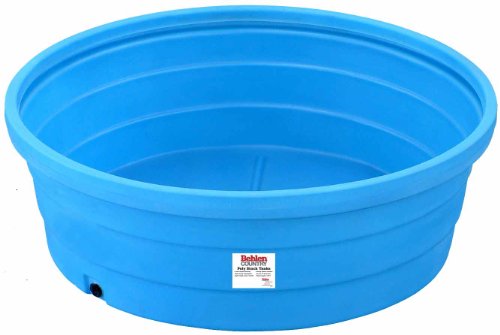
Behlen Country Poly Round Stock Tank
Behlen’s poly round tanks are built for pasture life, with thick sidewalls and a rolled rim that resists cracking when a horse leans on it. They come in a range of capacities so you can match the tank to herd size rather than overfilling a huge trough that goes stale. Owners report the UV stabilised poly holds up in full sun, and the smooth interior does not trap algae in corners.
Pros
- Thick walls handle leaning and knocks
- Round shape is easy to scrub out
- Available in several capacities
Cons
- No insulation, freezes faster than foam tanks
- Light enough to shift when nearly empty

Jobe Valves Stock Tank Float Valve
A float valve turns any trough into a self filling one, which removes the daily hose routine and stops tanks from running dry when nobody gets to the far paddock. Jobe valves use a reliable float and lever mechanism with a threaded inlet that fits standard hose plumbing. Owners report they work well once the water level is set correctly, and recommend a protective cover so horses cannot play with the float.
Pros
- Keeps tanks topped up without daily filling
- Simple mechanism with few failure points
- Fits common trough plumbing
Cons
- Needs a guard or horses will play with it
- Supply line must be drained or heated in winter
Side by side
| # | Model | Capacity | Best for | Score | Price |
|---|---|---|---|---|---|
| 1 | Farm Innovators HB-60P Heated Flat-Back Bucket | 5 gallons | Best overall | 9.4 | Check price |
| 2 | API FL-1000 Floating Pond and Stock Tank De-Icer | 1000 watts | Best for stock tanks | 9.2 | Check price |
| 3 | Little Giant FB160 Flat Back Plastic Bucket | 16 quarts | Best value | 9.0 | Check price |
| 4 | Fortiflex Flat Back Bucket | 20 quarts | Best for durability | 8.8 | Check price |
| 5 | Rubbermaid Commercial Structural Foam Stock Tank, 150 Gallon | 150 gallons | Best large capacity | 8.6 | Check price |
| 6 | Behlen Country Poly Round Stock Tank | UV stabilised polyethylene | Best for pasture use | 8.3 | Check price |
| 7 | Jobe Valves Stock Tank Float Valve | Mechanical float valve | Best for automatic refilling | 8.0 | Check price |
Questions worth asking
How much water does a horse drink each day?
Most adult horses drink roughly five to ten gallons daily, though this rises sharply in hot weather, during heavy work, or on a diet of dry hay rather than pasture. Lactating mares drink considerably more. Sizing buckets and tanks around the upper end of that range gives you a sensible margin.
Are heated buckets safe to leave on all winter?
Thermostat controlled buckets such as the Farm Innovators HB-60P are designed for continuous seasonal use and only draw power near freezing. Safety depends on the installation rather than the bucket: use a GFCI outlet, protect the cord from chewing, and inspect the unit for cracks or exposed wire before each season.
Will a de-icer work in a plastic stock tank?
Some will and some will not, so check the specific product guidance. Floating de-icers are generally the safer option for poly tanks because the element stays away from the tank wall, while submersible sinking heaters can sit against plastic and damage it. Never run any de-icer dry.
How often should water buckets be scrubbed?
Daily rinsing and a proper scrub every two to three days is the usual barn standard. Biofilm builds fast in warm weather and horses will drink less from a slimy bucket. Stock tanks need emptying and scrubbing every one to two weeks in summer, less often in cold weather when algae growth slows.
Do float valves work in freezing weather?
The valve itself is fine, but the supply line feeding it is the weak point. Unless the line is buried below frost depth or heat traced, it will freeze and can split. Many barns run float valves seasonally and switch back to hand filling once hard frosts arrive.
What wattage de-icer do I need for a stock tank?
For most horse sized tanks, a 1000 watt thermostatically controlled unit like the API FL-1000 is the common choice. Larger tanks in severe climates sometimes need more, and small tanks need less. The more important consideration is that the circuit is rated for the load and protected by a GFCI.
Should buckets be hung at a particular height?
Chest height for the horse is the general rule, high enough that bedding and manure do not get kicked in, low enough that the horse does not have to reach up awkwardly. Lower for ponies and foals. Flat back buckets sit closer to the wall, which reduces the chance of a halter or blanket catching.
Is it better to use several buckets or one large tank?
In stalls, two buckets per horse gives you a safety margin if one is knocked over or fouled overnight. In turnout, one tank per small group works well provided there is enough space for lower ranked horses to drink without being chased off, which in a larger herd often means adding a second water point.
Our pick
For stalls in a cold climate the Farm Innovators HB-60P heated flat back bucket removes the most work from a winter routine, and it is the accessory most barns notice immediately. Out in the field, pairing an insulated tank with the API FL-1000 floating de-icer keeps a whole group watered without hauling buckets. If your winters are mild, the Little Giant FB160 and a Jobe float valve cover the job for far less.


