Kayaks Sized to Fit Smaller and Younger Paddlers
The Lifetime Youth Wave Kayak suits first-time paddlers around age five with an 18 pound hull. Perception Prodigy XS adds padded outfitting for kids who paddle often. Families wanting one boat to grow into should consider the Ocean Kayak Frenzy, rated up to 325 pounds.
Three kayaks fit most families: the Lifetime Youth Wave Kayak, the Perception Prodigy XS and the Ocean Kayak Frenzy. Weight range and hull length decide how many seasons a child gets before switching to an adult-sized boat. Cockpit style shapes the rest of the decision.
Sizing a kayak for a kid balances hull weight a parent can lift against a cockpit roomy enough for a growing paddler. We compared weight capacity, hull length and cockpit style, then checked what parents report about stability and how long each model actually stayed in use.
Our top picks

Lifetime Youth Wave Kayak, 6 Feet
At 18 pounds, this sit-on-top hull is light enough for one parent to carry to the water’s edge. A sloped tail lets a child climb back on unassisted after tipping into a lake. Self-bailing scupper holes drain the open deck automatically, so puddles do not collect underfoot.
Pros
- Light enough for a parent to carry alone
- Sloped tail allows unassisted re-entry
- Includes a paddle sized for smaller hands
Cons
- 130 pound limit means an earlier size upgrade
- Open deck offers less wind and spray cover
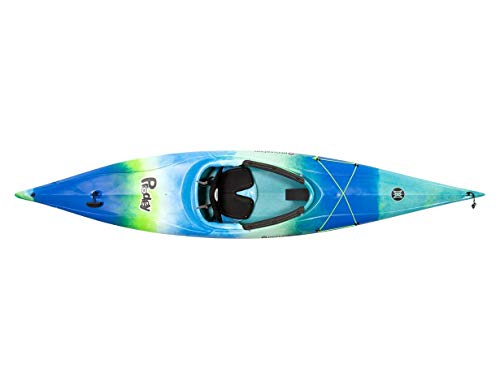
Perception Prodigy XS
Padded knee pads and an adjustable back band bring outfitting usually reserved for adult kayaks to this sit-inside hull. Footrests adjust as a child grows, extending its useful years beyond fixed footpegs. A roomy cockpit rim eases entry and exit for less confident paddlers.
Pros
- Adjustable footrests extend fit over time
- Padded outfitting suits frequent paddlers
- Sit-inside design lowers center of gravity
Cons
- Heavier than sit-on-top youth models
- Sit-inside cockpit takes longer to drain if swamped
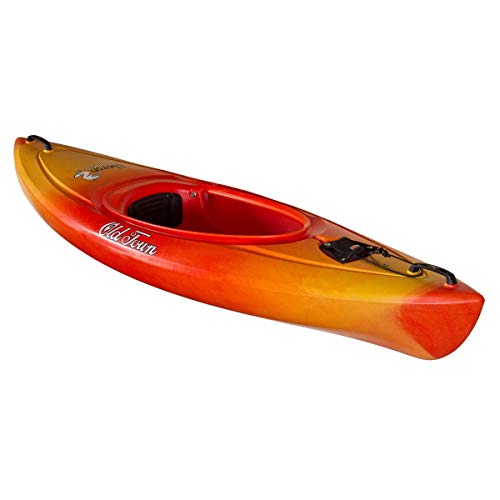
Old Town Heron Junior
A single-layer polyethylene hull keeps total weight to 26 pounds, light enough for a kid to help drag it to shore. The contoured, padded seat is shaped for a child’s body rather than trimmed from an adult mold. A built-in tow system lets a parent pull the boat back if needed.
Pros
- Contoured seat fits a child’s frame
- Tow system helps in calm water emergencies
- Bow and stern handles simplify carrying
Cons
- Lowest weight capacity in this lineup
- Paddle sold separately

Pelican Argo 80X
At 7 feet 9 inches with a 200 pound capacity, this sit-inside hull suits teenagers who have outgrown a true youth kayak. An adjustable padded backrest and a cockpit table with a bottle holder add comfort on longer outings. Calm lakes and slow rivers suit it better than open water.
Pros
- 200 pound capacity suits growing teens
- Adjustable backrest supports longer trips
- Stable twin arched hull for beginners
Cons
- Rated for calm water only
- Larger cockpit fits younger kids loosely
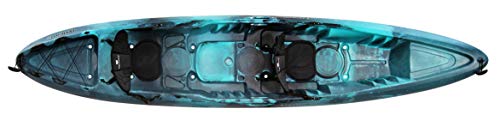
Ocean Kayak Frenzy
A 275 to 325 pound weight range means this 9 foot sit-on-top still fits a paddler well into their teen years. A four-way adjustable seat and molded foot wells accommodate a range of leg lengths as a child grows. The tri-form hull stays stable for beginners while handling light chop better than shorter youth boats.
Pros
- High weight capacity extends years of use
- Adjustable seat and foot wells fit a growing body
- Handles light chop better than shorter hulls
Cons
- 43 pounds is heavy for a young child to help carry
- Larger size is less nimble for the smallest paddlers
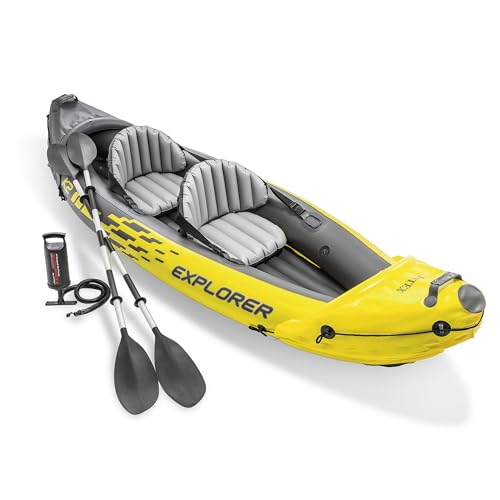
Intex Explorer K2 Kayak
This inflatable tandem seats a parent and child together, suiting kids too young to paddle alone. A 400 pound combined weight capacity covers most adult and child pairings with room to spare. Deflated, the kayak packs into a bag small enough for a car trunk or closet.
Pros
- Parent and child paddle together for young beginners
- Deflates for compact storage and transport
- High combined weight capacity
Cons
- Slower and less responsive than a hard shell hull
- Removable seats shift slightly during paddling

Sun Dolphin Bali 6 Kayak
An open cockpit and graduated foot wells let this 6 foot hull fit a range of leg lengths as a child grows into it. Self-bailing scupper holes clear splashed water without extra bailing. Cost stays below premium youth kayaks while covering the same basic paddling needs.
Pros
- Graduated foot wells fit various leg lengths
- Self bailing deck needs no manual draining
- Lower cost entry point for new paddlers
Cons
- Basic seat padding compared to pricier models
- 140 pound limit suits younger kids only
How to pick the right one
What should you look for in a youth kayak? Weight capacity sets the real lifespan of the boat, since kids grow faster than most parents expect. Hull weight matters just as much, because a kayak too heavy to carry alone rarely makes it to the water often. Sit-on-top hulls drain themselves and forgive tipping, while sit-inside hulls add wind and spray protection. Length also affects storage, from a roof rack to a garage corner.
Sit-inside vs sit-on-top: which is better for kids? Sit-on-top models like the Lifetime Youth Wave Kayak let water drain through scupper holes, so tipping over in calm water becomes a minor inconvenience rather than a struggle. Sit-inside hulls such as the Perception Prodigy XS sit a paddler lower, improving stability and blocking cold spray, though re-entry after a capsize takes more effort. Kids under about eight years old generally do better starting on a sit-on-top.
Best kayaks for young beginners vs teens Kids under 100 pounds fit best in dedicated youth hulls like the Lifetime Youth Wave Kayak or Sun Dolphin Bali 6, both sized and weighted for smaller frames. Teens who outgrow those boats move naturally into the Pelican Argo 80X, which carries up to 200 pounds while staying shorter than a full adult kayak. Skipping straight to an adult-sized hull often leaves a smaller paddler unable to reach the footpegs.
Tandem and growing-room options for paddling with a parent Kids too young to paddle solo do better in a tandem setup like the Intex Explorer K2, where a parent steers from the rear seat. Families wanting one boat to last several summers should look at the Ocean Kayak Frenzy, whose 275 to 325 pound range covers a child well into the teenage years. Both options trade some nimbleness for flexibility, which matters more on casual lake outings than in a race between siblings.
How they stack up
| # | Model | Length | Best for | Score | Price |
|---|---|---|---|---|---|
| 1 | Lifetime Youth Wave Kayak, 6 Feet | 6 feet (72 inches) | Best overall | 9.4 | Check price |
| 2 | Perception Prodigy XS | 26 pounds | Best sit-inside comfort | 9.1 | Check price |
| 3 | Old Town Heron Junior | 7 feet 5 inches | Best lightweight and easy to handle | 8.7 | Check price |
| 4 | Pelican Argo 80X | 7 feet 9 inches | Best for teens and smaller adults | 8.4 | Check price |
| 5 | Ocean Kayak Frenzy | 9 feet | Best for growing with your child | 8.1 | Check price |
| 6 | Intex Explorer K2 Kayak | 10 feet 3 inches, inflated | Best for parent and child tandem paddling | 8.0 | Check price |
| 7 | Sun Dolphin Bali 6 Kayak | 6 feet | Best value | 8.0 | Check price |
Common questions
What age is right for a kids kayak?
Most youth kayaks like the Lifetime Youth Wave Kayak are built for ages five and up, once a child sits unsupported and follows basic water safety instructions. Pair any kayak with a properly fitted life jacket regardless of age.
Sit-in or sit-on-top: which is safer for children?
Sit-on-top kayaks let a child fall off and climb back on easily, which many parents find less stressful in calm, shallow water. Sit-inside kayaks sit lower and feel more stable once seated, but take more skill to re-enter after tipping.
How much weight can a youth kayak hold?
Capacity ranges widely in this lineup, from 115 pounds on the Old Town Heron Junior up to 325 pounds on the Ocean Kayak Frenzy. Check that number against your child’s current weight plus room to grow.
Can a youth kayak fit an adult paddling alongside?
Most single youth kayaks are rated only for a child’s weight and sit low or take on water with an adult aboard. A tandem option like the Intex Explorer K2 is built for a parent and child to paddle together instead.
Is an inflatable kayak good for kids?
Inflatable models like the Intex Explorer K2 work well for calm lakes and easy storage, and soft sides forgive minor bumps. They respond more slowly to paddle strokes than a hard shell hull, which matters less for young beginners.
What size paddle does a child need?
Paddle length depends on the child’s height and the kayak’s width, typically shorter than an adult paddle by several inches. Several kayaks here, including the Lifetime Youth Wave Kayak, include a properly sized paddle in the package.
How long do kids kayaks last before they’re outgrown?
A dedicated youth kayak with a 115 to 140 pound capacity often lasts two to four years, depending on growth rate. Higher-capacity options like the Ocean Kayak Frenzy or Pelican Argo 80X stretch that timeline into the teen years.
Can two kids share a tandem kayak?
Yes, a tandem like the Intex Explorer K2 with a 400 pound combined capacity can seat two kids instead of a parent and child, as long as both paddle cooperatively. Younger siblings still need supervision from shore or a nearby boat.
The bottom line
The Lifetime Youth Wave Kayak remains the easiest starting point for younger kids, thanks to its light hull and simple self-bailing deck. Families who paddle often should invest in the Perception Prodigy XS for its adjustable, padded outfitting. A single boat that lasts through the teen years is the Ocean Kayak Frenzy, worth the extra size and cost.