Which Knitting Tools Actually Earn Their Bag Space?
The ChiaoGoo Twist Red Lace interchangeable set is our top pick for its secure joins and memory-free cables. LYKKE Driftwood suits knitters who prefer warm wooden tips, and Clover Wonder Clips are the small buy that changes seaming and edging most.
If you are building a knitting kit that lasts, start with the ChiaoGoo Twist Red Lace interchangeable set, add LYKKE Driftwood if you prefer wood in hand, and pick up Clover Wonder Clips as the cheap upgrade that pays off immediately.
Knitting tools are tricky to shop for because the differences that matter are small and only show up after hours of work: a join that snags yarn, a cable that coils back into its packaging shape, a tip a half millimetre too blunt for lace. We compared published specifications, material choices and the patterns in long-term owner reports, then ranked by how well each tool holds up across many projects rather than how it feels in the first ten minutes.
What to look for
Decide between fixed circulars and an interchangeable set Fixed circulars have no join to loosen and cost less individually, which makes them ideal if you knit the same few sizes repeatedly. Interchangeable sets cost more up front but cover a wide size and length range in one case, and they let you change cable length mid-project. If you already know your favourite gauges, fixed needles are the cheaper path. If you are exploring patterns, a set pays for itself.
Tip material changes which yarns feel comfortable Metal tips are fast and sharp, which suits tightly spun wool, lace and colourwork. Bamboo and wood add friction that keeps stitches from sliding off, which helps beginners and anyone working with slippery silk or bamboo yarns. Many experienced knitters keep both, using metal for plain fabric and wood when the yarn is slick or the stitch pattern demands control.
Cable quality matters more than most buyers expect A cable that keeps the coil shape from its packaging fights you on every row, especially with magic loop. Memory-free cables, usually nylon-coated steel, hang straight from the first use. Join smoothness is the paired concern: run a fingernail across the join and, if you can feel a step, your yarn will catch there thousands of times over a sweater.
Build the notions kit gradually, not all at once Beyond needles, the tools that get used constantly are stitch markers, a tapestry needle for weaving ends, a tape measure, a row counter and something to hold seams. Clips and a magnetic case cost little and reduce daily friction more than an extra needle size. Buy notions as projects reveal the gaps rather than purchasing a large pre-assembled kit that includes items you never touch.
Our top picks

ChiaoGoo Twist Red Lace Interchangeable Knitting Needle Set
Stainless steel tips with a sharp taper make this the reference set for lace and colourwork. The red nylon-coated steel cables stay flexible and do not hold coils, which removes a constant low-level annoyance. Owners report the screw joins stay tight when tightened with the supplied key rather than by hand.
Pros
- Sharp tips handle fine lace and tight stitches
- Cables genuinely resist memory
- Joins stay smooth against yarn
Cons
- Metal tips feel cold and slippery to some knitters
- Screw joins need periodic retightening
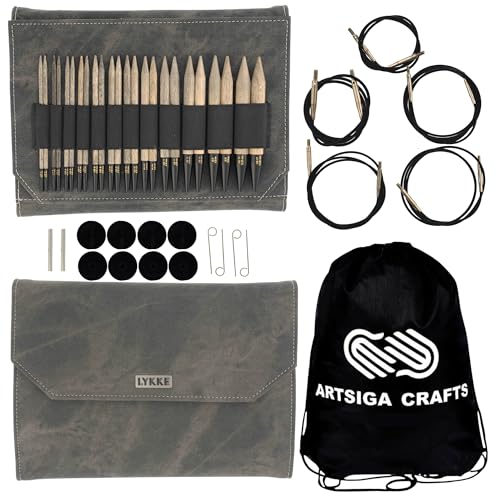
LYKKE Driftwood Interchangeable Circular Knitting Needle Set
Birch tips with a driftwood finish give grip that slippery yarns need, and the warmth suits knitters with hand pain who find metal fatiguing. The set arrives in a fabric case that stores flat. Wood tips are less pointed than steel, so lace with very fine yarn is less comfortable here.
Pros
- Grippy surface controls slick yarns
- Comfortable for long sessions
- Attractive and quiet in use
Cons
- Tips too blunt for very fine lace
- Wood can chip if dropped on hard floors

addi Turbo Circular Knitting Needles
The brass tips with a nickel-plated finish let stitches slide with almost no resistance, which is exactly what you want for large stockinette projects. Owners report the fixed-circular format has fewer failure points than any interchangeable system. The trade-off is that you buy one length and size at a time.
Pros
- Very fast stitch movement
- No join to loosen or snag
- Cable stays soft and pliable
Cons
- Slippery for loosely spun yarns
- Buying many sizes gets expensive

Clover Takumi Bamboo Circular Knitting Needles
Bamboo has just enough friction to stop stitches sliding off while you are still learning tension, which is why so many first projects start here. The needles are light and quiet. They wear faster than metal, so treat them as a learning and light-use tool rather than a lifetime set.
Pros
- Stitches stay put while you learn
- Warm and quiet to work with
- Cheap enough to buy several sizes
Cons
- Thin sizes can bend or snap
- Surface roughens with heavy use

Knitter’s Pride Mindful Collection Interchangeable Needle Set
This set sits between budget and premium, with stainless steel tips and a well-organised case that includes cable connectors and stoppers. Owners report the finish is smoother than the price suggests. Tips are moderately sharp, which makes it a reasonable single set if you knit a mix of lace, cables and plain fabric.
Pros
- Good value for a full interchangeable system
- Complete accessory kit included
- Tips suit varied project types
Cons
- Cables hold slight memory at first
- Joins need care to seat fully
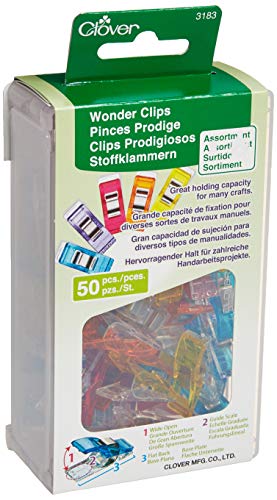
Clover Wonder Clips
These clips hold seams, hems and bulky knitted edges without piercing the fabric or losing grip on thick layers. Anyone who has fought pins through a heavy cabled seam understands the appeal instantly. They also work as stitch holders in a pinch and cost very little to add to a bag.
Pros
- Grips thick knitted layers securely
- No holes or snags in yarn
- Cheap and endlessly useful
Cons
- Too bulky for very fine lace
- Easy to lose loose in a bag
Cocoknits Maker’s Keep Accessory Case
A magnetic case that keeps stitch markers, tapestry needles and cable needles from scattering across a project bag. The lid holds small metal tools in place, which solves the classic problem of losing a darning needle inside a skein. It is a storage tool rather than a knitting tool, so buy it once the rest of the kit exists.
Pros
- Stops small metal tools going missing
- Sturdy enough for daily carry
- Neat and quick to open one-handed
Cons
- Holds only small notions
- Magnets can attract stray metal debris
How they compare
| # | Model | Tip material | Best for | Score | Price |
|---|---|---|---|---|---|
| 1 | ChiaoGoo Twist Red Lace Interchangeable Knitting Needle Set | Stainless steel | Best overall | 9.4 | Check price |
| 2 | LYKKE Driftwood Interchangeable Circular Knitting Needle Set | Birch wood | Best for wooden tips | 9.2 | Check price |
| 3 | addi Turbo Circular Knitting Needles | Nickel-plated brass | Best for speed knitting | 9.0 | Check price |
| 4 | Clover Takumi Bamboo Circular Knitting Needles | Bamboo | Best for beginners | 8.8 | Check price |
| 5 | Knitter’s Pride Mindful Collection Interchangeable Needle Set | Stainless steel | Best mid-range set | 8.6 | Check price |
| 6 | Clover Wonder Clips | Plastic with metal spring | Best small upgrade | 8.3 | Check price |
| 7 | Cocoknits Maker’s Keep Accessory Case | Magnetic notions case | Best for organising notions | 8.0 | Check price |
Questions worth asking
Do I need an interchangeable set as a beginner?
Not immediately. One or two fixed circular needles in the sizes your first patterns call for will teach you what you prefer. Once you find yourself buying a third or fourth size, a set becomes better value and takes up far less space.
Are metal or wooden needles better?
Neither is universally better. Metal is faster and sharper, wood grips more. The right answer depends on your yarn and your tension. Loose knitters often prefer wood for control, and tight knitters often prefer metal because stitches move more easily.
Why do my interchangeable needles keep unscrewing?
Most screw joins loosen if tightened by hand only. Use the supplied key or pin, and retighten every hour or so of knitting. Some knitters also rotate the work in the direction that tightens rather than loosens the join.
What size knitting needles should I start with?
Worsted weight yarn with needles around 4.5mm to 5mm is the most forgiving starting point. The stitches are large enough to see clearly and the fabric grows quickly, which keeps early projects motivating.
Are expensive knitting needles worth it?
They are worth it for smoother joins, better cables and sharper tips, all of which reduce friction over long projects. They do not make you knit better. If a budget needle is not snagging your yarn or fighting your hands, there is no urgency to upgrade.
What is the difference between lace tips and standard tips?
Lace tips have a longer, sharper taper for picking up multiple stitches and working decreases in fine yarn. They can split loosely spun yarn more easily, so many knitters keep standard tips for everyday fabric and lace tips for detailed work.
How do I stop cables from curling?
Cables with memory can be relaxed by soaking them briefly in warm water and hanging them straight. Memory-free nylon-coated steel cables avoid the problem entirely, which is one of the main reasons knitters upgrade sets.
Which notions do I actually need?
A tapestry needle, stitch markers, a tape measure and sharp scissors cover almost everything. Clips, row counters and magnetic cases are quality-of-life additions that owners report using constantly once they own them.
Our pick
The ChiaoGoo Twist Red Lace set is the strongest all-round buy because the joins and cables remove the two most common daily irritations. LYKKE Driftwood is the pick if metal tips tire your hands, and addi Turbo is worth owning in your favourite size for fast plain knitting. Add Clover Wonder Clips regardless of which needles you choose, since they cost little and improve every seam you finish.


