How to Water Evenly With the Right Lawn Sprinkler
Melnor XT4200M covers rectangular lawns evenly with an adjustable oscillating spray. Orbit Voyager II handles wide open square yards through 360 degree gear drive coverage. Facing an oddly shaped lot? Nelson Rain Train self propels across irregular ground for full coverage.
Yard shape decides more here than raw output or brand name. Melnor XT4200M suits rectangles, Orbit Voyager II covers large open squares, and Nelson Rain Train handles irregular or sloped ground that a fixed head sprinkler cannot reach evenly.
A mismatched sprinkler either leaves dry patches or soaks a driveway, so pattern shape matters more than price. We compared spray pattern, adjustable range, build material and flow rate, then checked that against owner reports of nozzle clogging and how evenly water lands across a full cycle.
The shortlist, ranked

Melnor XT4200M Metal Turbo Oscillating Sprinkler
A three way adjustable arm sets width, distance and pattern shape, fitting rectangular yards from small to large. Twenty precision rubber nozzles rated near 4500 square feet resist the clogging that plastic nozzles develop over time. Turbo drive gearing keeps the oscillation motion smooth under normal water pressure.
Pros
- Adjustable arm fits varied rectangle sizes
- Rubber nozzles resist mineral clogging
- Metal base stays stable at full spray width
Cons
- Rectangular pattern wastes water on round beds
- Wider settings demand higher water pressure

Orbit Voyager II Gear-Drive Sprinkler
A 360 degree gear drive head throws water between 25 and 52 feet, adjustable for smaller sections or a full open lawn. Slow rotation soaks ground evenly rather than pooling near the base the way faster impact heads can. A metal spike anchors the unit against tipping on soft, freshly watered soil.
Pros
- Full 360 degree coverage from one spot
- Slow rotation reduces water pooling
- Metal spike resists tipping in wet soil
Cons
- Overkill for small city lots
- Gear drive head runs slower than impact styles

Rain Bird 32ETI Brass Impact Sprinkler
Brass and metal construction resists the cracking that plastic impact sprinklers develop after a season or two in direct sun. An adjustable arc sprays a partial or full circle, useful along a fence line or driveway edge. A diffuser pin softens the spray for new seed without a separate attachment.
Pros
- Brass build resists UV cracking over seasons
- Adjustable arc handles edges and corners
- Diffuser pin suits new grass seed
Cons
- Impact head runs louder than gear-drive designs
- Higher build quality raises the cost

Nelson Rain Train Traveling Sprinkler
A cast iron gear system drives the unit along a garden hose track, covering up to 13500 square feet without repositioning by hand. Automatic shutoff stops the sprinkler once it reaches the end of its hose path, which prevents overwatering. Tread wheels handle mild slopes better than a stationary sprinkler manages.
Pros
- Covers large or irregular lots automatically
- Automatic shutoff prevents overwatering
- Handles mild slopes better than fixed sprinklers
Cons
- Laying out the hose path takes extra setup
- Not suited to small, simple yards

Orbit H2O-Six Gear-Drive Sprinkler on Metal T-Spike
A shorter throw radius than the Voyager II suits watering one section of a larger yard without soaking neighboring beds. A metal T-spike base keeps the head upright on uneven ground. Adjustable arc settings let one head cover a corner, a strip, or a full circle depending on placement.
Pros
- Shorter range suits zoned watering
- T-spike stays upright on uneven ground
- Arc adjusts from corner to full circle
Cons
- Shorter reach than full-yard sprinklers
- Needs more units to cover a large lawn
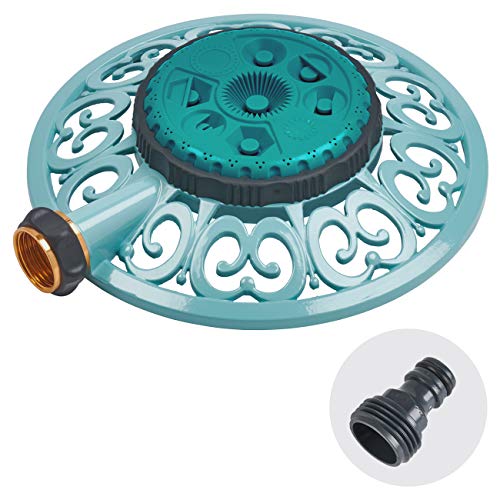
Melnor 65101-AMZ Sprout Metal 8-Pattern Sprinkler
Eight spray patterns switch with a simple dial, covering flower beds, garden rows or small lawn sections from one compact base. A metal sled base resists tipping better than lightweight plastic stationary sprinklers. Coverage stays modest, so this fits a small yard rather than a full acre lot.
Pros
- Eight patterns suit gardens and small lawns
- Metal base resists tipping in soft soil
- Lowest cost option in this comparison
Cons
- Limited range for larger properties
- Fewer adjustment options than turbo models
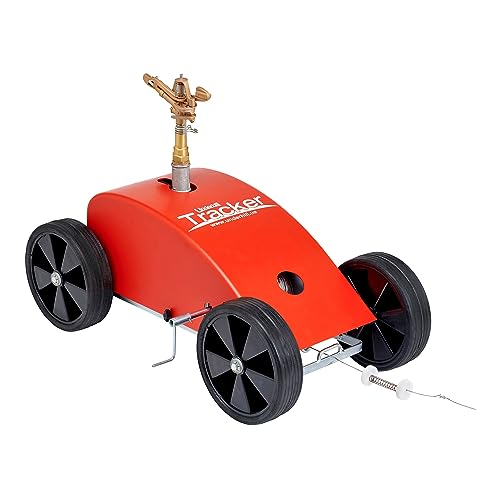
Underhill Tracker2 Traveling Sprinkler
Heavier duty construction than home grade traveling sprinklers targets sports fields, large estates and commercial grounds crews. Adjustable speed control changes the water application rate along the travel path for different soil types. Tread design copes with rougher terrain than a typical residential traveling sprinkler.
Pros
- Built for commercial and large property use
- Adjustable speed suits different soil types
- Handles rougher terrain than residential models
Cons
- More capacity than most home lawns require
- Costs more than residential traveling sprinklers
Before you buy
How sprinkler pattern should match yard shape Oscillating sprinklers, like the Melnor XT4200M, throw a rectangular fan suited to standard house lots. Circular or gear-drive heads, including the Orbit Voyager II, spread evenly from one center point across open square yards. A long, narrow or L-shaped lot usually needs several heads or a traveling sprinkler instead.
Why rated coverage depends on real water pressure A sprinkler rated for 4500 square feet still needs adequate household water pressure to reach that full range. Homes with low pressure see reduced throw distance regardless of what the box claims. Checking actual home pressure before buying avoids a sprinkler that underperforms its listed specs.
When a traveling sprinkler beats a stationary one Stationary sprinklers work fine for yards under roughly 5000 square feet. Larger, irregular or sloped lawns benefit from a traveling design like the Nelson Rain Train, which follows a hose path instead of relying on one fixed spray radius. Automatic shutoff on traveling models also cuts water waste from a forgotten sprinkler.
Metal, brass and plastic: what lasts outdoors Metal bases and brass nozzles, seen on the Rain Bird 32ETI, resist UV cracking that plastic housings develop after repeated sun exposure. Rubber nozzles, like those on the Melnor XT4200M, resist mineral buildup better than rigid plastic ones. Budget plastic sprinklers still function but typically need replacing sooner.
How they stack up
| # | Model | Pattern | Best for | Score | Price |
|---|---|---|---|---|---|
| 1 | Melnor XT4200M Metal Turbo Oscillating Sprinkler | Oscillating, three-way adjustable | Best overall | 9.4 | Check price |
| 2 | Orbit Voyager II Gear-Drive Sprinkler | 360-degree gear-drive rotary | Best for large open yards | 9.1 | Check price |
| 3 | Rain Bird 32ETI Brass Impact Sprinkler | Impact, adjustable arc | Best for durability | 8.9 | Check price |
| 4 | Nelson Rain Train Traveling Sprinkler | Self-propelled traveling spray | Best for irregular or large lawns | 8.7 | Check price |
| 5 | Orbit H2O-Six Gear-Drive Sprinkler on Metal T-Spike | Gear-drive, adjustable arc | Best for sectional watering | 8.5 | Check price |
| 6 | Melnor 65101-AMZ Sprout Metal 8-Pattern Sprinkler | 8 selectable spray patterns | Best budget | 8.2 | Check price |
| 7 | Underhill Tracker2 Traveling Sprinkler | Self-propelled traveling spray | Best for commercial or large properties | 8.0 | Check price |
Common questions
What sprinkler is best for a rectangular yard?
An oscillating sprinkler like the Melnor XT4200M matches a rectangular spray pattern to a typical house lot shape.
Which sprinkler covers the most ground?
The Nelson Rain Train covers up to 13500 square feet by traveling along a hose path rather than staying fixed in one spot.
How do gear-drive sprinklers differ from impact sprinklers?
Gear-drive heads rotate quietly through internal gearing, while impact sprinklers click as a spring-loaded arm strikes the water stream. Both cover a circle, but impact designs tend to run louder.
Is a traveling sprinkler worth it for a small yard?
Not usually. Traveling sprinklers suit large or irregular lawns, while a stationary or oscillating sprinkler covers a small yard with less setup.
What causes a sprinkler to clog over time?
Mineral deposits from hard water build up inside nozzles, especially plastic ones. Rubber nozzles, like those on the Melnor XT4200M, resist this better.
Can one sprinkler cover an entire large lawn?
Rarely, without a traveling design. Most stationary sprinklers need moving or multiple units to fully cover a lawn over an acre.
How much water pressure does a sprinkler need?
Most home sprinklers work fine on standard residential pressure, but reaching a sprinkler’s maximum rated range needs pressure at or above what the packaging specifies.
Are metal sprinklers better than plastic ones?
Metal bases and brass components resist cracking and UV damage longer than plastic, which matters most for sprinklers left outside all season.
Sprinkler vs drip irrigation, which suits a lawn?
Sprinklers suit open grass areas that need broad overhead coverage. Drip irrigation fits garden beds and rows where water should reach roots directly instead of the whole surface.
What size yard needs a traveling sprinkler?
Lawns over roughly 5000 square feet, or ones with an irregular shape, usually see better coverage from a traveling design than from a single stationary head.
The bottom line
Melnor XT4200M suits the largest share of standard rectangular yards with adjustable, even coverage. Large open lawns do better with the 360 degree spread of the Orbit Voyager II. Irregular or sloped properties are better served by a self-propelled option like the Nelson Rain Train.


