Seed Starting Kits for Stronger Spring Seedlings
The Hydrofarm Jump Start Germination Station tops our ranking because it pairs a heat mat with a humidity dome, covering the two things seeds need most. Burpee’s self watering kit suits gardeners who travel, and Bootstrap Farmer trays are the choice for anyone starting seeds every year.
For reliable germination the Hydrofarm Jump Start Germination Station is the kit we rank first, since bottom heat plus a dome solves most seed starting failures at once. The Burpee self watering kit suits irregular schedules, and Bootstrap Farmer trays last for many seasons.
Seed starting kits are surprisingly easy to get wrong, because the cheap ones fail at the exact moment that matters, which is when seedlings need deeper roots and stronger light rather than more warmth. We compared cell depth, dome clearance, heat mat inclusion, tray rigidity and drainage across seven current listings, weighting toward kits that keep working past the first true leaves.
The best picks, ranked

Hydrofarm Jump Start Germination Station CK64050
This bundles a 72 cell insert, a watertight tray, a tall humidity dome and a heat mat, which together address warmth and moisture without any improvisation. Bottom heat is what lifts germination rates on peppers, tomatoes and aubergines specifically. The dome is tall enough that seedlings do not press against it within days.
Pros
- Heat mat makes a real difference on warm season crops
- Tall dome avoids early crowding
- Everything needed in one box
Cons
- Cells are shallow for long term growing
- Heat mat has no thermostat included

Burpee Self-Watering Seed Starting Kit
A capillary mat wicks water up from a reservoir, so cells stay evenly moist without daily attention and without the surface saturation that causes damping off. That makes it the sensible choice for anyone away from home during the week. The reservoir still needs topping up every few days as seedlings grow.
Pros
- Very consistent moisture levels
- Reduces damping off risk
- Forgiving of missed days
Cons
- Reservoir needs regular refilling
- No heat source included

Bootstrap Farmer 1020 Seed Starting Trays
These are the trays that survive being picked up when full, which cheap black nursery flats never do, and they are rated for many seasons of reuse. Depth options let you match the tray to the crop. They are sold as components rather than a complete kit, so you add a dome, mat and inserts to suit.
Pros
- Genuinely durable and reusable
- Carries safely when full
- Multiple depth and hole options
Cons
- Components bought separately
- Higher initial outlay

Jiffy Professional Greenhouse 72 Peat Pellet Kit
Peat pellets expand with water and become both the container and the growing medium, which removes the messiest part of seed starting entirely. Transplanting is easy because the whole pellet goes into the ground. Owners report the netting around each pellet should be peeled back at planting to avoid restricting roots.
Pros
- No potting mix to buy or handle
- Minimal transplant shock
- Very simple for first timers
Cons
- Pellet netting can restrict roots
- Pellets dry out quickly if uncovered

VIVOSUN Seed Starter Tray with Humidity Dome
VIVOSUN sells trays in multi packs with domes and adjustable vents, which suits gardeners starting large numbers of seedlings across staggered sowings. The vents let you reduce humidity gradually as seedlings harden off. The plastic is thinner than Bootstrap Farmer trays, so support them underneath when moving.
Pros
- Good quantity for the outlay
- Adjustable vents on domes
- Several cell size options
Cons
- Thin plastic needs supporting
- Domes crack if forced

MIXC Seed Starter Tray Kit
This kit adds plant labels, a hand tool set and a watering aid to the usual trays and domes, which covers everything a first time seed starter needs to buy. The cells are a reasonable depth for lettuce, brassicas and flowers. Based on specifications the tray material is light, so expect a couple of seasons rather than many.
Pros
- Nothing else to buy on day one
- Useful labels and tools included
- Reasonable cell depth
Cons
- Lightweight trays flex when full
- Not built for many seasons
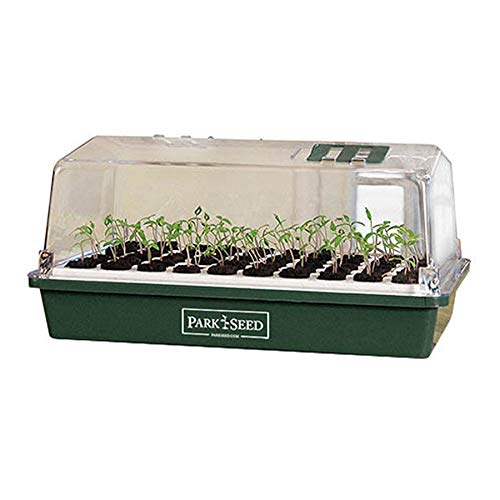
Park Seed Bio Dome Seed Starter Kit
Park Seed uses a foam block with sponge cells rather than loose mix, and the arrangement holds moisture and air in a balance that suits fussy germinators. Roots are easy to inspect and separate at transplant time. The sponges are a consumable, so factor in replacements each season.
Pros
- Excellent air to water balance
- Good results on slow germinators
- Clean to handle
Cons
- Replacement sponges are an ongoing cost
- Fewer cells than standard trays
How to choose
Warmth germinates, light grows Most germination failures come down to soil temperature rather than anything else, with tomatoes, peppers and aubergines wanting roughly 75 to 85 degrees Fahrenheit at the root zone. A heat mat under the tray achieves that far more reliably than a warm windowsill. Once seedlings emerge, warmth stops being the priority and light takes over, which is where a sunny window usually falls short and a simple grow light pays for itself.
Cell depth and when to pot on Shallow 72 cell inserts are fine for the first few weeks, but tomato and squash roots will circle and stall in them. Plan to pot on into three or four inch pots once the first true leaves are established, or start those crops in deeper cells from the beginning. Root bound seedlings transplanted into the garden recover slowly and rarely catch up with those potted on in time.
Moisture, airflow and damping off Damping off is a fungal collapse at the soil line that kills healthy looking seedlings overnight, and it thrives in still, saturated conditions. Bottom watering keeps the surface drier, vented domes reduce standing humidity, and removing the dome entirely once most seeds have sprouted is the single most effective prevention. A small fan running a few hours a day also strengthens stems noticeably.
Hardening off before planting out Seedlings raised indoors have thin cuticles and no wind conditioning, so moving them straight outside causes scorch and snapped stems. Introduce them over seven to ten days, starting with an hour in dappled shade and building up exposure and duration. Owners report this step is skipped more often than any other, and it is the most common reason strong looking seedlings fail in the first week outdoors.
How they compare
| # | Model | Cells | Best for | Score | Price |
|---|---|---|---|---|---|
| 1 | Hydrofarm Jump Start Germination Station CK64050 | 72 cell insert | Best overall | 9.4 | Check price |
| 2 | Burpee Self-Watering Seed Starting Kit | 72 cell version and smaller sizes | Best for consistent moisture | 9.2 | Check price |
| 3 | Bootstrap Farmer 1020 Seed Starting Trays | Standard 1020 flat | Best build quality | 9.0 | Check price |
| 4 | Jiffy Professional Greenhouse 72 Peat Pellet Kit | 72 peat pellets | Best for beginners | 8.8 | Check price |
| 5 | VIVOSUN Seed Starter Tray with Humidity Dome | Available in 12, 24 and 72 cell formats | Best value | 8.6 | Check price |
| 6 | MIXC Seed Starter Tray Kit | Multiple tray configurations | Best complete beginner bundle | 8.3 | Check price |
| 7 | Park Seed Bio Dome Seed Starter Kit | 40 or 60 cell versions | Best for tricky seeds | 8.0 | Check price |
Good to know
Do I need a heat mat for seed starting?
For warm season crops like peppers, tomatoes and aubergines it makes a substantial difference to speed and germination rate. Cool season crops such as lettuce and brassicas germinate fine at normal room temperature.
When should I remove the humidity dome?
Once most seeds have sprouted. Leaving it on afterwards traps humidity around the stems and encourages damping off. Vent it first, then remove it entirely over a day or two.
Can I reuse seed starting trays?
Yes, provided you wash them and sanitise with a dilute bleach or hydrogen peroxide solution between seasons. Heavy duty trays reuse for many years, while thin nursery flats often crack after one.
What is the best growing medium for seeds?
A fine, sterile seed starting mix rather than garden soil or standard potting compost. Seed mixes hold moisture without compacting and carry no weed seeds or pathogens.
How much light do seedlings need?
Around fourteen to sixteen hours a day from a grow light positioned a few inches above the leaves. A south facing window alone usually produces stretched, weak seedlings.
Why are my seedlings tall and floppy?
Almost always insufficient light, which causes them to stretch toward the source. Move the light closer, extend the daily hours, and run a small fan to strengthen stems.
Should I bottom water or top water?
Bottom watering is generally better, since it keeps the surface drier and encourages roots downward. Top water gently only when the surface needs settling after sowing.
How long before seedlings go outside?
Most transplants go out four to eight weeks after sowing depending on the crop and your last frost date, and only after seven to ten days of hardening off.
Final word
The Hydrofarm Jump Start Germination Station takes our top spot because it solves warmth and humidity together, which is where most seed starting attempts fail. Gardeners with unpredictable schedules will get better survival rates from the Burpee self watering kit and its steady moisture. If you start seeds every spring, buying Bootstrap Farmer trays once works out cheaper than replacing thin flats each year.