Lightweight Suitcases for Strict Airline Weight Limits
The Travelpro Maxlite 5 is the lightweight suitcase we would pick first, saving real weight without giving up wheel quality. The Samsonite Ascella 3.0 offers the best pocket layout we compared, and the Amazon Basics Softside Spinner covers occasional trips affordably.
The Travelpro Maxlite 5 gives back the most allowance for what it costs, the Samsonite Ascella 3.0 organises better with front pockets, and the Amazon Basics Softside Spinner is the sensible choice for occasional travel. Empty weight is the spec that decides this category.
Lightweight luggage is tricky because saving weight usually means thinner fabric, smaller wheels and less rigid frames, and the wrong compromise shows up as a broken wheel on trip three. We compared published empty weights against capacity, fabric denier, wheel and handle construction and warranty terms, alongside what owners report after repeated flights.
Our top picks

Travelpro Maxlite 5 Softside Expandable Spinner
Travelpro built its reputation on crew luggage, and the Maxlite 5 applies that engineering to a properly light case. It weighs noticeably less than most rivals while keeping wheels and a handle that survive real use. Expansion adds a useful margin for the trip home.
Pros
- Excellent weight to durability balance
- Smooth long lasting spinner wheels
- Strong warranty terms
Cons
- Plain styling
- Soft shell offers less protection for fragile items

Samsonite Ascella 3.0 Softside Luggage
Front pockets that actually fit a laptop and documents make this the easiest case here to move through an airport without unpacking. The fabric shell keeps weight down while giving useful flex when a bin is tight. Interior dividers and straps keep clothes from shifting.
Pros
- Genuinely useful external pockets
- Flexible shell for tight bins
- Solid interior organisation
Cons
- Fabric marks more easily than a hard shell
- Pockets tempt overpacking
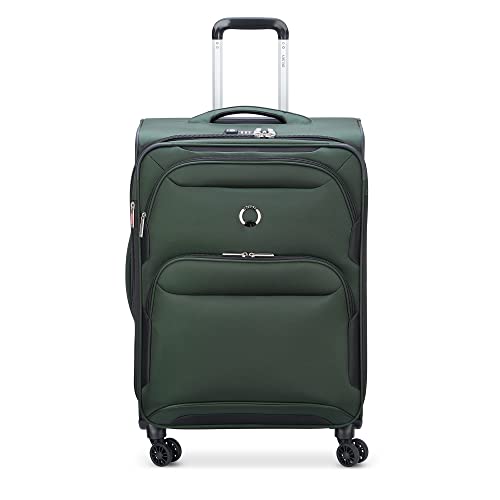
Delsey Paris Sky Max 2.0 Softside Luggage
A generous expansion zip adds meaningful volume without the case losing its shape when loaded. Delsey uses a reinforced base that resists the wear light cases usually show first. Wheels roll well loaded, though they are not as quiet as premium hardshells.
Pros
- Substantial usable expansion
- Reinforced base resists wear
- Good value for the capacity
Cons
- Heavier than the Maxlite 5
- Expanded size can exceed cabin limits

SwissGear Sion Softside Expandable Luggage
Heavier denier fabric and reinforced corners give this case more resistance to scuffing than most light softsides. It weighs a little more as a result, which is a fair trade for anyone who checks bags often. Owners report the zips hold up better than the class average.
Pros
- More abrasion resistant than most
- Sturdy zips and pulls
- Effective compression straps
Cons
- Not the lightest option here
- Bulkier profile when expanded

American Tourister 4 Kix 2.0 Softside Luggage
This hits a sensible middle ground of light weight, generous capacity and a price that makes buying a full set realistic. The colours make it easy to identify on a carousel. Construction is lighter duty than Travelpro or Samsonite, so it suits moderate rather than constant travel.
Pros
- Affordable enough to buy as a set
- Bright colours are easy to spot
- Light for the capacity
Cons
- Lighter duty than premium rivals
- Handle has some play when extended

Amazon Basics Softside Expandable Spinner Luggage
For two or three trips a year this covers the essentials with four spinner wheels and a light fabric shell that keeps the empty weight down. Interior organisation is basic but functional. Owners report it does the job for light use and shows wear faster under heavy travel.
Pros
- Very low outlay
- Light empty weight
- Simple usable layout
Cons
- Not built for frequent flying
- Wheels are the first thing to wear

U.S. Traveler Rio Carry-On Luggage
Sold as a pair of cabin sized cases, this is the easiest way to kit out two people travelling with hand luggage only. Both cases are extremely light, which is exactly what strict cabin allowances demand. Build is basic, so treat them as short trip cases rather than long haul workhorses.
Pros
- Two cases in one purchase
- Extremely light for cabin limits
- Front pocket for documents
Cons
- Basic construction throughout
- Small wheels struggle on rough ground
How they stack up
| # | Model | Weight | Best for | Score | Price |
|---|---|---|---|---|---|
| 1 | Travelpro Maxlite 5 Softside Expandable Spinner | Among the lightest in its size class | Best overall | 9.4 | Check price |
| 2 | Samsonite Ascella 3.0 Softside Luggage | Light for its capacity | Best organisation | 9.2 | Check price |
| 3 | Delsey Paris Sky Max 2.0 Softside Luggage | Durable woven polyester | Best for expansion | 9.0 | Check price |
| 4 | SwissGear Sion Softside Expandable Luggage | Heavy denier polyester | Best for durability | 8.7 | Check price |
| 5 | American Tourister 4 Kix 2.0 Softside Luggage | Lightweight polyester | Best value | 8.5 | Check price |
| 6 | Amazon Basics Softside Expandable Spinner Luggage | Lightweight softside | Best budget | 8.2 | Check price |
| 7 | U.S. Traveler Rio Carry-On Luggage | Two carry on cases | Best carry on pair | 8.0 | Check price |
Before you buy
Empty weight is the number that matters Every pound the case weighs is a pound you cannot pack. On carriers with a 15 or 20 kilogram allowance, a heavy suitcase can eat a tenth of your capacity before you put anything in it. Compare empty weights within the same size class rather than across sizes, and be sceptical of listings that quote weight without stating whether wheels and handle are included.
Soft usually beats hard on weight, but not always Fabric cases are typically lighter than hardshells of the same capacity and squeeze into tight overhead bins better. They also add external pockets, which hardshells cannot offer. The trade is less protection for fragile contents and more vulnerability to rain and slashing. If your packing is clothes and shoes, soft is the sensible choice.
Do not let weight saving reach the wheels The cheapest way to shave weight is smaller, lighter wheels and a thinner handle, and those are precisely the parts that fail first. Look for sealed bearing spinner wheels and a handle that locks firmly at several heights without much wobble. Travelpro’s crew luggage heritage shows here, which is why the Maxlite 5 leads a category otherwise full of compromises.
Check the case against the airline you actually fly Cabin size limits vary widely, and budget carriers measure strictly, including wheels and handles. An expandable case zipped open will almost never pass a sizer. Measure your case yourself rather than trusting the listing, since manufacturers sometimes quote body dimensions rather than the full external size.
Common questions
How much should a lightweight suitcase weigh?
For a carry on, roughly 5 to 7 pounds is light. For a large checked case, anything under about 10 pounds is doing well. Compare within a size class, since a big case will always weigh more than a cabin bag.
Are lightweight suitcases less durable?
Not necessarily, but cheap ones are. Weight saved through better engineering, as in the Travelpro Maxlite 5, holds up. Weight saved by using thinner fabric and smaller wheels shows within a few trips.
Softside or hardside for lightweight travel?
Softside is usually lighter for the same capacity and offers external pockets and more give in a tight bin. Hardside protects fragile contents better and resists rain. For clothes only packing, softside is the practical pick.
Do external pockets add much weight?
Very little, and they save time at security. The main downside is that they encourage packing more than you intended, which is what actually pushes you over the weight limit.
Will an expandable case still count as carry on?
Not usually when expanded. Treat expansion as something you use on a checked bag or when the airline is relaxed, and pack to the unexpanded size if you need to guarantee cabin compliance.
How do I weigh my suitcase at home?
A handheld luggage scale is the accurate way. Standing on a bathroom scale holding the case and subtracting your own weight works, but the margin of error is large enough to matter near a strict limit.
What fails first on a light suitcase?
Wheels, then the telescoping handle, then zip pulls. Sealed bearing wheels and a handle with minimal play when fully extended are the two things worth checking before buying.
Should I buy a matching set?
Only if you will genuinely use all the sizes. Many travellers use one cabin case and one checked case repeatedly and leave the third piece in a cupboard, so two well chosen cases often beat a three piece set.
Final word
The Travelpro Maxlite 5 is the lightweight suitcase we would buy for ourselves, because the weight saving comes from good engineering rather than corners cut on wheels and handles. Travellers who want front pocket access to a laptop and documents will get more from the Samsonite Ascella 3.0. If you fly rarely, the Amazon Basics Softside Spinner does the job honestly without pretending to be built for weekly travel.