How to Slice Vegetables Thin and Even Every Time
For everyday cooking, the OXO Good Grips V-Blade Mandoline Slicer wins overall with an easy thickness dial and a stable base. The Mueller Multi Blade Adjustable Mandoline Slicer costs less while adding julienne and grating blades. Pick the Benriner Japanese Mandoline Slicer instead when paper-thin, restaurant-style slices matter most.
Home cooks reach for the OXO Good Grips V-Blade Mandoline Slicer most often, since its dial handles daily slicing without a manual. Bigger batches favor the Mueller Multi Blade Adjustable Mandoline Slicer, which swaps blades for julienne and grating. Chefs chasing translucent slices pick the Benriner Japanese Mandoline Slicer instead.
Blade sharpness that saves prep time also raises injury risk, so guard design matters as much as the cut. Thickness systems range from one fixed slot to a full dial, changing how versatile a slicer feels in daily use. We compared blade material, guard coverage, published thickness ranges, and owner cleanup reports across all seven picks.
The shortlist, ranked

OXO Good Grips V-Blade Mandoline Slicer
A stainless V-blade meets a dial that steps through several thicknesses, so slice depth changes with one twist. A non-slip foot keeps the base planted on a counter during long prep sessions. Owners single out the food holder as the reason new cooks pick up a mandoline without hesitation.
Pros
- Dial adjusts thickness in seconds
- Non-slip foot resists sliding
- Food holder suits mandoline beginners
Cons
- Only slices, no julienne blade
- Takes more drawer space than handheld models

Mueller Multi Blade Adjustable Mandoline Slicer
Interchangeable stainless blades cover slicing, julienne, and grating in one box. A folding stand plus a catch container keeps the kit tidy between uses. Firm vegetables like carrots and potatoes hold up well under the adjustable knob, according to owner reports.
Pros
- Several blades cover three cut styles
- Adjustable knob changes thickness fast
- Low cost for the blade variety
Cons
- More small parts to track and store
- Blade swaps require careful handling
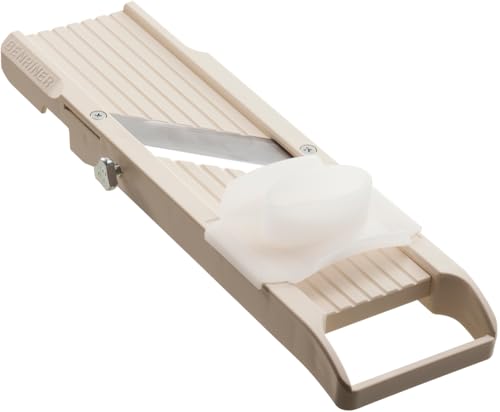
Benriner Japanese Mandoline Slicer
Professional kitchens have relied on this Japanese-steel blade for decades, and a screw adjusts thickness in fine increments. Julienne teeth attach separately for matchstick cuts. Translucent onion and radish slices come out even, though only with a steady hand.
Pros
- Fine screw adjustment for exact thickness
- Julienne teeth attachment included
- Lightweight body stores in a drawer
Cons
- Guard offers minimal finger coverage
- Blade demands careful, slow technique

Fullstar Mandoline Slicer and Vegetable Chopper
A built-in catch container drops slices straight into a bowl-ready pile, cutting cleanup during batch cooking. Interchangeable inserts switch between slicing, julienne, and dicing. Weekly meal-prep cooks cite the fast blade changes as the main draw.
Pros
- Catch container reduces mess
- Three cut styles from swappable inserts
- Fast blade changes for batch prep
Cons
- Preset thickness only, no dial
- Plastic housing feels less sturdy than steel

KitchenAid Hand-Held V-Blade Mandoline Slicer
Slicing happens directly over a mixing bowl here, skipping the need for a standing base. Flat storage means it slides into a drawer next to other tools. Small kitchens gain quick, even slices without giving up counter space.
Pros
- Slices directly over a bowl
- Stores flat in a drawer
- Backed by a recognized kitchen brand
Cons
- Less stable than a standing mandoline
- Cutting surface narrower than full-size models

Swissmar Borner V-Prep V-Slicer
German engineering built this fixed V-blade for repeatable results batch after batch. Insert swaps change between slicing and julienne cuts. Firm produce like cabbage and potatoes moves through cleanly, with little flex in the frame.
Pros
- Consistent slice thickness every time
- Rigid frame with no flex
- Handles dense, firm vegetables well
Cons
- Insert changes take extra time
- Guard requires a firm, deliberate grip

Kyocera Advanced Ceramic Mandoline Slicer
An advanced ceramic blade replaces steel here, so it resists rust and holds an edge for years. Acidic produce like tomatoes and citrus will not pick up a metallic taste from this blade. The slim body weighs less than most steel mandolines.
Pros
- Ceramic edge resists rust long term
- No metallic taste on acidic produce
- Slim, lightweight for easy storage
Cons
- Ceramic can chip if dropped
- Slicing only, no julienne option
How they stack up
| # | Model | Blade | Best for | Score | Price |
|---|---|---|---|---|---|
| 1 | OXO Good Grips V-Blade Mandoline Slicer | Stainless V-blade | Best overall | 9.3 | Check price |
| 2 | Mueller Multi Blade Adjustable Mandoline Slicer | Interchangeable stainless | Best value | 9.0 | Check price |
| 3 | Benriner Japanese Mandoline Slicer | Japanese carbon-style steel | Best for thin precision | 9.1 | Check price |
| 4 | Fullstar Mandoline Slicer and Vegetable Chopper | Multiple stainless inserts | Best for meal prep | 8.7 | Check price |
| 5 | KitchenAid Hand-Held V-Blade Mandoline Slicer | Stainless V-blade | Best compact pick | 8.5 | Check price |
| 6 | Swissmar Borner V-Prep V-Slicer | German V-blade | Best for uniform slices | 8.8 | Check price |
| 7 | Kyocera Advanced Ceramic Mandoline Slicer | Advanced ceramic | Best ceramic blade | 8.6 | Check price |
How to pick the right one
What blade type should you look for? Straight blades need a longer push stroke and suit firm vegetables like potatoes. V-blades and Japanese-style edges bite in with less force, giving cleaner thin cuts. Ceramic blades resist rust and stay sharp for years, but they chip if dropped on tile. Match the blade to what you slice most, since it shapes both effort and finish.
How much thickness control do you actually need? A fixed-slot slicer produces one thickness only, while dial or insert systems shift from paper-thin chips to thick fries. Cooks who prepare varied dishes benefit most from adjustable settings. Anyone who wants one consistent cut, like coleslaw cabbage, can save money with a simpler fixed design.
Why do safety guards matter so much? A mandoline blade cuts deeper than most kitchen knives on contact. A snug food holder and a base that will not slide are not optional extras. Cut-resistant gloves add another layer of protection during long prep sessions. Vegetable ends are the riskiest moment, so finish those pieces by hand instead of forcing them through.
Is cleanup different for handheld versus standing mandolines? Standing mandolines slice faster but need counter or cabinet space to store safely. Handheld models tuck flat into a drawer, trading some stability for a smaller footprint. Sliced residue collects around blades and inserts, so dishwasher-safe parts save real scrubbing time. Store the blade covered so it stays sharp between uses.
Common questions
What is the safest way to use a mandoline slicer?
Always feed vegetables through the included food holder or hand guard. Set the base on a non-slip surface, and finish the last inch of any vegetable by hand. A cut-resistant glove adds real protection during long sessions.
Is a V-blade or a straight-blade mandoline better?
V-blades and Japanese blades cut with less pushing force and leave cleaner thin slices. Straight blades are simpler and easier to sharpen at home. Most home cooks find a sharp V-blade the easier daily pick.
Can a dull mandoline blade be sharpened?
Some steel blades can be honed carefully with the right stone, though many mandolines rely on replaceable inserts instead. Ceramic blades like Kyocera’s hold an edge for years but are not designed for home sharpening.
How thin can a mandoline actually slice?
A precision model like the Benriner produces nearly translucent slices with practice. Adjustable home mandolines typically range from about one sixteenth of an inch up to thick fry cuts.
Are mandoline slicers dishwasher safe?
Several models, including the OXO and Fullstar, list top-rack dishwasher-safe parts. Hand washing still preserves sharp edges longer and prevents warping on plastic housings.
Do I need a multi-blade mandoline kit?
A multi-blade kit like the Mueller adds julienne and grating options in one purchase. Cooks who only need clean slices can skip the extra parts and pick a single sharp blade instead.
Should I buy a handheld or a standing mandoline?
Handheld models like the KitchenAid store flat and slice straight over a bowl. Standing mandolines are steadier and faster for slicing large batches of vegetables.
Why are my mandoline slices coming out uneven?
Inconsistent pressure or a loose grip on the food holder usually causes uneven slices. Keep steady, even strokes, seat the vegetable flat, and confirm the thickness dial is fully engaged before starting.
What is the best mandoline slicer for meal prep?
The Fullstar Mandoline Slicer and Vegetable Chopper suits batch cooking, since its catch container drops slices straight into a bowl. Interchangeable inserts speed up switching between cut styles.
Our pick
OXO’s V-Blade Mandoline Slicer earns the overall pick for its balance of sharpness, safety, and easy dial control. Choose the Mueller kit when versatility on a budget matters more, or the Benriner when paper-thin, professional-style slices are the goal.