Memory and Matching Games Kids Ask to Play Again
Ravensburger Disney Classics Memory is our top pick for thick tiles and images young children recognise instantly. Wonder Forge I Never Forget a Face adds real world faces that hold attention longer, and Blue Orange Spot It is the fast paced matching game that travels best.
For a first memory game, Ravensburger Disney Classics Memory is the safest choice thanks to sturdy tiles and instantly familiar images. Wonder Forge I Never Forget a Face keeps older preschoolers engaged with photographs of children around the world, and Blue Orange Spot It is the pocket sized matching game families actually keep playing.
Matching games are harder to pick than they look because the differences that matter are physical. Thin cards curl after a fortnight, glossy printing reflects overhead light, and a grid that is too large turns a five minute game into a frustrating twenty. We compared card stock and tile thickness, recommended ages, the number of pairs in a standard round and image legibility, then weighed those against what parents report about repeat play.
How to pick the right one
Start with fewer pairs than the box suggests Almost every memory game includes far more pairs than a young child should face at once. A grid of six to eight pairs gives a toddler a game they can finish and win, while a full 36 pair layout is overwhelming and usually ends in someone wandering off. Start small, add pairs as recall improves, and treat the printed pair count as a ceiling for later rather than an instruction for the first game.
Card thickness and finish decide how long it lasts The single biggest quality difference between sets is the board. Thick tiles stay flat, resist bending when a child scoops them up, and do not curl in a warm room. Thin card develops a bow within weeks, and a bowed card is a marked card because it stands out in the grid. Matte finishes also beat high gloss under a ceiling light, since glare makes it hard for a child sitting low at the table to see the images at all.
Memory games versus speed matching games Classic memory games train recall by hiding information, which suits younger children playing at their own pace. Speed matching games such as symbol spotting reward visual scanning instead, and they have the useful property of levelling the field between adults and children, since a five year old often beats a parent. Families with a wide age range usually get more mileage from a speed matching game, while a single toddler benefits more from a classic memory set.
Images that a child can actually name Matching is easier and more enjoyable when a child can say what they are looking at. Bold, high contrast illustrations of familiar animals and objects work better than detailed scenes with lots going on. Photographic sets add interest for older preschoolers who have exhausted the cartoon options. Whatever the style, check that pairs are visibly distinct from each other, since sets with several near identical images turn matching into guesswork.
The best picks, ranked

Ravensburger Disney Classics Memory Game
Ravensburger has made this style of memory game for decades and the tile quality shows, with thick board stock that stays flat and a matte finish that does not throw glare across the table. The Disney artwork gives younger children an instant hook, and the pairs are distinct enough that a three year old is not guessing between near identical images.
Pros
- Tiles stay flat with heavy use
- Matte finish avoids glare
- Easily recognised characters
Cons
- Full grid is too large for young starters
- Character appeal fades as kids age out

Wonder Forge I Never Forget a Face Matching Game
Instead of cartoon icons, this uses photographs of children from around the world, which holds attention noticeably longer because every card carries genuine detail to look at. The cards are thick and the back of each names the country shown, which gives parents an easy conversation to start. It works as a matching game and as a quiet talking point.
Pros
- Photographs sustain interest longer
- Country names printed on backs
- Sturdy card stock
Cons
- Faces are harder to match than icons
- Too subtle for the youngest players

Blue Orange Spot It Card Game
Spot It is a speed matching game rather than a memory game, where every pair of cards shares exactly one symbol and the first to shout it wins. The round cards live in a metal tin small enough for a glovebox, and a game takes minutes. It scales up in a way pure memory games do not, so adults are genuinely competitive against children.
Pros
- Adults and children compete fairly
- Tin survives a bag or glovebox
- Several game modes in one deck
Cons
- Fast pace frustrates some younger kids
- Not a memory game in the classic sense
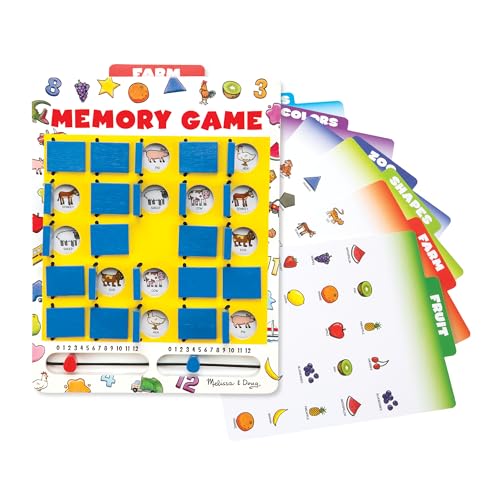
Melissa and Doug Flip to Win Memory Game
The pieces are wooden flippers set into a hinged board, so nothing gets lost under a sofa and setup is instant. Cards slide behind the flippers to change the images, which extends the life of the game beyond a single set. That closed format makes it one of the few matching games that survives being thrown in a car boot repeatedly.
Pros
- Nothing to lose or scatter
- Instant setup and pack away
- Swappable card sets add variety
Cons
- Limited to two players
- Bulkier than a card box

eeBoo Little Hands Memory and Matching Game
eeBoo builds this for small hands with large, thick cards and simple illustrated subjects that a two year old can name. The reduced number of pairs keeps a round short enough to finish before attention wanders, which is the practical difference between a game that gets played and one that does not. Printing is on recycled board with a soft matte finish.
Pros
- Card size suits toddler grip
- Short rounds match short attention
- Clear, nameable illustrations
Cons
- Outgrown within a couple of years
- Few pairs limits challenge

Briarpatch The World of Eric Carle Matching Game
Eric Carle illustrations are bold and high contrast, which happens to be exactly what a young child needs to distinguish one card from another quickly. The set covers animals and shapes from the books, so it doubles as an extension of stories already on the shelf. Card thickness is decent for the money, though not at Ravensburger level.
Pros
- High contrast art is easy to match
- Ties into familiar picture books
- Good value for the pair count
Cons
- Card stock thinner than premium sets
- Glossy coating shows fingerprints

Mudpuppy Memory Matching Game
Mudpuppy commissions illustrators rather than licensing characters, so the cards look like something you would leave out on a coffee table. The storage box is sturdier than average and the card backs are uniform enough that nobody can cheat by spotting a printing mark. A good pick when the game is a gift as much as a toy.
Pros
- Distinctive commissioned artwork
- Sturdy storage box
- Consistent card backs
Cons
- Detailed art is harder for toddlers
- Fewer pairs than large sets
Compared at a glance
| # | Model | Ages | Best for | Score | Price |
|---|---|---|---|---|---|
| 1 | Ravensburger Disney Classics Memory Game | 3 and up | Best overall | 9.4 | Check price |
| 2 | Wonder Forge I Never Forget a Face Matching Game | 4 and up | Best for older preschoolers | 9.2 | Check price |
| 3 | Blue Orange Spot It Card Game | 6 and up | Best for travel | 9.0 | Check price |
| 4 | Melissa and Doug Flip to Win Memory Game | 5 and up | Best self contained | 8.8 | Check price |
| 5 | eeBoo Little Hands Memory and Matching Game | 2 and up | Best for toddlers | 8.6 | Check price |
| 6 | Briarpatch The World of Eric Carle Matching Game | 3 and up | Best value | 8.3 | Check price |
| 7 | Mudpuppy Memory Matching Game | 3 and up | Best design | 8.0 | Check price |
Good to know
What age can a child start playing memory games?
Around two years old with a small number of oversized cards, and more reliably from three. Start with six to eight pairs and increase gradually. The limiting factor is usually attention span rather than actual recall ability.
How many pairs should I lay out for a first game?
Six to eight pairs is a comfortable starting grid for a toddler or young preschooler. It produces a game that lasts a few minutes and ends with the child successfully finishing, which matters far more for whether they want to play again.
Do memory games actually help development?
They give practice at short term recall, turn taking and naming objects, all in a format young children enjoy. Treat them as useful play rather than a training programme, since the benefit comes from repeated relaxed exposure rather than intensity.
What is the difference between a memory game and a matching game?
Memory games hide the cards face down so you must remember where a pair sat. Matching games leave images visible and reward spotting a connection quickly. They exercise different skills, and many families end up owning one of each.
Are wooden memory games better than card ones?
Wooden and board tiles last longer and resist bending, which matters with young children. Card sets offer more pairs and more variety for the same outlay. A self contained board format is the most practical for travel because nothing can be lost.
How do I stop cards getting lost?
Choose a set with a sturdy box or a self contained flip board, and count the pairs back in at the end of each game. Adding a small elastic band around the deck helps, since the original boxes on card sets often split along the corners first.
Can adults play these fairly against children?
In classic memory games, adults have a clear advantage. Speed matching games are far more even, because visual scanning speed does not favour adults nearly as much. Handicapping an adult by having them play with fewer turns also works well.
Which sets work best for a mixed age group?
Symbol spotting games scale across ages best, since everyone plays the same round at once. For classic memory, use a larger grid with older children and deal a smaller sub grid to the youngest player so each has a game they can win.
Final word
Ravensburger Disney Classics Memory is the set most families should start with, because thick tiles and clear images survive the enthusiasm of a three year old. Wonder Forge I Never Forget a Face is the better next step once cartoon icons feel too easy. If the game needs to travel and cover a range of ages, Blue Orange Spot It earns its place in a bag.


