STEM Toys Kids Keep Playing With After Week One
Snap Circuits Jr. SC-100 tops this roundup because it turns real electronics into something a child can build alone. Magna-Tiles Classic offer the widest open ended play across ages, while ThinkFun Gravity Maze delivers genuine logic practice in a quiet solo format.
If you want one STEM toy that keeps earning its shelf space, Snap Circuits Jr. SC-100 is the pick, with Magna-Tiles Classic for younger open ended building and ThinkFun Gravity Maze for logic puzzles. Each teaches something specific rather than simply carrying a science label.
This category is tricky because plenty of kits deliver one impressive afternoon and then sit unused, and others need so much adult involvement that they only come out when a parent is free. We compared stated age ranges, component durability, expansion options and the skills actually practised, and weighed what owners report about how often each set gets picked up months later.
The best picks, ranked

Snap Circuits Jr. SC-100 Electronics Exploration Kit
Snap Circuits replaces soldering and breadboards with colour coded parts that snap onto a plastic grid, so a child can build a working radio or alarm without adult hands. The project book moves from simple circuits to genuinely interesting builds. Expansion kits plug straight in when the first hundred projects run out.
Pros
- Teaches real circuit concepts safely
- Children can build independently
- Expansion sets extend the life for years
Cons
- Small parts are easy to lose
- Manual assumes some reading ability

Magna-Tiles Classic 100 Piece Set
Magnetic tiles cover the widest age span of anything here, working as simple shape play for toddlers and as structural engineering practice for older children. The magnets are strong enough for tall builds without frustration. Owners report the tiles surviving years of use, which is why the set holds its value so well.
Pros
- Works across a very wide age range
- No batteries, instructions or setup needed
- Extremely durable over years of play
Cons
- One of the pricier sets per piece
- Cheaper imitations do not always fit together

ThinkFun Gravity Maze Marble Run Logic Game
Gravity Maze presents sixty challenge cards of increasing difficulty where the child must place towers so a marble reaches the target. It is genuinely a logic puzzle rather than a free build toy, and the later challenges will stump adults. Quiet, self contained play makes it useful for travel and waiting rooms.
Pros
- Real progression from easy to hard
- Self checking so no adult needed
- Compact enough to travel with
Cons
- Single player only
- Replay drops once all cards are solved

Osmo Genius Starter Kit for iPad
Osmo uses a mirror over the tablet camera so physical tiles and drawings become inputs to the app, which turns screen time into physical work with numbers, words and shapes. Five games cover a decent spread of skills. It only makes sense if you already own a compatible tablet.
Pros
- Physical pieces keep hands involved
- Games adapt difficulty automatically
- Covers several subjects in one box
Cons
- Needs a compatible tablet you supply
- Tied to one company’s app ecosystem

Learning Resources Botley 2.0 the Coding Robot
Botley teaches sequencing and loops without any screen, using a remote programmer that sends up to a hundred and fifty steps to the robot. Children build obstacle courses and debug their own instructions, which is the actual skill behind coding. It suits younger children who cannot yet read fluently.
Pros
- Teaches coding logic with no screen
- Works before a child can read well
- Obstacle building adds creative play
Cons
- Gets outgrown by about age eight
- Consumes batteries fairly quickly

Thames & Kosmos Kids First Chemistry Set
This set introduces real lab equipment such as test tubes, a stand and a pipette alongside experiments using safe household materials. The illustrated manual is written for children who cannot read independently yet. Adult supervision is expected throughout, which makes it a shared activity rather than solo play.
Pros
- Real equipment rather than toy imitations
- Manual written for pre readers
- Uses safe everyday household materials
Cons
- Needs an adult for every session
- Some consumables must be resupplied
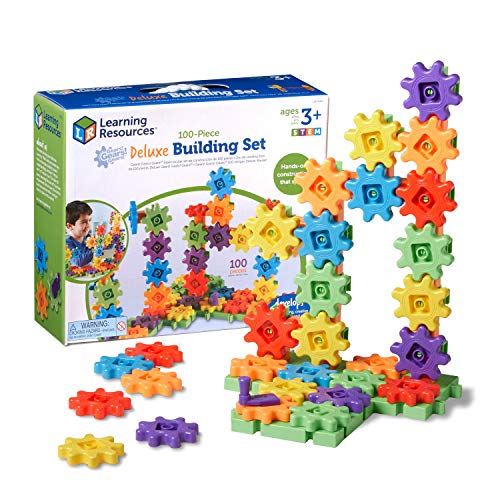
Learning Resources Gears! Gears! Gears! Deluxe Building Set
Interlocking gears, axles and connectors let young children build machines that visibly move, which makes cause and effect immediately obvious. The pieces are large enough for small hands and there are no instructions to follow. It is the simplest set here and the one that suits preschool age best.
Pros
- Large pieces suit preschool hands
- Movement makes the concept obvious
- No batteries or instructions needed
Cons
- Outgrown by around age seven
- Bright plastic parts scatter easily
Before you buy
Replay value beats the impressive first afternoon The kits that stay in circulation are the ones with no fixed endpoint, either because they are open ended like magnetic tiles or because they expand like Snap Circuits. Sets built around a fixed number of experiments deliver a great weekend and then need something new. Before buying, ask what a child would do with the toy on its tenth outing, because that answer predicts whether it becomes a favourite or a cupboard occupant.
Be honest about how much adult time is available Chemistry and physics kits that need supervision are excellent when a parent can sit down with them and frustrating when nobody can. Sets like Gravity Maze and Snap Circuits are self checking, so a child can succeed and fail without help. If weekday evenings are busy, weight your choice towards toys that work independently and save the supervised kits for holidays.
Match the age range to skills, not just years Stated ages assume average reading and fine motor development, and children vary widely. A five year old who reads well can enjoy sets labelled for eight and up with light help, while a struggling reader will find the same manual discouraging. Look at what the toy demands, whether that is reading, patience, pinch grip or spatial reasoning, and match those requirements rather than the number on the box.
Check the ongoing cost before you commit Some systems are cheap to enter and expensive to grow, with expansion packs, refill chemicals or batteries adding up quickly. Others need nothing further for years. Magnetic tiles and gear sets have essentially no running cost, while robots consume batteries and chemistry sets consume supplies. Factor that into the comparison, because a slightly pricier set with no extras can end up cheaper over two years.
Compared at a glance
| # | Model | Age range | Best for | Score | Price |
|---|---|---|---|---|---|
| 1 | Snap Circuits Jr. SC-100 Electronics Exploration Kit | 8 and up | Best overall | 9.4 | Check price |
| 2 | Magna-Tiles Classic 100 Piece Set | 3 and up | Best value | 9.2 | Check price |
| 3 | ThinkFun Gravity Maze Marble Run Logic Game | 8 and up | Best for logic skills | 9.0 | Check price |
| 4 | Osmo Genius Starter Kit for iPad | 6 to 10 | Best for screen time that counts | 8.8 | Check price |
| 5 | Learning Resources Botley 2.0 the Coding Robot | 5 and up | Best for early coding | 8.6 | Check price |
| 6 | Thames & Kosmos Kids First Chemistry Set | 5 to 10 | Best for supervised experiments | 8.3 | Check price |
| 7 | Learning Resources Gears! Gears! Gears! Deluxe Building Set | 3 and up | Best for younger children | 8.0 | Check price |
Common questions
What age should a child start with STEM toys?
Around three, with simple cause and effect toys such as gears and magnetic tiles. Circuits, coding robots and logic puzzles land better from about five to eight depending on reading ability and patience.
Do STEM toys actually help with school?
They build the underlying habits of prediction, testing and iteration rather than teaching curriculum directly. The most useful effect owners report is comfort with being wrong and trying again, which carries into science and maths lessons.
Are screen based STEM toys worth it?
Systems like Osmo that require physical manipulation are a reasonable middle ground, because the child is still handling objects and thinking. Purely app based products offer less than a good physical kit for the same money.
How do I keep small pieces organised?
Store each set in a lidded box with a parts list taped inside the lid and pack away before switching activities. Sets like Snap Circuits include a moulded tray, which is worth using since the projects fail if one component is missing.
Which STEM toys work for a wide age range in one family?
Magnetic tiles and gear sets span the widest ages because there is no reading barrier and no correct answer. Older siblings tend to build structures while younger ones explore shapes, so both stay engaged with the same box.
Are cheaper magnetic tile brands compatible?
Many claim compatibility and most connect, though tile thickness and magnet strength vary, which shows up when building tall. Mixing brands generally works for flat play and disappoints on ambitious structures.
Do coding robots teach real programming?
They teach sequencing, loops and debugging, which are the concepts underneath programming languages. The syntax comes later, and children who have used a robot usually pick up block coding quickly.
How much supervision do chemistry sets need?
Sets aimed at younger children use household safe substances but still expect an adult present for setup and cleanup. Read the manual before the first session so you know which experiments need extra care.
Final word
Snap Circuits Jr. SC-100 offers the strongest combination of independent play, genuine learning and years of expansion, which makes it the most useful single purchase here. Younger families get more from Magna-Tiles Classic because the same box works from preschool to primary school, and Gravity Maze is the pick when quiet logic practice is what you are after. Match the toy to available adult time as much as to age.