How to Pick a Microphone Isolation Shield for Echo
Aokeo’s 5-panel shield gives the deepest absorption for untreated bedrooms and offices. Streamers who need fast setup get more from the Auphonix Portable Vocal Booth and its one-minute mount. Tightest budgets still get real coverage from the On-Stage ASMS4730 without losing panel count.
Aokeo’s 5-panel shield tops this list for anyone recording in an untreated bedroom or office, though its wraparound frame takes up more desk space than single-shell designs.
Hard walls and bare desks bounce sound straight back into a microphone, layering slap-back echo onto every take. Matching panel size and foam type to your room matters more than picking the largest box available, so we compared foam density, mount type, and coverage across seven current listings.
Our top picks

Aokeo Professional Microphone Isolation Shield
Five hinged panels wrap around a standard condenser mic, blocking reflections from three sides at once. Its high-density foam layer runs roughly 1.5 inches thick, and owners report it noticeably tightens vocal recordings in bedrooms. A universal mic clip mount fits most boom arms and stands without an adapter.
Pros
- Wraps around the mic on three sides for fuller coverage
- Dense foam noticeably reduces slap-back in untreated rooms
- Universal mount fits most boom arms without adapters
Cons
- Bulkier footprint takes up more desk space
- Foam can shed small particles when new
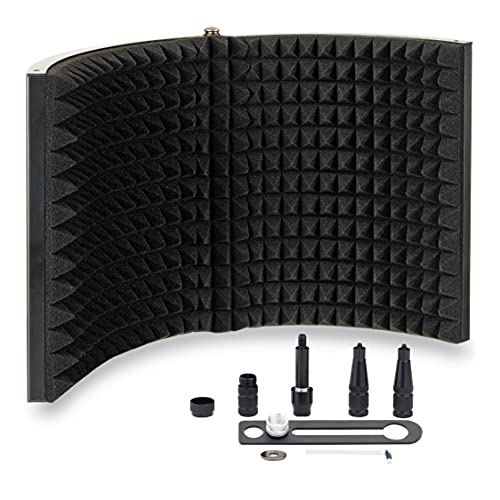
Auphonix Portable Vocal Booth
A curved single-piece shell mounts directly to a mic stand in under a minute, suiting streamers who record daily and cannot leave a bulky rig assembled. Acoustic foam lining absorbs mid and high frequencies where voice clarity matters most. Light overall weight keeps a boom arm balanced without extra counterweight.
Pros
- Assembles and mounts in under a minute
- Light enough for boom arms without rebalancing
- Curved shape directs reflections away from the capsule
Cons
- Narrower coverage than hinged multi-panel shields
- Less effective against low-frequency room rumble

On-Stage ASMS4730 Microphone Isolation Shield
Three-panel coverage here suits first-time podcasters testing whether room treatment helps before spending more. A gooseneck mount clamps onto a mic stand and holds position under normal desk vibration. Foam density runs lighter than premium shields but still cuts noticeable reflection.
Pros
- Lowest entry cost among compared shields
- Gooseneck mount holds steady on standard stands
- Compact size stores easily between sessions
Cons
- Foam is thinner than higher-tier options
- Coverage gaps at the top let some reflection through

Marantz Professional Sound Shield
Marantz builds this shield with a broadcast-style curved frame that pairs well with dynamic mics common in podcast setups. Perforated metal backing sits behind the acoustic foam, adding rigidity so the shell resists warping over time. Owners note it pairs naturally with the brand’s own boom arms.
Pros
- Rigid metal frame resists warping long-term
- Threaded adapter pairs easily with Marantz boom arms
- Curved shape suits dynamic broadcast mics well
Cons
- Heavier than foam-only alternatives
- Limited included hardware for non-Marantz stands

Pyle Pro PSMH6 Microphone Isolation Shield
Two foam densities stack inside this shield to target both mid-range voice frequencies and higher sibilance. Its tri-fold panel design collapses flat for storage between recording sessions. A direct stand clamp mounts it without needing a separate boom arm.
Pros
- Dual foam density targets a wider frequency range
- Folds flat for easy storage between sessions
- Clamps directly to stands without extra hardware
Cons
- Tri-fold hinges feel less sturdy than welded frames
- Smaller interior fits only compact mic bodies

Neewer Microphone Isolation Shield
Neewer’s five-panel version matches much of the coverage found in pricier shields while staying at a mid-price tier. Its foam core rates for both voice recording and light instrument work, so it doubles for acoustic guitar sessions. A metal gooseneck holds angle adjustments without drifting.
Pros
- Five-panel coverage at a mid-tier price point
- Gooseneck holds angle without drifting over a session
- Doubles for light instrument recording
Cons
- Assembly instructions are minimal out of the box
- Foam edges need trimming on some units

Monoprice Microphone Isolation Shield
Monoprice extends the rear panel deeper than most competitors, which voiceover artists use to block reflections bouncing off a wall behind the desk. Its foam surface carries a treatment that resists compression over months of daily use. A simple thumbscrew mount adjusts tilt in seconds.
Pros
- Deep rear panel blocks wall reflections effectively
- Foam resists compression after months of daily use
- Thumbscrew tilt adjusts quickly between sessions
Cons
- Side panels are narrower than the rear coverage
- Thumbscrew can loosen on rougher desk surfaces
How to choose
What an isolation shield actually fixes A shield absorbs sound reflecting off nearby walls, desks, and monitors before it re-enters the microphone capsule. It will not remove noise coming from outside a room, like traffic or HVAC hum. Buyers expecting soundproofing instead of echo control often end up disappointed with any model.
Panel count and foam density matter more than size More hinged panels wrap further around the capsule, blocking reflections from additional angles. Foam density determines which frequencies get absorbed, with denser foam handling low-mid voice tones better than thin acoustic sheets. Check both specs together instead of judging a shield by its overall dimensions.
Best setup for small desks and bedroom studios Curved single-piece shells like the Auphonix option take up less horizontal space than hinged multi-panel designs. A boom arm frees up desk surface entirely, letting the shield swing out of the way between sessions. This matters most in shared rooms where the setup needs to disappear quickly.
When a shield alone is not enough Rooms with hard floors, bare walls, and large windows can still produce audible flutter echo even with a shield in place. Adding a rug, curtains, or foam panels on the wall behind the desk reduces that remaining reflection. Combining passive room treatment with a shield gives the cleanest result for daily podcast or voiceover work.
Compared at a glance
| # | Model | Panel count | Best for | Score | Price |
|---|---|---|---|---|---|
| 1 | Aokeo Professional Microphone Isolation Shield | 5 hinged sections | Best overall | 9.4 | Check price |
| 2 | Auphonix Portable Vocal Booth | Curved one-piece shell | Best for streamers | 9.1 | Check price |
| 3 | On-Stage ASMS4730 Microphone Isolation Shield | 3 sections | Best budget | 8.8 | Check price |
| 4 | Marantz Professional Sound Shield | Perforated metal with foam layer | Best for podcasters | 8.7 | Check price |
| 5 | Pyle Pro PSMH6 Microphone Isolation Shield | Dual density, mid and high frequency | Best for home studios | 8.5 | Check price |
| 6 | Neewer Microphone Isolation Shield | 5 sections | Best value | 8.9 | Check price |
| 7 | Monoprice Microphone Isolation Shield | Extended, roughly 9 in | Best for voiceover work | 8.3 | Check price |
Common questions
Do microphone isolation shields really reduce echo?
Yes, they absorb reflections bouncing off nearby surfaces before the mic picks them up, based on the foam specifications each manufacturer lists. They work best in small to medium rooms with some hard surfaces nearby.
Is a reflection shield better than foam panels on the wall?
A shield treats reflections at the source and moves with the mic, while wall panels treat a fixed room area. Owners report combining both gives the most consistent result for daily recording.
Can I use an isolation shield with a dynamic microphone?
Most shields work with both dynamic and condenser mics, though broadcast-style shells like the Marantz option are built specifically around dynamic mic shapes. Check interior dimensions before buying a larger dynamic capsule.
How much does an isolation shield reduce background noise?
It reduces reflected room echo, not ambient noise from outside the room. Traffic, HVAC, or fan noise still needs separate soundproofing or noise gating in software.
What is the difference between a reflection filter and a pop filter?
A reflection filter is the larger curved or panel shield discussed here, aimed at room echo. A pop filter is a small mesh screen placed inches from the mic to block plosive air bursts, and the two serve different purposes.
Do isolation shields work for singing as well as speech?
Dual-density foam models like the Pyle Pro PSMH6 handle a wider vocal range, which suits singing better than shields tuned narrowly for speech frequencies. Check the foam layer specs for instrument or singing compatibility.
Will a shield fit an existing boom arm?
Universal clip mounts fit most standard boom arms, but threaded or brand-specific mounts like the Marantz shield may need an adapter. Confirm the mount type against your arm’s thread size before ordering.
Are cheaper isolation shields worth buying for occasional use?
Budget three-panel shields like the On-Stage ASMS4730 give a real improvement over no treatment at all for casual recording. Frequent daily recording benefits more from denser foam and wider panel coverage.
Isolation shield versus a closet recording booth, which works better?
A shield is faster to set up and stays at the desk, while a closet lined with clothes and blankets absorbs more low-frequency reflection. Podcasters recording daily in a shared room tend to prefer the shield for convenience.
Final word
Aokeo’s 5-panel shield earns the overall pick for its wraparound coverage and dense foam, suited to anyone recording regularly in an untreated room. Streamers who need a fast daily setup should look at the Auphonix curved shell instead, since it mounts in seconds without sacrificing much absorption. Buyers testing whether treatment helps at all can start with the On-Stage ASMS4730 and upgrade later.


