Misting Fans That Actually Cool Down a Hot Patio
The Lasko 7050 Misto is the most practical patio misting fan, running from a garden hose with adjustable nozzles and a stable pedestal. The NewAir NIF18OFR moves far more air across a large deck. The Geek Aire CF1S is the cordless option for spaces without an outlet.
Connecting straight to a garden hose and dialing mist back to almost nothing makes the Lasko 7050 Misto the pick for most patios, and it stands steady without needing a wall mount. Larger decks or outdoor bar areas need the extra push the NewAir NIF18OFR delivers. No outlet nearby is where the rechargeable Geek Aire CF1S earns its spot.
Evaporative cooling drives every misting fan, so effectiveness depends heavily on how dry the air is. Arid heat brings a dramatic temperature drop, while humid coastal air mostly leaves you damp. We compared airflow ratings, nozzle size and clog resistance, hose versus tank water supply, weather rated construction, and what owners report about mineral scale after a summer of hard water.
What matters most
What to check before buying a misting fan Airflow, nozzle quality, water supply method and local humidity determine whether a misting fan actually cools your space. Hose fed units suit a fixed patio position, while tank or battery models go anywhere. Match the water supply method to where the fan will live before comparing anything else.
How evaporative cooling actually works A misting fan cools by turning water into vapor, which draws heat out of the surrounding air. That process only works well when air is dry enough to absorb more moisture. Above roughly sixty percent relative humidity, mist has nowhere to evaporate to and you mostly end up damp. Local humidity patterns predict satisfaction better than any specification sheet.
Hose fed versus tank fed versus battery power Hose connected fans give unlimited runtime and suit a fixed patio position, but they tie you to a tap and a hose across the ground. Tank fed and battery units go anywhere, including campsites and market stalls, at the cost of frequent refilling. Bucket mounted job site fans sit between the two, holding a large water supply that only needs occasional topping up.
Nozzle care and where to place the fan Fine nozzles produce smaller droplets that evaporate before landing, but they clog with mineral deposits more easily, especially in hard water areas. Removable, cleanable nozzles and an end of season flush prevent most buildup. Position the fan several feet from seating and angle it slightly upward, since a fan that soaks cushions gets switched off and never used again.
The shortlist, ranked
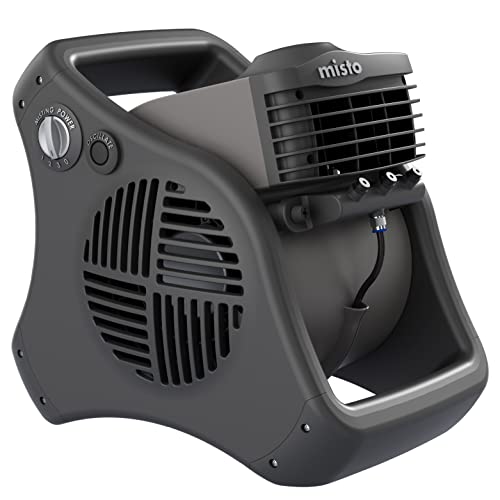
Lasko 7050 Misto Outdoor Misting Fan
A hose connection, adjustable mist output and three speeds sit on a pedestal that adjusts for height, making this the model most people picture as a patio misting fan. Turning the mist down to a fine haze keeps furniture dry on a covered patio. Owners report the nozzles need periodic cleaning in hard water areas.
Pros
- Continuous water supply from a hose
- Mist volume adjusts down to a light haze
- Adjustable height pedestal
Cons
- Needs a hose within reach
- Nozzles scale up in hard water

NewAir NIF18OFR 18 Inch Outdoor Misting Fan
An eighteen inch blade moves substantially more air than typical patio units, which matters because mist needs airflow to carry it across a wide space. Wide arc oscillation and a housing built for permanent outdoor placement back that up. Based on specifications, this suits outdoor dining or bar areas rather than a small balcony.
Pros
- Serves a much larger area than compact units
- Sturdy build suited to permanent outdoor use
- Wide oscillation spreads mist evenly
Cons
- Heavy and awkward to move around
- Loud at the highest speed

Geek Aire CF1S Rechargeable Outdoor Misting Fan
A built in rechargeable battery and onboard water tank let this sit anywhere in a garden, at a campsite or beside a market stall. Runtime drops quickly at maximum speed, so plan around that. It also works as a power bank, a genuinely useful detail on a long day outdoors.
Pros
- Works completely untethered from power and hose
- Doubles as a device charger
- Portable enough for camping and events
Cons
- Tank needs frequent refilling
- Runtime falls sharply on high speed
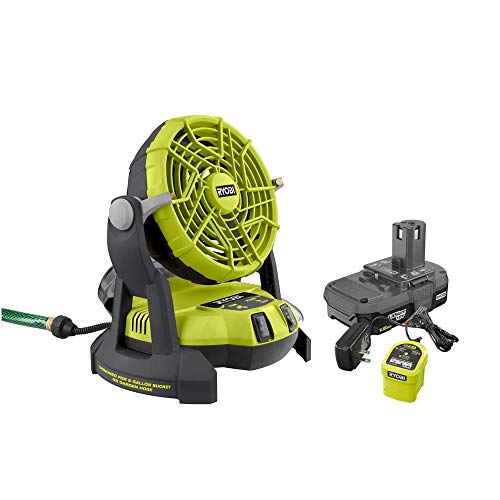
Arctic Cove MBF0181 18V Bucket Top Misting Fan
Clamping onto a standard five gallon bucket and drawing its own water, this runs from a cordless tool battery with no hose and no outlet involved. That arrangement is exactly what a job site or garage needs. It is built as a work tool rather than patio furniture, and it looks the part.
Pros
- Completely independent of hose and mains power
- Large bucket supply lasts a long session
- Rugged construction for work environments
Cons
- Requires a compatible battery and bucket
- Not designed to look good on a patio

O2COOL Elite Handheld Misting Fan
A small water reservoir and trigger mister fit into a handheld fan aimed at sport sidelines, theme park queues and gardening breaks. One person gets effective cooling at almost no running cost. Nobody should expect it to change the temperature of a whole space, since that is not its job.
Pros
- Genuinely portable personal cooling
- Very cheap to buy and run
- Soft blades are safe around children
Cons
- Cools one person only
- Reservoir empties quickly

COMLIFE F150 Handheld Misting Fan
A rechargeable battery, a folding base and a larger mist reservoir upgrade the handheld formula here. Indoors it works as a desk fan, and outdoors it becomes a personal mister. Mist output stays fine rather than heavy, which suits humid climates where a wet spray would be unpleasant.
Pros
- Rechargeable rather than battery powered
- Folds to work as a small desk fan
- Fine mist rather than a heavy spray
Cons
- Very limited cooling range
- Reservoir is small

Orbit 30013 Outdoor Mist Cooling System
This is a hose fed misting line with nozzles rather than a fan, mounted along a patio edge or wrapped around a fan you already own. It is the cheapest route to misting if decent airflow already exists. Installation takes some planning, and the tubing needs securing properly to look tidy.
Pros
- Cheapest way to add mist to existing airflow
- Nozzles can be spread across a wide area
- No electricity required for the mist itself
Cons
- Needs careful installation to look tidy
- No fan included, so airflow is your problem
Compared at a glance
| # | Model | Water supply | Best for | Score | Price |
|---|---|---|---|---|---|
| 1 | Lasko 7050 Misto Outdoor Misting Fan | Standard garden hose connection | Best overall | 9.4 | Check price |
| 2 | NewAir NIF18OFR 18 Inch Outdoor Misting Fan | 18 inch blade | Best for large decks | 9.2 | Check price |
| 3 | Geek Aire CF1S Rechargeable Outdoor Misting Fan | Rechargeable battery, mains chargeable | Best cordless | 9.0 | Check price |
| 4 | Arctic Cove MBF0181 18V Bucket Top Misting Fan | Fits a standard five gallon bucket | Best for job sites | 8.8 | Check price |
| 5 | O2COOL Elite Handheld Misting Fan | Handheld with mist trigger | Best personal cooling | 8.5 | Check price |
| 6 | COMLIFE F150 Handheld Misting Fan | Rechargeable, USB charged | Best budget | 8.2 | Check price |
| 7 | Orbit 30013 Outdoor Mist Cooling System | Hose fed misting line kit | Best add on for an existing fan | 8.0 | Check price |
Questions worth asking
Do misting fans actually cool you down?
Yes, through evaporative cooling, but the effect depends on humidity. Dry heat brings a noticeable drop, while above roughly sixty percent relative humidity you mostly feel damp rather than cool.
Will a misting fan make my patio furniture wet?
It can if mist volume is set too high or the fan sits too close. Set the mist low, keep the fan several feet from seating, and angle it slightly upward so droplets have distance to evaporate.
Are hose connected or tank misting fans better?
Hose fed units like the Lasko 7050 Misto run indefinitely and suit a fixed patio spot. Tank or battery units such as the Geek Aire CF1S go anywhere but need refilling. Choose based on whether the fan will stay in one place.
How do I stop misting fan nozzles from clogging?
Mineral scale is the usual cause. Remove and soak the nozzles in white vinegar periodically, flush the line at the end of the season, and consider an inline filter if your water is very hard.
Can misting fans be left outside all year?
Weather rated models can stay outdoors during the season, but water left in the lines will freeze and split them in winter. Drain the system and store the fan under cover once the weather turns.
Do misting fans use a lot of water?
Far less than most people expect. A patio misting fan typically uses a modest flow measured in gallons per hour, and personal handheld units use only a small reservoir over a whole afternoon.
Can I use a misting fan indoors?
Generally not a good idea, since indoor air quickly saturates and moisture has nowhere to go. Handheld personal misters used briefly are fine, but a full misting fan belongs outdoors or in a well ventilated garage.
What size misting fan do I need for a deck versus a small balcony?
A large deck or outdoor dining space needs at least an eighteen inch pedestal unit such as the NewAir NIF18OFR, since airflow has to carry mist across the area. Small balconies are well served by compact patio models like the Lasko 7050.
Misting fan vs regular fan: is the mist worth the extra maintenance?
The mist adds real cooling in dry climates that a plain fan cannot match, but it also adds nozzle cleaning and, for hose fed models, a water connection to manage. In humid regions a regular fan alone may be the simpler choice.
Are battery powered misting fans good for camping?
Yes, models like the Geek Aire CF1S with an onboard tank and rechargeable battery are built for exactly that. Runtime falls at high speed, so most campers run them on a lower setting to stretch the charge.
The verdict
The Lasko 7050 Misto fits the most patios, thanks to hose fed operation and mist you can dial down until it is barely visible. Step up to the NewAir NIF18OFR when the space is large enough that airflow becomes the limiting factor, and pick the Geek Aire CF1S if there is no outlet or tap nearby.


