How to Pick a Motorcycle Helmet That Actually Fits
For most road riders the Shoei RF-1400 is the strongest all rounder, built across four shell sizes with a quiet aerodynamic profile. Riders bothered by neck fatigue should look at the AGV K6 S, one of the lightest full face lids sold today, while the Bell Qualifier DLX MIPS brings rotational impact protection to an entry level price.
Picking a helmet by graphics alone is how riders end up with something loud, hot or poorly balanced on the head. Shell construction, certification and real weight matter far more than paint, and those numbers rarely appear on the box art.
We lined up specifications across shell sizing, certification stack, claimed weight, vent count and visor hardware, then weighed that against what long distance owners say about pressure points and wind noise after repeated use.
How to choose
What does a helmet certification actually verify? DOT relies on manufacturer self certification with occasional spot audits in the United States. ECE 22.06 and SNELL involve independent batch testing, and 22.06 adds rotational and oblique impact assessment. Every helmet on this list meets legal requirements, but a fuller certification stack is a reasonable proxy for engineering effort behind the shell.
Why shell count matters more than the size label on the box Budget ranges often stretch one or two shell moulds across every size by adding thicker padding, so a small head ends up inside a large, heavy shell. Shoei and AGV instead run four shell sizes, giving each head size correct proportions. That choice affects weight, aerodynamics and how much strain the helmet puts on your neck over a long ride.
How weight and noise shape comfort on a long day A 1250 gram carbon shell versus a 1700 gram polycarbonate one feels similar for the first ten minutes and very different after four hours. Noise is the other fatigue driver, mostly a function of shape and how well the neck roll seals. Earplugs remain worth carrying even inside the quietest helmet on this list.
Best for small spaces or new riders needing a forgiving fit Measure head circumference roughly an inch above the eyebrows, then check that figure against the specific manufacturer’s chart, since sizing varies between brands. Head shape counts too, splitting into round oval, intermediate oval and long oval profiles across different models. A correctly sized helmet feels snug everywhere with no single hot spot, and the cheek pads should compress noticeably when new.
The best picks, ranked

Shoei RF-1400
Four separate shell sizes mean a small head gets a genuinely compact helmet instead of extra padding stuffed into a bigger shell. Wind noise and buffeting stay low at highway speed thanks to the aerodynamic profile. Owners repeatedly cite the washable liner and emergency release cheek pads as reasons they buy another RF next time.
Pros
- Four shell sizes give a true fit
- Quiet and stable at highway speed
- Emergency release cheek pads
Cons
- No drop down sun visor
- Premium end of the range

AGV K6 S
A carbon and aramid fibre blend keeps the K6 S near the bottom of the scale for full face road helmets, and long distance owners report noticeably less neck strain by day’s end. Five intakes feed an internal channel system for strong airflow. Fit runs snug and sporting, so not every head shape gets along with it.
Pros
- Among the lightest full face helmets available
- Extensive ventilation channels
- Wide field of view
Cons
- Tight intermediate oval fit
- Noisier than the Shoei at speed
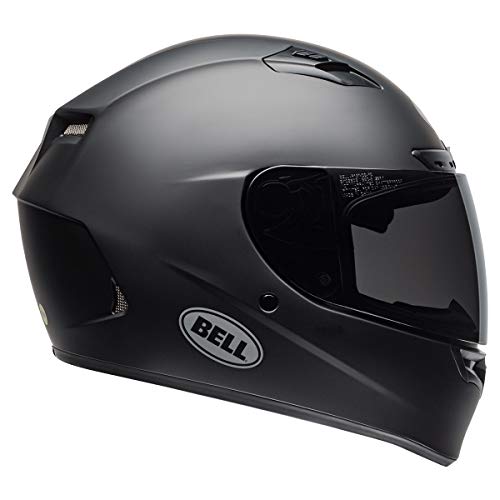
Bell Qualifier DLX MIPS
MIPS rotational impact management usually shows up only in far pricier helmets, yet the Qualifier DLX includes it alongside a drop down internal sun shade. A Panovision shield opens up the field of view, and the liner unclips for washing. Based on specifications, the polycarbonate shell adds weight compared with composite lids, which is noticeable on longer days.
Pros
- MIPS system at an accessible price
- Built in sun shade is genuinely useful
- Speaker pockets for comms units
Cons
- Heavier polycarbonate shell
- Fewer shell sizes than premium rivals
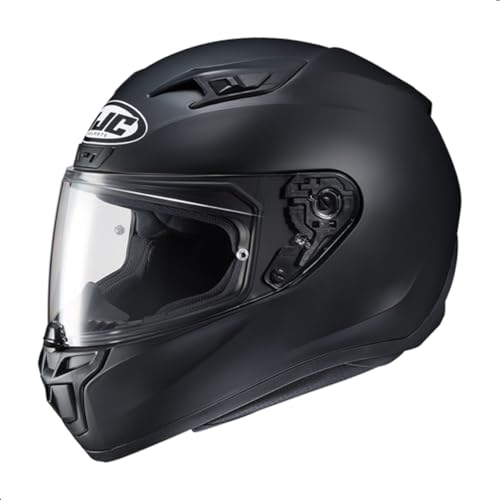
HJC i10
HJC has owned the sensible entry level full face slot for years, and the i10 keeps that reputation with a polycarbonate shell, a drop down shield and ACS channel ventilation. Finish and fit feel solid without extras that push up cost. According to owner feedback it runs quieter than expected for its tier, though shell size range trails premium lids.
Pros
- Strong specification for the price
- Drop down shield included
- Liner removes for washing
Cons
- Limited shell sizes affect fit
- Basic visor mechanism

Schuberth C5
Touring and commuting riders who lift the chin bar at fuel stops and red lights gravitate toward modular designs, and the C5 sets the benchmark. Schuberth engineers heavily against noise, giving this lid one of the lowest published figures among road helmets. An integrated antenna and comms preparation make it the natural pick for anyone running an intercom.
Pros
- Exceptionally quiet for a modular
- Certified for use open and closed
- Comms integration is well engineered
Cons
- Heavier than a comparable full face
- Most expensive helmet here
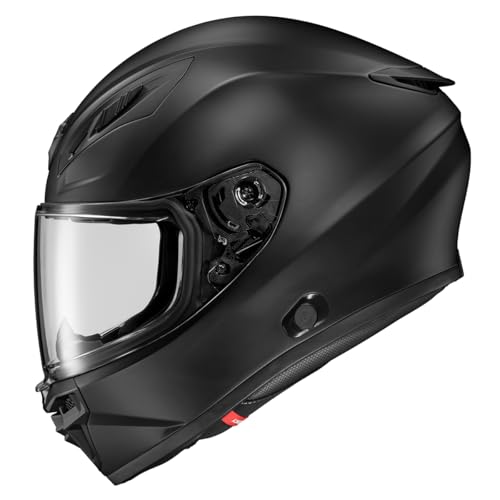
Scorpion EXO-R420
Getting the basics right matters most for a first proper helmet, and the EXO-R420 delivers a plush KwikWick liner, an EverClear anti fog visor and a simple ratchet strap. Its rounder fit suits a wider range of head shapes than the sportier options on this list. Motorway speed brings a touch more wind noise, according to owner feedback.
Pros
- Forgiving fit for varied head shapes
- Anti fog visor included as standard
- Comfortable liner materials
Cons
- Noticeable wind noise at speed
- No internal sun shade

Klim Krios Pro
Mixed surface riders need one helmet that adapts, and the Krios Pro converts between adventure trim with peak and visor, street use as a full face, and open dirt riding with goggles. A carbon shell keeps weight in check despite the added hardware. On pavement only, this specialist tool is overkill.
Pros
- Genuinely three helmets in one
- Light carbon shell for the category
- Strong airflow for slow technical riding
Cons
- Peak generates lift at highway speed
- Overkill for pure road use
How they stack up
| # | Model | Shell | Best for | Score | Price |
|---|---|---|---|---|---|
| 1 | Shoei RF-1400 | Multi-ply matrix AIM+ | Best overall | 9.4 | Check price |
| 2 | AGV K6 S | Carbon and aramid fibre | Best lightweight | 9.2 | Check price |
| 3 | Bell Qualifier DLX MIPS | Polycarbonate | Best value | 9.0 | Check price |
| 4 | HJC i10 | Advanced polycarbonate | Best budget | 8.8 | Check price |
| 5 | Schuberth C5 | Modular flip up | Best modular | 8.6 | Check price |
| 6 | Scorpion EXO-R420 | Polycarbonate, two shell sizes | Best for new riders | 8.3 | Check price |
| 7 | Klim Krios Pro | Carbon fibre | Best for adventure riding | 8.0 | Check price |
Frequently asked questions
How often should a motorcycle helmet be replaced?
Manufacturer guidance commonly points to five years from first use or seven from manufacture, and immediate replacement after any impact. Liner foam compresses with sweat and use over time, so an old helmet fits looser and manages energy less predictably even when it still looks fine.
Is MIPS worth looking for in a helmet?
MIPS addresses rotational forces, a recognised injury mechanism that standard linear drop testing does not fully capture. Finding it inside the Bell Qualifier DLX MIPS at entry level pricing is unusual, which is exactly what makes that helmet stand out in its tier.
Are modular helmets as safe as full face helmets?
A modular certified to ECE 22.06 in both P and J modes, like the Schuberth C5, has been tested with the chin bar closed and open. That dual certification is the standard worth seeking out. Uncertified flip up designs are the ones safety advocates warn riders away from.
What stops a visor from fogging up?
A Pinlock insert fixes most fogging, and most premium visors ship with the pins already fitted. Cracking the visor to its first detent at low speed, combined with directing chin vent airflow across the shield, helps further.
What is the difference between DOT, ECE and SNELL certification?
DOT relies on manufacturer self certification with spot audits. ECE 22.06 requires independent type approval plus rotational and multiple impact point testing. SNELL is a voluntary private standard with its own severe impact criteria, and many premium helmets carry two or three of these marks at once.
Do new helmets need a break in period?
Cheek pads and liner foam compress over the first several hours of wear, so a correctly sized helmet can feel tight initially. What should never happen is a hard pressure point on the forehead or crown, which signals the wrong head shape rather than the wrong size.
Can a comms unit be fitted to any of these helmets?
Most modern helmets include speaker recesses built into the liner. Schuberth goes furthest with a dedicated integrated system for the C5, while the Bell, HJC and Scorpion models here use standard pockets that accept common universal kits.
Is a carbon fibre shell worth paying more for?
Carbon mainly buys a lighter helmet rather than a leap in protection, since every model here meets its certification requirements regardless of shell material. Riders doing long days or already fighting neck fatigue will feel the difference in the AGV K6 S or Klim Krios Pro. On a short commute, the benefit shrinks.
Which helmet is best for adventure or dual sport riding?
The Klim Krios Pro converts between three configurations, covering paved adventure touring, street riding and off road use with goggles, which single purpose helmets cannot match.
Which helmet fits smaller or narrower heads best?
Helmets built across four shell sizes, such as the Shoei RF-1400 and AGV K6 S, come closest to a proportioned fit for smaller heads instead of extra padding inside a shell meant for a larger size.
The bottom line
Four shell sizes, low noise and a liner built to last push the Shoei RF-1400 to the top of this list for everyday road riding. Riders who notice every gram should try the AGV K6 S, and the Bell Qualifier DLX MIPS proves that rotational safety technology no longer demands a premium budget.


