Motorcycle Tires Ranked by Grip, Wear and Wet Bite
The Michelin Road 6 leads for all round road use, with wet weather grip that few rivals match. The Bridgestone Battlax Hypersport S23 is the sharper choice for spirited riding, while the Dunlop Roadsmart IV prioritises mileage for riders covering long distances.
For most road riders the Michelin Road 6 is the tire we would fit first, with the Bridgestone Battlax Hypersport S23 for sport riding and the Dunlop Roadsmart IV when mileage matters most.
Tires are hard to compare because manufacturers publish grip claims rather than numbers, and the same tire behaves differently on a heavy tourer than on a middleweight naked. We compared compound layouts, tread void ratios, construction and published load and speed ratings, and weighed those against what owners consistently report about wear rate and wet weather confidence.
The shortlist, ranked
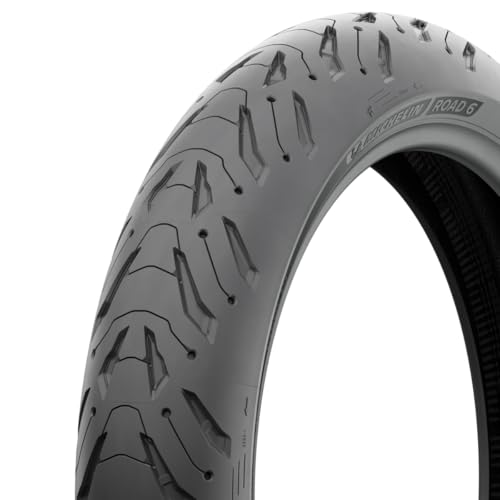
Michelin Road 6
Michelin’s sport touring line has led on wet grip for several generations and the Road 6 continues that with a silica heavy compound and an aggressive siping pattern that clears standing water. It warms up quickly, which matters on a cold morning commute more than most riders realise. Owners report strong mileage as well, which is unusual for a tire this focused on wet performance.
Pros
- Class leading confidence in the wet
- Warms up faster than most rivals
- Good mileage despite soft feel
Cons
- Premium pricing tier
- Less sharp turn in than sport tires

Bridgestone Battlax Hypersport S23
The S23 is aimed at riders who use the full width of the tire, with a soft shoulder compound and a harder centre so straight line mileage does not collapse. Turn in is noticeably quicker than a sport touring tire. Owners running fast road and occasional track days report excellent feedback at lean, at the cost of shorter overall life.
Pros
- Excellent dry grip and feedback
- Fast, precise turn in
- Harder centre protects mileage
Cons
- Shorter life than touring tires
- Needs heat to work properly
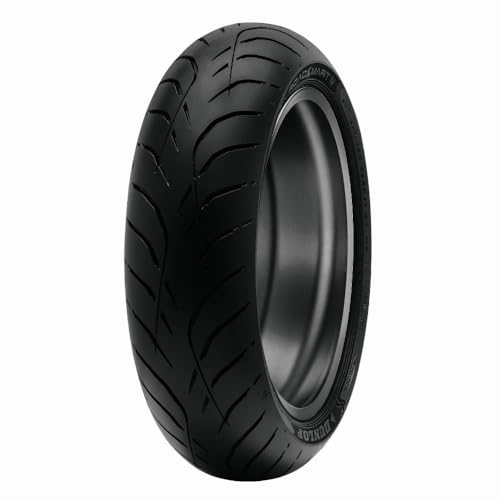
Dunlop Roadsmart IV
Dunlop built the Roadsmart IV around covering distance without the mid life handling drop that plagues touring tires as the centre squares off. The carcass is tuned for heavier bikes carrying luggage and a pillion. Based on the construction it favours stability and wear over the last few degrees of lean angle grip.
Pros
- Holds profile well as it wears
- Stable with luggage and a pillion
- Strong mileage figures
Cons
- Less agile than sport rubber
- Wet grip trails the Michelin

Pirelli Angel GT II
The Angel GT II uses a reinforced construction specifically aimed at large capacity tourers and heavy sport tourers where a standard carcass flexes under load. That gives it composure when the bike is fully loaded that lighter tires cannot match. Owners of large touring machines consistently cite stability at speed as the reason they refit them.
Pros
- Composed with a full load
- Predictable feel at high speed
- Even wear across the tread
Cons
- Feels heavy on lighter bikes
- Slower to warm on cold mornings

Metzeler Roadtec 01 SE
The SE version of the Roadtec 01 uses a softer compound aimed squarely at cool and wet conditions, which suits riders in northern climates who ride year round. Grip on a cold damp road is where it stands apart from standard sport touring rubber. That softness does cost mileage compared with the standard version.
Pros
- Excellent on cold damp roads
- Very short warm up period
- Predictable feedback near the limit
Cons
- Wears faster than the standard version
- Less suited to hot dry climates

Shinko 705 Dual Sport
For a dual sport or adventure bike that spends most of its time on tarmac with occasional gravel, the 705 covers the job at a fraction of the premium adventure tire outlay. The blocky pattern handles loose surfaces while remaining reasonably quiet on road. Owners report mileage well above what the price suggests, though ultimate wet tarmac grip is modest.
Pros
- Very strong value for the mileage
- Handles gravel and hardpack
- Available in many adventure sizes
Cons
- Limited grip on wet tarmac
- Noisier than a pure road tire

Michelin Anakee Adventure
Aimed at large adventure machines used mainly on road, the Anakee Adventure gives close to sport touring behaviour on tarmac while retaining enough tread void for gravel tracks and forest roads. The construction copes with the weight of a fully loaded large capacity adventure bike. It is not a serious off road tire, and Michelin does not claim it to be.
Pros
- Behaves like a road tire on tarmac
- Copes with heavy loaded adventure bikes
- Confident on gravel and hardpack
Cons
- Limited in mud or soft sand
- Premium price for the category
Compared at a glance
| # | Model | Category | Best for | Score | Price |
|---|---|---|---|---|---|
| 1 | Michelin Road 6 | Sport touring | Best overall | 9.4 | Check price |
| 2 | Bridgestone Battlax Hypersport S23 | Hypersport | Best for sport riding | 9.2 | Check price |
| 3 | Dunlop Roadsmart IV | Sport touring | Best for long distance | 9.0 | Check price |
| 4 | Pirelli Angel GT II | Sport touring | Best for heavy bikes | 8.8 | Check price |
| 5 | Metzeler Roadtec 01 SE | Sport touring | Best wet grip alternative | 8.6 | Check price |
| 6 | Shinko 705 Dual Sport | Dual sport, road biased | Best budget | 8.3 | Check price |
| 7 | Michelin Anakee Adventure | Adventure, road biased | Best for adventure bikes | 8.0 | Check price |
How to choose
Read the sidewall before you shop The size code, such as 180/55 ZR17, gives width in millimetres, aspect ratio as a percentage of width, construction type and rim diameter in inches. Alongside it sits a load index and speed rating that must meet or exceed what your bike specifies. Fitting a tire below the required load index is both unsafe and, in many places, a legal problem at inspection time.
Compound layout explains the grip and wear trade Modern road tires are rarely a single compound. A harder centre strip carries the straight line miles while softer shoulders provide grip at lean angle, which is why a tire can offer both mileage and cornering performance. Softer overall compounds like the Metzeler Roadtec 01 SE trade life for cold and wet performance, and that is a deliberate choice rather than a flaw.
Match tread pattern to your actual conditions Tread grooves exist to clear water, not to provide grip, which is why racing slicks have none. A high void ratio like the Michelin Road 6 pattern moves more water and resists aquaplaning, while sport tires run less tread for a larger contact patch. Adventure tires add blocks for loose surfaces and give up some tarmac contact area in exchange.
Age and pressure matter as much as tread depth Rubber hardens with age regardless of mileage, and most manufacturers suggest replacing tires around five years from the date code on the sidewall even if tread remains. Pressure is the other daily factor, since underinflation causes heat build up, uneven wear and vague steering. Check pressures cold, weekly, against the figures on the bike rather than the tire.
Frequently asked questions
How long do motorcycle tires last?
It varies enormously with compound and riding style. Sport tires can be finished in a few thousand miles of hard use, while sport touring tires such as the Dunlop Roadsmart IV commonly reach several times that. Rear tires always wear faster than fronts on road bikes.
Can I mix tire brands front and rear?
It is generally discouraged. Front and rear tires are developed as a pair with matched profiles, and mixing can produce odd steering behaviour mid corner. If you must mix, matching within the same category and profile family reduces the risk.
What pressure should motorcycle tires run at?
Use the figures in the owner manual or on the bike’s swingarm sticker, not the maximum printed on the tire sidewall. Those bike specific figures account for weight distribution and intended load, and most manufacturers list separate solo and two up pressures.
Do new tires need scrubbing in?
Yes. New tires have a smooth surface layer from the mould and need roughly 100 miles of progressively increasing lean to develop full grip. Avoid hard acceleration, heavy braking and maximum lean during that period.
How do I read the date code on a tire?
Look for a four digit number in an oval on the sidewall. The first two digits are the week and the last two the year of manufacture, so 2325 means the twenty third week of 2025. Tires more than five years old are generally due for replacement regardless of tread.
What does the load and speed rating mean?
The load index is a coded maximum weight per tire and the speed rating letter is the maximum sustained speed. Both must meet or exceed the motorcycle manufacturer specification. This matters most on heavy touring bikes carrying luggage and a passenger.
Are adventure tires worth it if I mostly ride on road?
Only if you genuinely leave the tarmac. A road biased adventure tire like the Michelin Anakee Adventure gives up some grip and refinement compared with a sport touring tire, so a rider who never rides gravel is better served by the Michelin Road 6 or Dunlop Roadsmart IV.
When should a tire be replaced?
At the wear indicator bars in the tread grooves, or earlier if you find cuts, bulges, uneven cupping or the tire has squared off in the centre. Squared profiles hurt handling long before the tread depth becomes legally marginal.
Our pick
The Michelin Road 6 is the tire we would recommend to most road riders, because wet weather confidence and quick warm up matter far more in real use than the last degree of dry grip. Riders chasing sharper handling should look at the Bridgestone Battlax Hypersport S23, and anyone counting miles per set is better served by the Dunlop Roadsmart IV.


