Tire Pressure Gauges Ranked on Accuracy and Grip
The JACO ElitePro Tire Pressure Gauge is our top pick for its tight stated accuracy, protective boot and swivel chuck. The AstroAI Digital Tire Pressure Gauge is the value choice for everyday checks, and the Milton S-921 pencil gauge is the reliable glovebox backup.
The JACO ElitePro Tire Pressure Gauge leads this roundup because it pairs a tight stated accuracy tolerance with a swivel chuck and a rubber boot, which is the combination that keeps a gauge honest after it has been dropped on a garage floor a few times. The AstroAI Digital Tire Pressure Gauge is the value pick for routine checks, and the Milton S-921 pencil gauge remains worth keeping in the glovebox because it never needs a battery.
Tire gauges seem too simple to get wrong and are routinely wrong anyway, since a cheap gauge reading two psi high means you are driving on underinflated tyres while believing you are not. That costs grip, tread life and fuel economy. We compared stated accuracy tolerances, pressure ranges, analogue and digital displays, chuck and hose designs, backlighting and physical durability, then weighed those against what owners report about gauges drifting after a drop and readings that vary between attempts on the same valve.
The shortlist, ranked

JACO ElitePro Tire Pressure Gauge
JACO states a tight accuracy tolerance and backs it with a mechanical dial gauge protected by a thick rubber boot, which is what keeps calibration intact in a toolbox. The 360 degree swivel chuck reaches awkward valve stems on alloy wheels without leaking air. Based on specifications it is a professional style gauge in a package aimed at careful owners.
Pros
- Repeatable readings across attempts
- Swivel chuck reaches recessed valve stems
- Boot protects calibration from knocks
Cons
- Bulkier than pencil or digital gauges
- No illumination for night checks
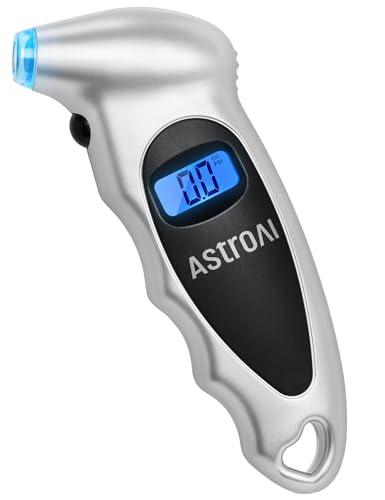
AstroAI Digital Tire Pressure Gauge
AstroAI covers what most drivers need in a digital gauge, namely a clear backlit readout, a lit nozzle for finding the valve in the dark and four selectable units. It is compact enough for a door pocket. Owners report the readings are consistent, though the plastic body will not tolerate the abuse a boot protected dial gauge shrugs off.
Pros
- Lit nozzle makes night checks easy
- Multiple pressure units selectable
- Very good value for a digital gauge
Cons
- Plastic body is vulnerable to drops
- Needs a battery that will eventually fail

Accutire MS-4021B Digital Tire Gauge
Accutire angles the head so the display faces you while the chuck is on the valve, which sounds trivial until you have crouched beside a wheel arch trying to read a straight gauge. The rubber grip is comfortable in cold weather. It is a long standing design that many drivers keep for years.
Pros
- Display faces you while in use
- Comfortable grip in cold conditions
- Simple one button operation
Cons
- Limited to lower pressure ranges
- No backlight on the nozzle

Rhino USA Heavy Duty Tire Pressure Gauge
Rhino builds this with a braided hose and a bleed valve, which matters if you air down for trail driving and need to release pressure precisely rather than in guesses. The dial is large and glow in the dark. It is heavier than a pocket gauge, which is the trade for the hose and the bleed function.
Pros
- Bleed valve makes airing down precise
- Flexible hose reaches dual rear wheels
- Large dial is easy to read
Cons
- Too bulky for a glovebox
- Overkill for ordinary car use
TEKTON 5941 Digital Tire Gauge
TEKTON keeps this straightforward with a large clear readout and a lit tip, aimed at people who simply want a number they can read without glasses. It holds the reading long enough to note it before switching off. Construction is plastic, so store it somewhere it will not be crushed under tools.
Pros
- Easiest display to read at a glance
- Reading holds long enough to record
- Auto shutoff preserves the battery
Cons
- Plastic housing feels light
- Fewer unit options than rivals

Milton S-921 Pencil Tire Gauge
The pencil gauge is the oldest design here and it still earns a place because it works forever without a battery and costs very little. Milton is the brand that trade users buy. Reading it takes more care than a digital display, and it is less precise, but it is never dead when you need it.
Pros
- Never needs a battery
- Almost indestructible metal body
- Costs very little to keep in every vehicle
Cons
- Less precise than digital or dial gauges
- Scale is hard to read in poor light

Slime 20017 Digital Tire Gauge
Slime offers a compact digital gauge at the low end that covers ordinary passenger car pressures with a clear display. It fits in a door pocket and gets the job done for routine monthly checks. Do not expect the tolerance of the professional gauges here, and treat any surprising reading as a prompt to verify with a second gauge.
Pros
- Cheapest digital gauge here
- Small enough for any door pocket
- Clear readout for routine checks
Cons
- Wider accuracy tolerance than premium gauges
- Lightweight construction
Side by side
| # | Model | Type | Best for | Score | Price |
|---|---|---|---|---|---|
| 1 | JACO ElitePro Tire Pressure Gauge | Mechanical dial | Best overall | 9.4 | Check price |
| 2 | AstroAI Digital Tire Pressure Gauge | Digital | Best value | 9.2 | Check price |
| 3 | Accutire MS-4021B Digital Tire Gauge | Digital | Best for ease of use | 9.0 | Check price |
| 4 | Rhino USA Heavy Duty Tire Pressure Gauge | Mechanical dial with bleed valve | Best for trucks and off road | 8.8 | Check price |
| 5 | TEKTON 5941 Digital Tire Gauge | Digital | Best display clarity | 8.6 | Check price |
| 6 | Milton S-921 Pencil Tire Gauge | Pencil stick gauge | Best glovebox backup | 8.3 | Check price |
| 7 | Slime 20017 Digital Tire Gauge | Digital | Best budget digital | 8.0 | Check price |
How to choose
Accuracy tolerance is the number that matters Most gauges state accuracy as a percentage of the reading or a fixed psi figure. A gauge accurate to within one percent behaves very differently from one accurate to within three psi. Small errors compound, because underinflation of a few psi noticeably increases tread wear at the shoulders, lengthens braking distances in the wet and costs fuel. If a gauge does not state a tolerance at all, treat that as an answer.
Digital, dial or pencil Digital gauges are easiest to read and usually accurate, but they depend on a battery and dislike being dropped. Dial gauges are mechanical, hold calibration well when boot protected, and are what most workshops use. Pencil gauges are the least precise but need nothing and last decades. The practical answer for many drivers is one good gauge in the garage and a pencil gauge in each vehicle.
Chuck design and getting a clean seal Most inconsistent readings come from the chuck not seating squarely on the valve, which lets air escape as you read. A swivel or angled chuck helps enormously on alloy wheels where the valve sits recessed. Press straight on in one confident motion, and if you hear hissing, reseat rather than taking the reading. A short flexible hose makes dual rear wheels and awkward arches far easier.
Check cold, check monthly, use the door placard Tyre pressure rises as tyres heat up, so check first thing before driving or at least three hours after. The correct pressure is the vehicle manufacturer’s figure on the door jamb placard, not the maximum pressure moulded into the tyre sidewall, which is a limit rather than a recommendation. Check monthly, since tyres lose pressure naturally, and remember cold weather drops pressure measurably.
Common questions
How accurate are tire pressure gauges?
Quality gauges typically state accuracy within one to two percent of the reading. Inexpensive gauges are often several psi out and can drift after being dropped. Comparing two gauges against each other is a useful sanity check, and a large disagreement means at least one of them is wrong.
Should I use the pressure on the tire sidewall?
No. The sidewall figure is the maximum pressure the tyre can safely hold, not the pressure your vehicle needs. Use the placard inside the driver’s door jamb or the figure in the owner’s manual, which reflects the vehicle’s weight and suspension design.
How often should I check tire pressure?
Monthly is the common recommendation, plus before any long trip and whenever the temperature changes significantly. Tyres lose a small amount of pressure naturally through the rubber, and cold weather reduces indicated pressure further.
Do I need a gauge if my car has a pressure monitoring system?
Yes. Most factory systems only warn once pressure has fallen substantially below target, often around 25 percent low, by which point handling and wear are already affected. A gauge lets you keep pressures correct rather than merely not dangerous.
Are digital gauges better than dial gauges?
They are easier to read and usually accurate, but they rely on a battery and are more fragile. Boot protected dial gauges hold calibration better over time in a working environment. Both are far better than an old unprotected gauge of unknown history.
Why do I get different readings each time?
Almost always because the chuck is not seating squarely on the valve, which lets air escape during the reading. Press on firmly and straight in one motion. Checking after driving also gives higher readings, since heat raises pressure, so always compare like with like.
Should I check pressure when tires are hot or cold?
Cold, meaning before driving or after the vehicle has sat for at least three hours. Driving heats tyres and raises indicated pressure by several psi. Never bleed pressure from hot tyres to reach the placard figure, or they will be underinflated once cool.
What is a bleed valve for on a tire gauge?
It lets you release air in controlled amounts while watching the reading, which is essential if you air down for sand or trail driving and then air back up afterwards. For ordinary road use it is a convenience rather than a necessity.
Our take
For anyone who cares about getting the number right, the JACO ElitePro Tire Pressure Gauge is the best choice here because its tolerance and protective boot keep it honest over years of use. The AstroAI Digital Tire Pressure Gauge covers routine monthly checks well for far less, and its lit nozzle earns its keep in a dark driveway. Keep a Milton S-921 pencil gauge in each vehicle as a backup that never runs out of battery.