RV Water Filters for Cleaner Tanks and Better Taste
The Clearsource Premier RV Water Filter System leads on filtration stages and flow rate for full time use. The Camco EVO Premium is the strongest single canister option, and the Camco TastePURE inline filter remains the simple weekend choice for taste and odour.
The Clearsource Premier RV Water Filter System tops this roundup because a two canister setup with a sediment stage ahead of a carbon block does what a single inline cartridge cannot, namely keep flow up while filtering finely. The Camco EVO Premium is the sensible single canister step down, and the Camco TastePURE inline filter is still the right call for occasional weekends where taste and odour are the main complaint.
RV water filtering is awkward because you are trying to solve several unrelated problems with one device, from grit in an old campground line to chlorine taste to hose smell after a summer in storage. A fine filter that removes the most also chokes flow at the low pressures many parks supply. We compared micron ratings and filtration stages, flow under realistic pressure, rated capacity, hose fitting quality and how each handles freezing and storage, then weighed those against what owners report about pressure drop and cartridge life on the road.
The top picks, ranked

Clearsource Premier RV Water Filter System
Clearsource runs a coarse sediment cartridge first so the fine carbon block is not immediately clogged by grit, which is the reason this setup holds flow while filtering to a much finer rating than an inline cartridge. The stainless frame stands upright next to the rig rather than kinking a hose. Based on specifications it is aimed at full timers and anyone who moves between water sources of unknown quality.
Pros
- Sediment prefilter protects the fine stage
- Maintains usable flow at low park pressure
- Sturdy stand keeps hoses from kinking
Cons
- Highest outlay and bulkiest to store
- Two cartridges to buy and track

Camco EVO Premium RV Water Filter
The EVO uses a replaceable cartridge in a proper canister rather than a sealed inline tube, so you swap the media and keep the housing. Filtration is a clear step above basic inline filters without the size and cost of a dual canister rig. Owners report it fits in a wet bay far more easily than a framed system.
Pros
- Reusable housing with cheap cartridge swaps
- Better filtration than inline tubes
- Compact enough for a wet bay
Cons
- Some pressure drop as the cartridge loads
- Needs draining before freezing weather

Camco TastePURE RV Water Filter
This is the blue inline filter you see on half the hookups in any campground, and its popularity is earned on simplicity. It knocks back chlorine taste, odour and visible sediment, includes a flexible hose protector to stop kinking at the spigot, and needs no assembly. It is a seasonal disposable rather than a serious filtration system.
Pros
- Cheapest way to fix taste and odour
- No assembly or maintenance at all
- Hose protector prevents spigot kinks
Cons
- Coarse filtration compared with canister systems
- Whole unit is discarded when spent
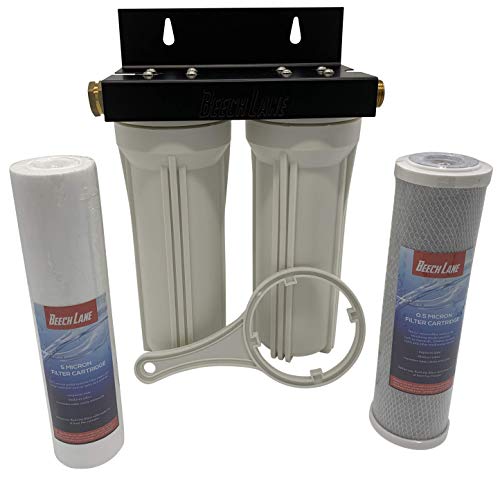
Beech Lane RV Water Filter
Beech Lane leans on carbon media and a generous flow path, which suits anyone whose main complaint is that park water tastes of chlorine rather than looks dirty. Fittings are brass rather than plastic, which matters because plastic hose threads are the usual failure point. It sits between the disposable inline filters and the canister systems.
Pros
- Brass fittings resist cross threading
- Noticeable improvement in taste and odour
- Holds flow better than narrow inline filters
Cons
- Limited sediment removal
- Costs more than standard inline filters
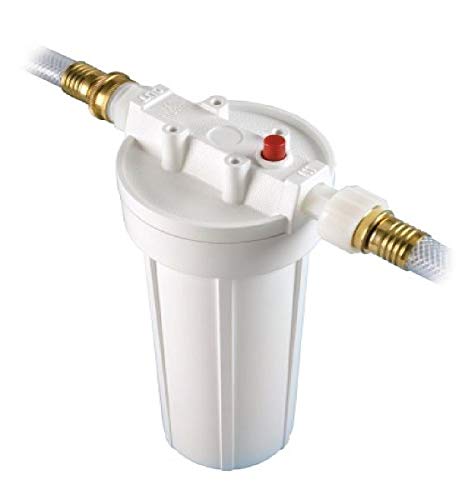
Culligan RV-800 Exterior Pre-Tank RV Water Filter
Culligan brings household filtration experience to a compact exterior housing that takes standard replacement cartridges. That means media choice is yours, so you can run a coarse sediment cartridge in a park with old lines and switch to carbon elsewhere. It mounts externally and needs a little setup rather than clipping straight on.
Pros
- Swap media to match the water source
- Widely available replacement cartridges
- Established household filtration brand
Cons
- Requires mounting rather than plug and play
- Housing must be drained for storage

Waterdrop RV Inline Water Filter
Waterdrop rates this for a large volume through a single cartridge, which suits long trips where changing filters is inconvenient. The carbon block is finer than the granular media in basic inline units. Owners report a modest pressure drop, which is the normal trade for finer media in an inline format.
Pros
- Long service interval between changes
- Carbon block is finer than granular media
- Straightforward hose connection
Cons
- Some pressure loss at low supply pressure
- No separate sediment stage

AQUA CREST RV Inline Water Filter
AQUA CREST sells these in multipacks, which makes keeping a spare in the rig easy and cheap. Performance is comparable to other granular carbon inline filters, dealing with taste, odour and visible particles rather than fine filtration. It is the sensible choice for occasional camping where the water is generally fine.
Pros
- Cheapest per filter in multipacks
- Easy to carry a spare on every trip
- No setup or maintenance
Cons
- Basic filtration only
- Not designed for full time use
How to choose
Know what you are filtering out Three separate problems get lumped together. Sediment is grit, rust and sand from old park plumbing and is handled by a coarse mechanical filter. Chlorine taste and odour need activated carbon. Bacteria and cysts need a sub micron rated element, and no basic inline filter provides that. Decide which you are actually solving, because a filter aimed at taste will do nothing about a cloudy tank, and vice versa.
Micron rating versus flow rate The finer the filter, the more pressure it costs you, and many campgrounds already deliver less pressure than a house. A sub micron carbon block in a single inline tube can leave you with a disappointing shower. This is the argument for two stage systems, where a coarse cartridge takes the sediment load first and the fine stage stays clean, keeping flow acceptable for longer.
Inline, canister or dual stage Disposable inline filters cost the least and are thrown away each season, which suits a few weekends a year. Canister systems use replaceable cartridges in a reusable housing, cutting long term cost and improving filtration. Dual stage framed systems are for full timers and boondockers who fill from varied sources. Match the format to how many nights a year you actually hook up.
Freezing, storage and sanitising Water left in a filter housing freezes, splits the case and grows biofilm in warm storage. Drain every filter before storing the rig, and store cartridges dry or discard them. Sanitise the fresh water system with a diluted bleach solution at the start of each season, and do it with the filter removed, since sending chlorine through a carbon filter simply consumes the media.
Side by side
| # | Model | Stages | Best for | Score | Price |
|---|---|---|---|---|---|
| 1 | Clearsource Premier RV Water Filter System | Sediment plus carbon block | Best overall | 9.4 | Check price |
| 2 | Camco EVO Premium RV Water Filter | Replaceable cartridge canister | Best value | 9.2 | Check price |
| 3 | Camco TastePURE RV Water Filter | Disposable inline | Best for weekend trips | 9.0 | Check price |
| 4 | Beech Lane RV Water Filter | Activated carbon | Best for taste improvement | 8.8 | Check price |
| 5 | Culligan RV-800 Exterior Pre-Tank RV Water Filter | Exterior housing, replaceable cartridge | Best for sediment | 8.6 | Check price |
| 6 | Waterdrop RV Inline Water Filter | Inline carbon block | Best for long capacity | 8.3 | Check price |
| 7 | AQUA CREST RV Inline Water Filter | Disposable inline | Best budget | 8.0 | Check price |
Common questions
Do I really need an RV water filter?
If you fill from campground spigots, yes in practice. Park plumbing varies from new to decades old, and a filter protects both your taste experience and the pump, water heater and fixtures from grit. It is inexpensive insurance against a supply you cannot inspect.
Where should the filter be installed?
Most owners fit it between the park spigot and the fresh water hose, so the filter takes park pressure and everything downstream stays cleaner. Some prefer it at the rig inlet so the hose itself is protected. Filtering before the hose keeps sediment out of the hose interior, which is generally the better choice.
How often should an RV water filter be replaced?
Disposable inline filters are typically rated for a season or a stated volume, whichever comes first. Canister cartridges vary widely, so follow the rating on the box. Replace early if flow drops noticeably or the water develops a taste, since both indicate a loaded cartridge.
Will a filter reduce my water pressure?
Some reduction is unavoidable, and finer filtration costs more pressure. A clean coarse filter loses very little. A loaded sub micron cartridge can be very noticeable, particularly at parks with weak supply. Two stage systems exist mainly to manage this trade.
Do RV water filters remove bacteria?
Only those with a sub micron rating that specifically state cyst or bacteria reduction. Standard carbon inline filters do not. If you are filling from an uncertain or non potable source, that requires a purpose built purification system rather than a taste and odour filter.
Can I leave the filter connected over winter?
No. Trapped water freezes, cracks the housing and can grow biofilm in storage. Disconnect, drain, dry the housing and either store cartridges dry or discard them, depending on the manufacturer’s guidance.
What is the difference between a sediment and a carbon filter?
A sediment filter mechanically strains particles such as sand, rust and silt. A carbon filter adsorbs chlorine and the compounds behind bad taste and odour. They solve different problems, which is why better systems run one after the other.
Is a two stage system worth it for occasional camping?
Usually not. If you camp a handful of weekends a year at established parks, a disposable inline filter handles the common complaints for a fraction of the cost and takes no storage space. Two stage systems make sense for full timers and anyone filling from varied or rural sources.
Final word
For full timers and anyone filling from unfamiliar sources, the Clearsource Premier RV Water Filter System is the one to buy because the sediment stage keeps the fine element working and the flow usable. The Camco EVO Premium delivers most of that benefit in a single canister that actually fits a wet bay. For a few weekends a year, the Camco TastePURE inline filter still solves the taste and odour complaint at the lowest cost.