Professional NAS for Creators and Studios
For most professional users, the Synology DiskStation DS923+ offers the best mix of performance, expandability, and software polish. It excels in multi-user environments and supports 10GbE upgrades. Its main limitation is the lack of built-in 10GbE, requiring an add-on card.
Network attached storage has moved beyond simple file sharing. Modern professionals need centralized, high-speed storage for video editing, database hosting, and team collaboration.
This roundup focuses on NAS units that deliver enterprise-grade features without the enterprise complexity. We considered hardware specs, software capabilities, and real-world reliability.
Our top picks

Synology DiskStation DS923+
A 4-bay powerhouse with excellent software and expandability. Supports 10GbE upgrade and NVMe caching. Ideal for small teams and demanding workloads.
Pros
- Synology DSM is the most polished NAS OS
- NVMe caching boosts small-file performance
- Excellent app ecosystem and security features
Cons
- No built-in 10GbE (requires add-on card)
- No PCIe slot for graphics card

QNAP TS-464-8G
A 4-bay NAS with 2.5GbE ports and PCIe expansion. Great for 4K video editing and multimedia streaming. Offers HDMI output and virtual machine support.
Pros
- Built-in 2.5GbE and PCIe slot for 10GbE
- HDMI output for direct display
- Strong multimedia and virtualization features
Cons
- QTS interface can be cluttered
- Some features require subscription
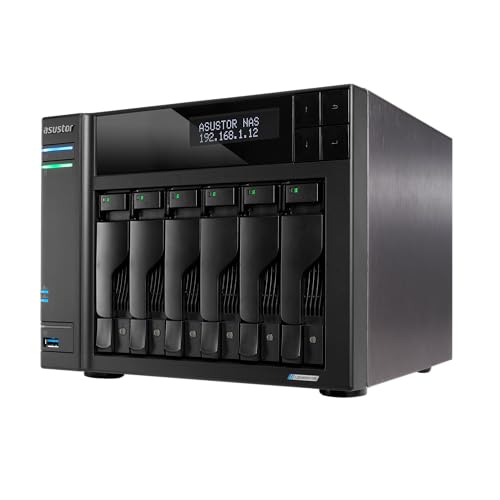
Asustor Lockerstor 6 AS6606T
A 6-bay NAS with dual 10GbE ports, making it ideal for high-speed editing. Features a fast Intel processor and expandable RAM.
Pros
- Includes two 10GbE ports at a competitive price
- Six bays for large storage capacity
- Good performance for multi-stream editing
Cons
- Software ecosystem less mature than Synology
- No PCIe expansion for add-on cards

TerraMaster F4-424
A 4-bay NAS with modern hardware and 10GbE option. Runs on TOS 6, which has improved significantly. Great for budget-conscious professionals.
Pros
- 10GbE support at an affordable price
- DDR5 RAM for better performance
- Good value for hardware specs
Cons
- TOS OS still has some bugs and less polish
- Customer support can be slow

Synology RackStation RS1221+
A 1U rackmount NAS with 8 bays for high capacity. Built for data-intensive tasks and offers redundant power supply options. Great for server rooms.
Pros
- Rackmount design for data centers
- High capacity and reliable performance
- Synology DSM with enterprise features
Cons
- No 10GbE built-in (optional add-on)
- Higher power consumption than desktop units

QNAP TVS-672XT
A 6-bay NAS with Thunderbolt 3 ports for direct Mac connection. Ideal for video editors who need fast local access. Also has 10GbE and 5GbE ports.
Pros
- Thunderbolt 3 for direct high-speed connection
- Powerful CPU for transcoding and VMs
- Multiple network options
Cons
- Expensive compared to similar models
- Runs hotter due to desktop CPU

Western Digital WD Red Pro 8TB (as NAS drive)
A high-capacity hard drive designed for 24/7 NAS operation. Offers good performance and reliability for RAID arrays. Not a NAS itself, but a component.
Pros
- Designed for NAS environments with high workload
- Reliable and stable performance
- Multiple capacities available
Cons
- Not a full NAS solution
- SSD alternatives provide faster access
What matters most
How they compare
| # | Model | Drive Bays | Best for | Score | Price |
|---|---|---|---|---|---|
| 1 | Synology DiskStation DS923+ | 4 (up to 9 with DX517) | Best overall for most professionals | 9.4 | Check price |
| 2 | QNAP TS-464-8G | 4 | Best for multimedia and 10GbE built-in | 9.1 | Check price |
| 3 | Asustor Lockerstor 6 AS6606T | 6 | Best for 10GbE out of the box | 8.8 | Check price |
| 4 | TerraMaster F4-424 | 4 | Best value for small studios | 8.5 | Check price |
| 5 | Synology RackStation RS1221+ | 1U Rackmount | Best rackmount for businesses | 9.0 | Check price |
| 6 | QNAP TVS-672XT | 6 | Best for Mac users with Thunderbolt 3 | 8.7 | Check price |
| 7 | Western Digital WD Red Pro 8TB (as NAS drive) | 8TB (also available in other sizes) | Best for filling your NAS | 8.0 | Check price |
Good to know
How much storage capacity do I need for a professional NAS?
It depends on your data. For video editing, calculate based on project sizes, with room for growth. A 4-bay NAS with 8TB drives gives 24TB usable in RAID 5, which may be enough for many small studios. Larger teams should consider 8-bay models.
What is the difference between NAS and DAS?
NAS connects to your network and can be accessed by multiple devices simultaneously. DAS connects directly to one computer via USB or Thunderbolt, offering higher speeds but limited to one user. Professionals often use NAS for collaboration and DAS for local editing.
Can I use a NAS for video editing over the network?
Yes, but you need sufficient network speed and a fast NAS. For 4K editing, 10GbE is recommended. Some editors prefer direct connection via Thunderbolt or use proxy workflows. The NAS should have a fast CPU and possibly NVMe cache.
What is the best RAID configuration for a professional NAS?
RAID 5 provides good balance of capacity and redundancy, but RAID 6 offers better protection at the cost of capacity. RAID 10 gives improved performance but requires more drives. Choose based on your tolerance for risk and performance needs.
Is a rackmount NAS better than a desktop NAS?
Rackmount NAS is designed for server rooms and offers more expansion options, but they are noisier and require a rack. Desktop NAS is quieter and more compact, suitable for offices or studios. Choose based on your environment.
How important is the NAS operating system?
The OS is crucial because it determines the features and user experience. Synology DSM is widely praised for its ease of use and app ecosystem. QNAP offers more advanced features but can be complex. Consider the learning curve and required features.
Can I upgrade the RAM and add NVMe cache later?
Yes, many NAS models allow RAM upgrades and have M.2 slots for NVMe caching. This is a cost-effective way to boost performance. Check the specifications for maximum supported RAM and number of M.2 slots.
Do I need a 10GbE network for a professional NAS?
If you work with large files and have multiple users, 10GbE will significantly improve workflow. However, it requires a compatible switch and network adapters. For small teams or less demanding tasks, 2.5GbE may be enough.
What are the best drives to use in a NAS?
NAS-specific drives like WD Red Pro or Seagate IronWolf are designed for 24/7 operation and RAID environments. They have better vibration tolerance and longer warranties. Avoid consumer desktop drives for high-workload scenarios.
How do I backup my NAS?
Implement the 3-2-1 rule: keep at least three copies of your data, on two different media, with one offsite. Use NAS-to-NAS backup, cloud backup, or external drives. Many NAS systems offer built-in backup tools.
Final word
For most professional users, the Synology DS923+ is the safest choice due to its robust software, solid performance, and expandability. If you need 10GbE out of the box or have a Mac-centric workflow, consider the Asustor Lockerstor 6 or QNAP TVS-672XT. For rackmount environments, the Synology RS1221+ is reliable. Always invest in quality drives like WD Red Pro.