Nonstick Pans That Release Eggs and Last for Years
The All-Clad HA1 hard anodized pan leads for even heating and a coating that tolerates daily use. Tramontina Professional is the value pick found in many working kitchens, while the GreenPan Valencia Pro suits cooks who want a ceramic coating without traditional nonstick chemistry.
For everyday cooking the All-Clad HA1 hard anodized nonstick pan is the one to shortlist first, with the Tramontina Professional offering most of the performance for far less and the GreenPan Valencia Pro covering cooks who prefer a ceramic surface.
Nonstick pans are hard to judge from a listing because almost every one releases an egg on day one, and the differences only appear after six months of real use. We compared coating construction, base thickness and material, oven ratings, handle design and induction compatibility, then weighed what owners report about when the coating starts to lose its slip and whether the pan warps on a hot burner.
Before you buy
Coating type changes how you cook Traditional PTFE based coatings give the most effortless release and tolerate a wider heat range in practice. Ceramic coatings avoid that chemistry entirely and start out extremely slippery, but they lose release faster if you routinely cook on high heat. Hybrid surfaces split the difference, trading some slip for the ability to sear and use metal tools. Choose based on how you cook, not on which sounds most advanced.
Base construction decides evenness A thin pan heats fast, warps easily and cooks unevenly, which is why eggs brown in a ring. Hard anodized aluminium or a thick gauge body spreads heat across the whole surface and stays flat on the burner. If you have an induction cooktop, check compatibility explicitly, because aluminium bodies need a bonded magnetic base to work at all.
Heat management extends coating life Nonstick coatings degrade with heat, not with time. Preheating an empty pan on high is the single fastest way to ruin one, and it is also unnecessary since nonstick surfaces do not need aggressive preheating to release food. Medium heat covers almost everything these pans are good at, and searing steak is a job for stainless or cast iron.
Cleaning and storage habits matter Hand washing with a soft sponge preserves coating far longer than dishwasher cycles, where detergent and heat attack the surface. Let the pan cool before washing, since thermal shock warps thin bases. In the cupboard, stack with a cloth or pan protector between surfaces, because most coating scratches happen in storage rather than during cooking.
The shortlist, ranked

All-Clad HA1 Hard Anodized Nonstick Fry Pan
Hard anodized aluminium with a bonded stainless base gives this pan the even heating that thin nonstick pans never manage, so eggs cook without hot spots. The coating is applied in multiple layers and the pan is rated for oven use well above most rivals. Owners report it stays flat over years of use instead of developing a rocking base.
Pros
- Heats evenly with no hot spots
- High oven temperature rating
- Stays flat over years of use
Cons
- Heavier than basic aluminium pans
- Handle gets hot on long stovetop sessions

Tramontina Professional Nonstick Fry Pan
This is the pan many restaurant kitchens buy because it takes abuse and keeps releasing. The heavy gauge aluminium body resists warping and the silicone wrapped handle stays comfortable through long cooking. Based on specifications the coating is reinforced for commercial use, which is why it turns up in professional supply catalogues.
Pros
- Built for high volume daily use
- Thick base resists warping
- Comfortable stay cool handle
Cons
- Not induction compatible in standard versions
- Plain finish looks utilitarian

OXO Good Grips Pro Nonstick Frying Pan
OXO applies three layers of coating over a hard anodized body, and the rolled edge pours cleanly instead of dribbling down the side. The handle is the signature feature, shaped to stay comfortable when the pan is full and heavy. Owners report the coating stays effective longer than typical mid range pans when hand washed.
Pros
- Comfortable handle when pan is loaded
- Clean pouring rolled edge
- Even heating base
Cons
- Hand washing needed for best coating life
- Not all sizes are induction ready

T-fal Ultimate Hard Anodized Nonstick Fry Pan
The Thermo-Spot indicator turns solid when the pan reaches cooking temperature, which is a genuinely useful cue for anyone who tends to add food to a cold pan. The hard anodized body is a real step up from T-fal’s basic aluminium lines. Owners report it performs well for a couple of years of regular use with care.
Pros
- Heat indicator helps with preheating
- Light enough for one handed use
- Widely available in matching sizes
Cons
- Coating life is shorter than premium pans
- Riveted handle needs care when cleaning

GreenPan Valencia Pro Ceramic Nonstick Frying Pan
Valencia Pro uses a diamond reinforced ceramic coating rather than traditional nonstick chemistry, and it is rated for higher oven temperatures than most ceramic pans. The heavy body handles induction and heats evenly. Based on specifications the ceramic surface performs best with lower heat, which is the main technique change for new ceramic users.
Pros
- Ceramic surface with no traditional nonstick chemistry
- Very high oven rating
- Works on induction
Cons
- Needs lower heat to preserve release
- Slip declines faster than PTFE if overheated

HexClad Hybrid Nonstick Fry Pan
The laser etched hexagon pattern leaves raised stainless steel ridges above a nonstick valley, so you can sear with more confidence than in a fully coated pan. It tolerates metal utensils better than conventional nonstick as a result. Owners report the release is not quite as effortless as a pure nonstick surface, which is the trade for the durability.
Pros
- Handles metal utensils
- Sears better than plain nonstick
- Dishwasher tolerant construction
Cons
- Release is less slippery than pure nonstick
- Ridges need attention when cleaning
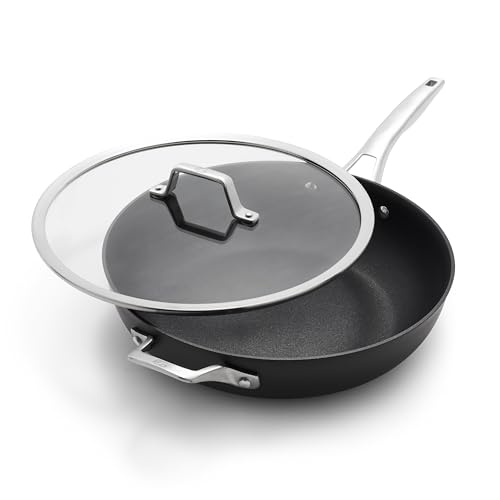
Calphalon Premier Space-Saving Nonstick Fry Pan
The Premier line is designed so pans nest and stack without the coating rubbing, which is the usual reason storage damages nonstick. The pans themselves use a multi layer coating over hard anodized aluminium. Owners report the stacking design genuinely helps in cupboards where pans previously had to be stored loose.
Pros
- Stacks without scratching coating
- Solid oven temperature rating
- Even heating base
Cons
- Benefits require buying matching pieces
- Heavier than basic pans of the same size
Compared at a glance
| # | Model | Construction | Best for | Score | Price |
|---|---|---|---|---|---|
| 1 | All-Clad HA1 Hard Anodized Nonstick Fry Pan | Hard anodized aluminium with steel base | Best overall | 9.4 | Check price |
| 2 | Tramontina Professional Nonstick Fry Pan | Heavy gauge aluminium | Best value | 9.2 | Check price |
| 3 | OXO Good Grips Pro Nonstick Frying Pan | Three layer nonstick | Best for everyday cooking | 9.0 | Check price |
| 4 | T-fal Ultimate Hard Anodized Nonstick Fry Pan | Hard anodized aluminium | Best budget | 8.7 | Check price |
| 5 | GreenPan Valencia Pro Ceramic Nonstick Frying Pan | Diamond reinforced ceramic | Best ceramic option | 8.5 | Check price |
| 6 | HexClad Hybrid Nonstick Fry Pan | Hybrid stainless and nonstick hexagons | Best for searing | 8.2 | Check price |
| 7 | Calphalon Premier Space-Saving Nonstick Fry Pan | Stackable space saving shape | Best for small kitchens | 8.0 | Check price |
Good to know
How long should a nonstick pan last?
With medium heat, hand washing and no metal utensils, three to five years of regular use is a reasonable expectation from a well built pan. Thin budget pans often lose their release within a year of daily cooking.
Can I use metal utensils on nonstick?
Avoid them on conventional and ceramic coatings, where they cause the scratches that start coating failure. Hybrid pans with raised stainless ridges are designed to tolerate metal, which is one of their main selling points.
Is ceramic nonstick better than traditional nonstick?
It is different rather than strictly better. Ceramic avoids PTFE chemistry and starts out very slippery, while traditional coatings hold their release longer under a wider range of heat. Your cooking style should decide which suits you.
Are nonstick pans dishwasher safe?
Many are labelled dishwasher safe, but hand washing measurably extends coating life. Dishwasher detergents are abrasive and the heat cycle stresses the coating, so treat the label as permission rather than a recommendation.
Why do nonstick pans warp?
Usually from thermal shock, such as running cold water into a hot pan, or from heating an empty thin pan on high. A thicker hard anodized base resists both, but letting the pan cool before washing helps any pan stay flat.
What heat should I use with nonstick?
Low to medium covers nearly everything nonstick does well. High heat shortens coating life and is not needed for eggs, pancakes, fish or vegetables, which are the tasks these pans are designed for.
Do I need an induction compatible pan?
Only if you have an induction cooktop, in which case it is essential. Aluminium bodies require a bonded magnetic base, so check the specification rather than assuming a heavy pan will work.
When should I replace a nonstick pan?
When food consistently sticks despite oil, or when the coating is visibly scratched, flaking or bubbling. A pan that has lost its release is no longer doing the one job it exists for.
Our take
The All-Clad HA1 is the nonstick pan to buy if you want one that heats evenly, stays flat and keeps releasing after years of use. Tramontina Professional gets you most of the way there and is the pan to choose if you would rather replace it occasionally than baby it, while the GreenPan Valencia Pro is the answer for cooks who want a ceramic surface. Whatever you choose, medium heat and hand washing will do more for its lifespan than any feature on the box.