Which Support Harness Fits a Dog with Hip Dysplasia?
For dogs with hip dysplasia or degenerative myelopathy, the Help ‘Em Up Harness gives the most complete front and rear support. Owners managing daily stairs often reach for the Walkin’ Lift Combo Harness. Seniors needing occasional steadying do well with the lighter GingerLead sling.
Help ‘Em Up Harness suits dogs with hip dysplasia, arthritis, or degenerative myelopathy best. Its design supports the front and rear end through separate handles. It costs more than a single-handle harness and takes longer to fit each time.
Beyond a basic no-pull design, orthopedic harnesses differ mainly in handle placement, panel width, and how weight spreads across the chest and belly. We compared listed materials, handle construction, and owner reports on fit, sizing accuracy, and daily use during recovery or aging.
The top picks, ranked
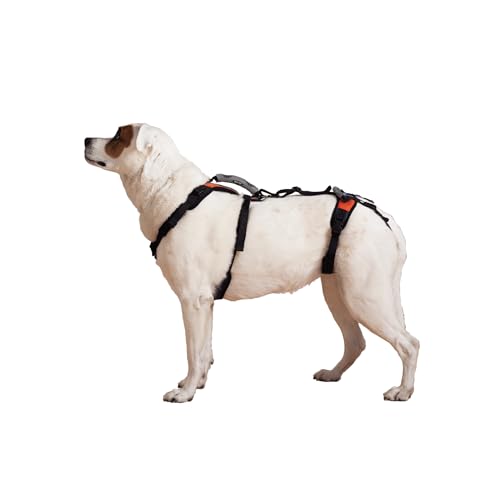
Help ‘Em Up Harness by Blue-9
Two connected harnesses, one at the chest and one at the hips, create separate lift points for the front and rear end. Neoprene lining spreads pressure across the ribcage and thighs instead of concentrating it on one strap. Owners managing hip dysplasia or degenerative myelopathy use it daily for stairs, car rides, and short walks.
Pros
- Supports both ends independently
- Neoprene padding reduces pressure sores
- Handles built for sustained lifting, not just brief grabs
Cons
- Two-piece design takes longer to fit each time
- Bulkier than a single support harness

Walkin’ Pets Walkin’ Lift Combo Harness
Front and rear harnesses connect into one combo set, each with its own handle sized for real lifting rather than light guidance. Wide straps cross the chest and hips, spreading weight over a larger area. Owners managing hip dysplasia describe using the rear handle constantly on stairs, with the front handle staying optional on flat ground.
Pros
- Handles strong enough for consistent daily lifting
- Wide straps reduce pinching on thin dogs
- Front and rear pieces can be used separately
Cons
- Higher cost than single-piece harnesses
- Setup takes practice for owners new to lift harnesses

Kurgo Tru-Fit Smart Harness
A padded chest plate and back handle give light lift assistance without the cost of a dedicated rehab harness. Front and back leash clips let owners manage pulling on the same harness used for support. Owners with dogs recovering from minor strains report enough handle strength for guiding onto a couch or into a car.
Pros
- Doubles as a training harness and light support harness
- Front clip helps manage pulling
- Machine washable padding
Cons
- Handle not rated for full-weight lifting
- Chest plate can rub short-legged breeds

GingerLead Dog Support & Rehabilitation Harness
A single continuous strap runs under the belly and up around the chest, letting an owner steady a dog with one hand while walking. Male and female specific versions avoid pressure on sensitive anatomy. Owners of aging dogs use it for short walks, yard trips, and getting up from a nap without wrestling a full harness on.
Pros
- Fast to put on for dogs stiff in the morning
- No hardware pressing on the spine
- Works well for brief support rather than constant wear
Cons
- Less structured support than a two-panel harness
- Not intended for dogs needing full front and rear lift
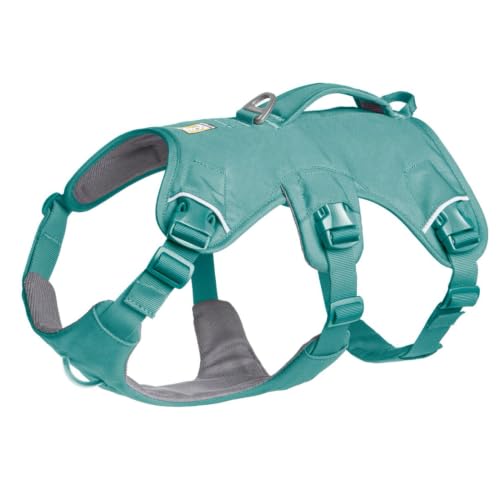
Ruffwear Web Master Harness
A padded handle sits above the shoulders, positioned for lifting or steering the front end on stairs, trailheads, or icy sidewalks. Five points of adjustment let it fit dogs with barrel chests or narrow waists. Owners with dogs weak in the front legs, or recovering from a foreleg injury, use the handle to take weight off the shoulders.
Pros
- Handle positioned specifically for front-end assistance
- Five adjustment points fit unusual body shapes
- Reflective trim for low-light walks
Cons
- No rear support for dogs weak in the hips
- Runs narrow through the chest on broad breeds

Ruffwear Doubleback Harness
Built for search and rescue dogs, the reinforced handle and rigid backplate hold up under sustained weight better than most support harnesses. Padded panels sit lower on the ribcage to avoid the windpipe when lifting. Owners of large and giant breeds use it for helping dogs in and out of trucks or over obstacles on hikes.
Pros
- Handle holds up under repeated heavy lifting
- Rigid backplate keeps the harness from twisting
- Padding positioned to avoid throat pressure
Cons
- Runs bulky and warm for small dogs
- Among the pricier single-handle options here

PetSafe CareLift Support Harness
A single rear sling wraps behind the ribcage and around the thighs, aimed at dogs that only need rear support for stairs or slippery floors. It skips front-end coverage entirely, which keeps the cost down against two-piece systems. Owners with mildly arthritic dogs describe it as an easy first harness before committing to a full rehab system.
Pros
- Lower cost than full front and rear systems
- Quick to put on for short lift assistance
- Adjustable straps fit a range of body shapes
Cons
- No front-end support for dogs weak in the shoulders
- Strap can shift on deep-chested breeds
How to pick the right one
What separates an orthopedic harness from a standard one Orthopedic harnesses add a lift handle and wider load-bearing panels that a standard walking harness skips. Some designs cover only the rear body, aimed at hips and back legs. Others connect a front harness to a rear harness for dogs weak throughout. Fit and handle placement matter more than any marketing label here.
Do lift handles really help with hip dysplasia and arthritis Vets do not claim a harness reverses arthritis or hip dysplasia. What owners report is easier stairs, fewer slips on hardwood, and less strain during flare-ups. A handle positioned over the hips helps most with rear weakness, while a chest handle assists dogs that stumble in front. Match the handle position to where the dog actually struggles.
Padding and pressure distribution across the chest and hips Thin straps concentrate weight into a line across the ribs or belly, which can chafe over long-term use. Wider padded panels spread that same weight over more skin. Neoprene and foam linings both help, though neoprene traps more heat in warm climates. Check where the padding actually sits, since some designs miss the pressure points that matter most.
Sizing a support harness for small and large breeds A harness sized for a Labrador will not fit a Dachshund’s proportions, even at a similar weight. Measure girth behind the front legs and around the widest part of the ribcage before ordering. Small breeds need proportionally narrower straps to avoid restricting the front legs. Large and giant breeds need a reinforced handle, since body weight alone can strain light stitching.
How they compare
| # | Model | Coverage | Best for | Score | Price |
|---|---|---|---|---|---|
| 1 | Help ‘Em Up Harness by Blue-9 | Front chest harness plus rear hip harness | Best overall | 9.4 | Check price |
| 2 | Walkin’ Pets Walkin’ Lift Combo Harness | Front harness and rear harness, sold as a combo | Best for hip dysplasia | 9.1 | Check price |
| 3 | Kurgo Tru-Fit Smart Harness | Front chest clip and back clip | Best value | 8.9 | Check price |
| 4 | GingerLead Dog Support & Rehabilitation Harness | One continuous strap, no buckles across the back | Best for senior dogs | 8.7 | Check price |
| 5 | Ruffwear Web Master Harness | Above the shoulders for front-end control | Best for front-leg lift | 8.5 | Check price |
| 6 | Ruffwear Doubleback Harness | Reinforced handle rated for sustained load | Best for large breeds | 8.3 | Check price |
| 7 | PetSafe CareLift Support Harness | Rear body only | Best budget | 8.0 | Check price |
Common questions
Do orthopedic harnesses actually help dogs with arthritis?
Owners report easier stairs and fewer slips once a harness handle takes some weight off sore joints. No harness treats the underlying arthritis, and a vet should still guide pain management alongside it.
What is the difference between an orthopedic harness and a regular walking harness?
A regular harness mainly controls pulling on leash. An orthopedic harness adds a reinforced handle and wider padded panels built for lifting or steadying a dog, not just walking one.
Should a support harness clip in the front or the back?
Support harnesses built for lifting usually skip a front clip entirely and focus on the handle. If daily walking is also a concern, a front clip helps manage pulling separately from the lift function.
Can a harness help a dog with hip dysplasia get up the stairs?
A rear handle positioned over the hips lets an owner take weight off the back legs during each step. Many owners of dogs with hip dysplasia use the handle specifically for stairs and getting into vehicles.
How do you measure a dog for a support harness?
Measure girth around the widest part of the ribcage, just behind the front legs, and check that number against the brand’s size chart. Two-piece harnesses also need a separate hip measurement for the rear panel.
Do vets recommend support harnesses for senior dogs?
Many vets suggest a support harness once a senior dog starts struggling with stairs, car rides, or slick floors. The specific style depends on whether the front, rear, or both ends need help.
Can a dog wear a lift harness all day?
Most support harnesses suit short periods of active lifting, not all-day wear. Extended wear can cause chafing under the straps, so owners typically remove it once the dog settles.
Which harness works best for a dog recovering from ACL surgery?
A front and rear combo harness lets an owner control both ends during the slow, controlled walks that ACL recovery requires. A single rear sling can work too if the front legs are unaffected.
Help ‘Em Up vs Walkin’ Lift Combo: which harness fits worse cases?
Help ‘Em Up uses neoprene lining and independent handles built for daily, ongoing lifting. Walkin’ Lift Combo pairs wide straps with handles rated for full-weight lifting, and its pieces can be used separately. Both suit dogs weak at both ends; owners often choose by fit and budget.
Our pick
Help ‘Em Up Harness remains the strongest pick for dogs with hip dysplasia or degenerative conditions, since it supports both ends with independent handles. Owners who only need rear assistance and want to spend less should look at the PetSafe CareLift Support Harness instead. For a dog still walking well but occasionally unsteady on stairs, the GingerLead sling covers that lighter need without the bulk of a full system.


