Outdoor Fireplaces and Fire Pits Worth Owning
The Solo Stove Bonfire 2.0 is our overall pick for its near smokeless burn and easy ash removal. The Sunnydaze Cast Iron Chiminea directs heat where you sit, while the Outland Living Series 401 is the best choice where wood fires are restricted.
For a patio fire that warms people rather than smoking them out, the Solo Stove Bonfire 2.0 is the pick, because its double wall airflow burns the smoke before it reaches you. The Sunnydaze Cast Iron Chiminea throws heat forward through its opening, and the Outland Living Series 401 is the answer in areas where open wood burning is not permitted.
Outdoor fireplaces are trickier to choose than they look, since the same word covers open bowls, enclosed chimineas, propane tables and steel fireplaces, and each behaves differently on a deck, in wind and under local burning rules. We compared models on fuel type, how much usable heat reaches seated people, smoke behaviour, required clearance from structures and decking, and what owners report about moving and storing them.
The best picks, ranked

Solo Stove Bonfire 2.0
The double wall design pulls air up through the base and reintroduces it at the top, burning off the smoke that normally chases everyone around the patio. The 2.0 version adds a removable base plate and ash pan, which fixes the main cleaning complaint about the original. Owners report it produces strong radiant heat for its size.
Pros
- Very little smoke once burning
- Simple ash removal
- Portable enough for camping trips
Cons
- Needs a heat shield on a wooden deck
- Burns through wood quickly

Sunnydaze Cast Iron Chiminea
A chiminea sends heat out of its front opening rather than straight upwards, which makes it far more effective for warming a seating area on a cool evening. Cast iron holds heat long after the flames drop. Owners report the chimney carries smoke above head height, which is the main advantage over an open bowl.
Pros
- Directs heat towards seating
- Chimney lifts smoke clear
- Retains warmth after burning down
Cons
- Heavy and awkward to reposition
- Needs covering to prevent rust

Outland Living Series 401 Propane Fire Table
Propane means no smoke, no sparks and no ash, which is what makes this usable on many decks and in areas where wood burning is banned during dry spells. The flame adjusts instantly, so you can turn the heat down rather than waiting for logs to burn out. Owners report the lava rock bed spreads the flame evenly.
Pros
- No smoke, sparks or ash
- Instant on and off with adjustable flame
- Often allowed where wood fires are not
Cons
- Needs propane tanks on hand
- Less radiant heat than a wood fire

Solo Stove Yukon 2.0
The largest of the range, sized for a wide seating circle where the smaller models leave people on the edge feeling cold. It uses the same secondary burn design, so the smoke stays minimal even at this size. Owners report it takes full size logs, which reduces how often you have to feed it.
Pros
- Heats a large seating circle
- Accepts full size logs
- Same low smoke design
Cons
- Heavy to move once loaded
- Consumes a lot of firewood
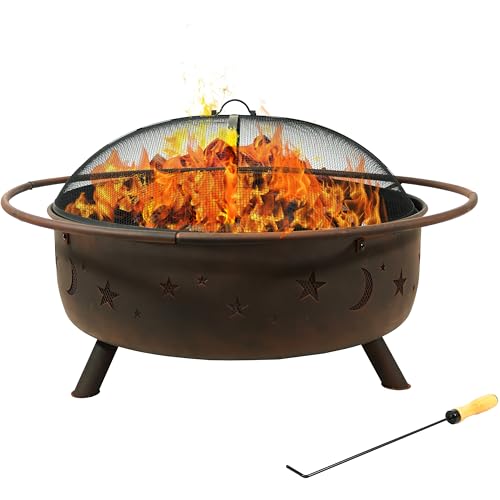
Landmann Big Sky Fire Pit
A traditional steel bowl with a decorative cut out pattern that glows when the fire is going, plus a full spark screen and poker. It is the straightforward answer if you simply want a wood fire in the garden without spending much. Owners report the screen is essential on breezy nights and worth keeping in place.
Pros
- Affordable route to a real wood fire
- Spark screen included
- Attractive glow through the cut outs
Cons
- Produces noticeable smoke
- Thin steel warps over time
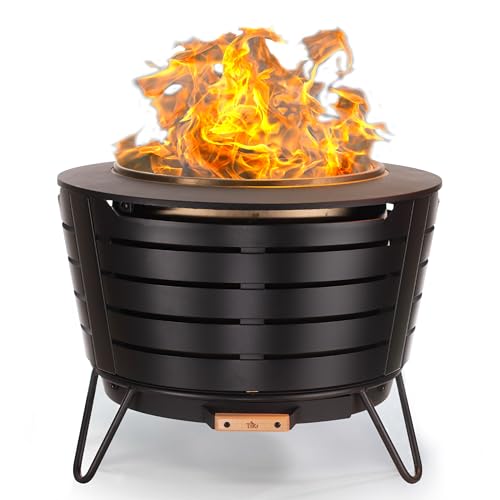
TIKI Brand Patio Fire Pit
TIKI uses a similar internal airflow principle to reduce smoke, at a lower outlay than the premium stainless options. It comes with a wood pack starter and a carry bag for moving it around the garden. Owners report smoke reduction is genuine though not quite at the level of the double wall stainless designs.
Pros
- Noticeably less smoke than a plain bowl
- Easier on the wallet
- Comes with a carry bag
Cons
- Not as clean burning as stainless rivals
- Coating can discolour with heavy use

Pleasant Hearth Outdoor Wood Burning Fireplace
A proper standing fireplace with a chimney and a mesh screen door, which suits gardens where a permanent looking feature is wanted rather than a portable bowl. The enclosed firebox contains sparks well. Owners report assembly takes a while and the unit is best positioned once and left in place.
Pros
- Contains sparks behind mesh doors
- Chimney lifts smoke away
- Looks like a permanent feature
Cons
- Long assembly
- Not portable once built
How to pick the right one
Choose the fuel before the shape Wood gives the crackle, the smell and the strongest radiant heat, but it also means smoke, sparks, ash and firewood storage. Propane gives instant heat with no smoke or cleanup, which matters if you use it on a covered deck or live somewhere with seasonal burn bans. Check your local rules first, because in many areas a propane unit is permitted on evenings when an open wood fire is not.
Respect the clearance and the surface underneath Every unit has a stated clearance from walls, fences, overhanging branches and furniture, and it is there for good reason. Wooden decking and composite boards need a heat shield or a fire resistant mat underneath, since radiant heat from the base will scorch or melt them. On grass, expect a dead patch. Gravel, stone and concrete are the easiest surfaces to work with.
Think about where the heat actually goes An open bowl radiates heat in all directions, so it warms a circle of people evenly but wastes a lot upwards. A chiminea or enclosed fireplace pushes heat out of the front opening, which is much better when seating is on one side or when you want to shelter from wind. Match the design to how your garden furniture is arranged rather than the other way around.
Plan for smoke, weather and storage Smoke follows the person it likes least, and no design eliminates it completely. Double wall airflow designs come closest, and burning properly seasoned hardwood makes more difference than any feature on the specification sheet. Steel and cast iron both rust if left uncovered through winter, so budget for a fitted cover and somewhere dry to store the unit out of season.
Compared at a glance
| # | Model | Fuel | Best for | Score | Price |
|---|---|---|---|---|---|
| 1 | Solo Stove Bonfire 2.0 | Wood logs | Best overall | 9.4 | Check price |
| 2 | Sunnydaze Cast Iron Chiminea | Wood logs | Best for directed heat | 9.2 | Check price |
| 3 | Outland Living Series 401 Propane Fire Table | Propane | Best for fire restrictions | 9.0 | Check price |
| 4 | Solo Stove Yukon 2.0 | Wood logs | Best for larger groups | 8.8 | Check price |
| 5 | Landmann Big Sky Fire Pit | Wood logs | Best value wood pit | 8.6 | Check price |
| 6 | TIKI Brand Patio Fire Pit | Wood logs | Best for low smoke on a budget | 8.3 | Check price |
| 7 | Pleasant Hearth Outdoor Wood Burning Fireplace | Wood logs | Best traditional design | 8.0 | Check price |
Frequently asked questions
What is the difference between a fire pit and an outdoor fireplace?
A fire pit is an open bowl that radiates heat in all directions. An outdoor fireplace has an enclosed firebox and a chimney, so it directs heat forwards and carries smoke upwards. Chimineas sit between the two.
Are smokeless fire pits really smokeless?
They are much lower in smoke rather than smoke free. The double wall design burns off most of the smoke once the fire is up to temperature, but the first few minutes of lighting still smoke, and damp wood will smoke in any design.
Can I use one on a wooden deck?
Only with a heat shield or fire resistant mat underneath and the manufacturer’s stated clearance respected. Many wood burning units are not recommended on wooden decks at all, while propane tables are more commonly approved.
What wood should I burn?
Seasoned hardwood with low moisture content, such as oak, ash or birch. Never burn treated timber, pallets, painted wood or construction offcuts, since these release harmful fumes. Softwoods spit sparks and burn through quickly.
How much heat do I actually get?
A wood fire produces strong radiant heat for people sitting within a couple of metres, and the effect drops off quickly beyond that. Propane units are gentler and more consistent. Neither will heat an exposed garden on a cold windy night on its own.
Do I need a spark screen?
For any wood burning unit, yes. Sparks travel further than people expect, especially in a breeze, and a screen is the difference between an enjoyable evening and a burnt patio cushion or a scorched lawn.
How do I clean out the ash?
Let the ash cool completely, ideally overnight, then scoop it out into a metal container. Models with a removable base plate and ash pan make this a two minute job. Never dispose of ash in a plastic bin, since embers can remain hot for a day or more.
Should I cover it over winter?
Yes. Water sitting in a fire bowl is the main cause of rust and of warped bases. Use a fitted cover, keep the unit off wet ground, and empty any ash before storing since it holds moisture against the metal.
The verdict
The Solo Stove Bonfire 2.0 is the one we would put on a patio, because the low smoke burn is the difference between an evening outside and an evening spent moving chairs. Choose the Sunnydaze Cast Iron Chiminea if your seating is on one side, and the Outland Living Series 401 where wood fires are restricted.