LED and Softbox Lighting Kits Compared by Color Accuracy
Most home studios do well with the Neewer 660 RGB LED kit, which pairs CRI 97 color accuracy with app control. Tight budgets fit better with the Emart 3-point softbox kit. Video creators recording long sessions should look at the GVM 800D-RGB panel instead.
The Neewer 660 RGB LED kit suits most photographers who want accurate color without cinema-grade pricing, thanks to CRI 97 output and app-based dimming. Its light stands feel less sturdy in a draft, a tradeoff for the lower weight.
Color rendering index and beam angle rarely appear in marketing photos, yet they matter more than wattage for accurate skin tones. We compared published CRI, wattage, and stand specifications against owner feedback on color consistency and heat buildup.
Before you buy
What to look for in a lighting kit Color rendering index matters more than wattage when it comes to skin tones and product colors, so look for CRI 90 or higher. Bi-color and RGB panels adapt to mixed lighting without gels. Fixed-temperature fixtures cost less but limit how a shooter can match ambient light.
Continuous LED vs softbox kits with bulbs LED panels run cooler and dim instantly, which matters for video where flicker shows up on camera. Softbox kits built around CFL or fluorescent bulbs cost less upfront but generate more heat and offer little fine control over brightness.
Best lighting setups for small home studios Compact two-light setups, like the Fovitec or LimoStudio kits, fit apartments and spare rooms without crowding a small backdrop area. Softboxes under 24 inches and stands that collapse to under three feet make the most sense for tight spaces.
Lighting for video creators and streamers A cooling fan, like the one built into the GVM 800D-RGB, prevents the heat buildup that comes with hour-long streams or tutorials. Bi-color and RGB modes also help creators match background scenery for branded video content.
The shortlist, ranked

Neewer 660 RGB LED Video Light (2-Pack)
Each panel switches between 3200 and 5600K white light plus full RGB color, rated at CRI 97 for accurate skin tones. A companion app or the on-panel dial handles adjustments. Two 79-inch stands and softbox diffusers ship in the box, so there is nothing extra to buy for a two-light setup.
Pros
- CRI 97 output stays accurate across the full dimming range
- Controllable from an app or the panel itself
- Softboxes included instead of sold separately
Cons
- Light stands feel unstable in drafty rooms
- App pairing occasionally drops mid-session

GVM 800D-RGB LED Video Light
One 800D panel does the work of a two-light setup for many YouTubers, outputting 65 watts with 360-degree RGB hue selection. A built-in fan keeps the panel cool through hour-long recording sessions. Barn doors narrow light spill without an extra accessory purchase.
Pros
- Built-in fan prevents heat buildup on long shoots
- Barn doors control spill without extra gear
- 65W output covers most single-panel setups
Cons
- Fan noise can bleed into sensitive microphones
- Heavier than flat LED panel alternatives
Godox SL-60W LED Video Light
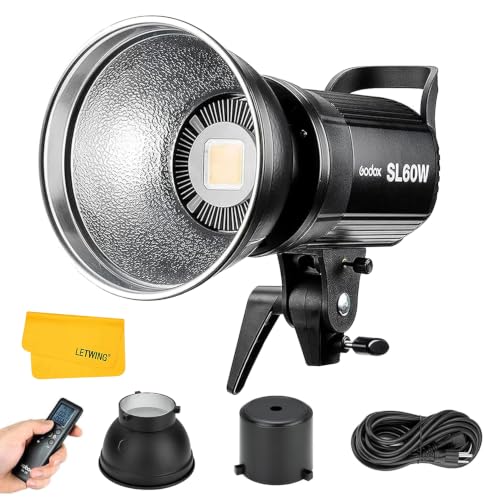
A Bowens S-type mount lets this fixture accept standard softboxes, umbrellas, and grids already common in studio setups. Anyone who owns other Godox or third-party Bowens modifiers can reuse them here. The fixed 5600K output pairs with a 2.4G wireless remote for adjustments from across a room.
Pros
- Bowens mount works with existing studio modifiers
- Wireless remote included for hands-off adjustment
- Consistent 5600K daylight output
Cons
- No bi-color adjustment, output is fixed
- Softbox modifier sold separately

Emart 3 Point Softbox Lighting Kit
Two 135W-equivalent softbox heads plus a small tabletop light cover a home studio corner for product shots or portraits. Standard E27 sockets mean replacement bulbs are easy to find at any hardware store. A carrying bag comes bundled for anyone who needs to move the kit between rooms.
Pros
- Low-cost entry into three-point lighting
- E27 sockets simplify bulb replacement
- Carrying bag included for storage or travel
Cons
- No dimming control beyond on and off
- Umbrella-style softboxes catch drafts easily

Neewer 2-Pack Bi-Color 660 Softbox Kit
Bi-color panels shift between 3200 and 5600K, letting portrait shooters match window light or tungsten bulbs without gels. Built-in softboxes soften output enough to flatter skin tones on their own. Dimming runs from 10 to 100 percent for fine control over exposure.
Pros
- Matches mixed light sources without gels
- Dimming from 10 to 100 percent gives fine control
- Softboxes soften light without a separate diffuser
Cons
- No RGB modes for creative color work
- Stands top out at 75 inches, shorter than some kits

Fovitec 2-Light Softbox Lighting Kit
Four 45W fluorescent-equivalent bulbs per head produce even, shadowless light suited to flat-lay and e-commerce product shots. A 10 by 12 foot white backdrop stand ships in the box, rounding out a tabletop studio. Compact 24×24 inch softboxes fit into tighter spaces than larger kits allow.
Pros
- Backdrop stand included at no extra cost
- Even output suits flat product photography
- Compact softboxes fit small rooms
Cons
- Less output for full-body portrait work
- Fluorescent bulbs run warmer with extended use
LimoStudio 700W Photography Softbox Kit
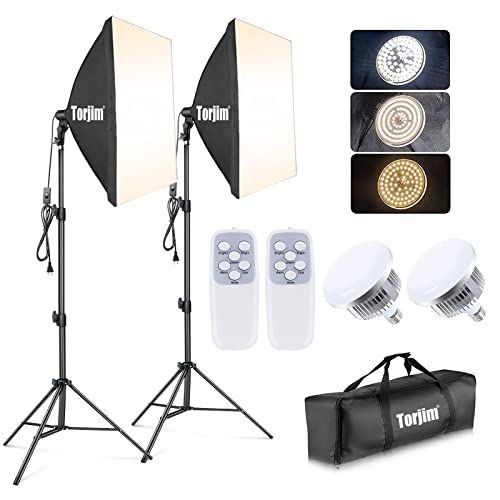
A printed setup guide and clearly labeled parts help first-time buyers avoid the usual assembly confusion. Combined 700W-equivalent output from two softboxes covers a small home studio. A boom arm and background support ship in the same box, useful for anyone building a first setup from scratch.
Pros
- Printed instructions ease first-time setup
- Boom arm and backdrop support bundled in
- Lightweight stands pack down for easy storage
Cons
- Smaller 16×24 inch softboxes limit spread at distance
- CFL bulbs take a moment to reach full brightness
Compared at a glance
| # | Model | Color temp range | Best for | Score | Price |
|---|---|---|---|---|---|
| 1 | Neewer 660 RGB LED Video Light (2-Pack) | 3200K-5600K + RGB | Best overall | 9.4 | Check price |
| 2 | GVM 800D-RGB LED Video Light | 65W per panel | Best for video creators | 9.1 | Check price |
| 3 | Godox SL-60W LED Video Light | Bowens S-type | Best for continuous studio lighting | 8.9 | Check price |
| 4 | Emart 3 Point Softbox Lighting Kit | 135W equivalent | Best budget | 8.6 | Check price |
| 5 | Neewer 2-Pack Bi-Color 660 Softbox Kit | 3200K-5600K | Best for portrait photography | 8.4 | Check price |
| 6 | Fovitec 2-Light Softbox Lighting Kit | 45W x4 per head | Best for product photography | 8.2 | Check price |
| 7 | LimoStudio 700W Photography Softbox Kit | 700W equivalent | Best for beginners | 8.0 | Check price |
Frequently asked questions
How much wattage does a home photography studio need
A 400 to 800 watt equivalent setup split across two or three lights covers most portrait and product work in a small room.
Are LED lighting kits better than bulb-based softbox kits
LED panels dim more precisely and run cooler, though bulb-based softbox kits usually cost less for similar output.
Can a photography lighting kit improve video call lighting
Yes. A single softbox or LED panel placed at eye level does more for video call lighting than any webcam software setting.
How many lights do I need for a basic photography setup
Two lights, a key and a fill, cover most portrait and product photography. A third light adds separation from the background.
Is CRI or lumens more important for photography lighting
CRI has a bigger effect on color accuracy. A high-lumen light with poor CRI still renders skin tones and colors inaccurately.
What lighting works best for product photos on a white background
Softbox setups with even, diffused output reduce shadows on white backgrounds more effectively than a single hard light source.
What is the difference between bi-color and RGB lighting panels
Bi-color panels shift only between warm and cool white. RGB panels add full color output for creative or background lighting.
How much space does a two-light photography setup need
Plan on roughly 10 by 10 feet to position both lights, a subject, and enough distance for even coverage.
Neewer 660 vs GVM 800D-RGB, which is better for video
The GVM’s built-in fan and single-panel output suit long recording sessions better, while the Neewer kit’s two-light setup gives more even coverage for photos.
Do continuous lights work for both photography and video
Yes. Continuous LED and softbox lights suit both, unlike flash strobes, which only fire for still photography.
Our take
Most home studios are better served by the Neewer 660 RGB kit, which delivers accurate color and app control at a moderate price. Anyone recording hour-long video sessions should upgrade to the GVM 800D-RGB instead, since its built-in fan handles heat that the Neewer setup cannot. Buyers still deciding whether photography is worth the investment should start with the Emart budget kit and upgrade later if needed.