Backyard Playhouses Ranked by Age and Yard Size
Step2 Neat & Tidy Cottage II is the strongest all round playhouse for toddlers, with a moulded plastic shell that shrugs off weather. Backyard Discovery Sweetwater suits older children who want a real cedar structure. Little Tikes Cape Cottage is the compact pick for small yards.
Step2 Neat & Tidy Cottage II covers most families with toddlers, since moulded plastic survives rain without maintenance. Backyard Discovery Sweetwater is the cedar upgrade for school age children, and Little Tikes Cape Cottage fits yards where space is tight.
Playhouse buying goes wrong on two fronts: outgrowing it within a year, or choosing wood that needs annual sealing nobody has time for. Age range and material together decide how long a house stays in use. Our picks weigh footprint, interior height, weather resistance, assembly effort and included features, plus owner reports about fading and hardware rust.
Before you buy
What should you consider before buying a playhouse? Measure the space first, including clearance for doors and any slide run out. Then match the age range honestly, because a house sized for a two year old is abandoned by five. Material sets the maintenance burden: plastic needs nothing, wood needs sealing every couple of years. Check the assembly requirement too, since several wooden houses take a full day with two adults and a drill.
Plastic or wooden playhouse, which lasts longer? Moulded plastic wins on maintenance and shrugs off rain, though ultraviolet light fades colour over three or four summers. Cedar and treated wood last longer structurally and feel more substantial, but they need resealing and can splinter as they age. Families in wet climates usually favour plastic. Anyone wanting a structure that survives more than one child tends toward cedar.
Which playhouse suits toddlers versus school age children? Toddlers want small, enclosed and low, with interactive features like doors, shutters and pretend kitchens. Interior height around 40 inches is fine. School age children need standing room closer to 60 inches, plus something to do beyond hiding. Backyard Discovery Sweetwater and KidKraft’s modern house both bridge that gap, which is why they stay in use several years longer.
How do you site and maintain a playhouse safely? Set the house on level ground, ideally on grass, mulch or a rubber mat rather than concrete. Leave at least 6 feet of clear space around any slide exit. Anchor lightweight plastic houses in windy areas, since they can tip. Check wooden houses each spring for splinters, loose screws and rust. Drill drainage holes in plastic floors if water collects after storms.
The top picks, ranked

Step2 Neat & Tidy Cottage II
Double wall moulded plastic resists cracking through freeze and thaw cycles, so this survives being left outside year round. Inside, a play kitchen with sink and phone gives pretend play beyond just hiding. Recommended for ages two through six, which covers the preschool years fully.
Pros
- Needs no sealing, staining or annual maintenance
- Interior kitchen extends play beyond hiding
- Assembles without power tools in about an hour
Cons
- Colours fade after several summers in direct sun
- Outgrown by most children around age six

Backyard Discovery Sweetwater Wooden Playhouse
Pre stained cedar and a raised floor make this feel like a small building rather than a toy. Interior height suits children up to about age ten, and adults can stand stooped inside. A serving counter, flower boxes and working windows encourage longer play sessions.
Pros
- Cedar naturally resists rot and insects
- Large enough for several children at once
- Stays usable well into primary school years
Cons
- Assembly takes a full day with two people
- Needs resealing every couple of years

Little Tikes Cape Cottage Playhouse
A narrow footprint around 36 inches wide lets this fit a patio, balcony corner or playroom. Dutch style split door and working shutters give the interaction toddlers want. Moulded plastic construction means it can live indoors in winter and outdoors in summer.
Pros
- Small footprint suits patios and playrooms
- Light enough for one adult to reposition
- Split door adds interactive play value
Cons
- Interior fits only one or two small children
- Fewer built in play features than larger cottages

KidKraft Modern Outdoor Wooden Playhouse
Clean lines and a flat roof suit gardens where a pastel cottage would clash. Wood construction with a weather resistant finish handles seasonal exposure. Inside there is a play kitchen with sink and stovetop, plus a bench that doubles as storage.
Pros
- Styling blends into a landscaped garden
- Bench storage keeps outdoor toys contained
- Kitchen features suit a wide age range
Cons
- Flat roof holds standing water without a slope
- Assembly involves a large number of small screws
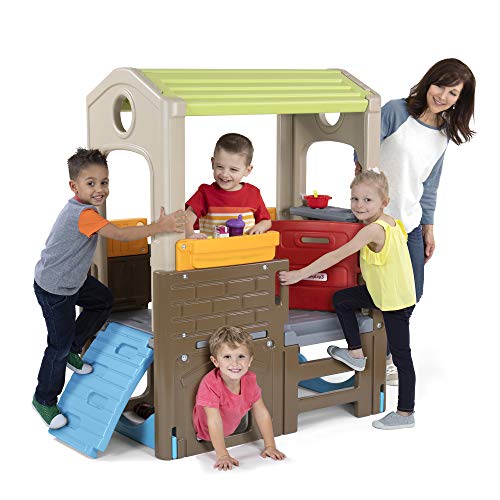
Simplay3 Young Explorers Discovery Playhouse
Made in the United States from double wall plastic, this house works as a permanent playroom fixture. Chalkboard panels and an activity wall give quiet indoor play options. Its open roof design keeps sightlines clear so adults can supervise from across a room.
Pros
- Open roof design keeps children visible
- Chalkboard panels extend indoor play value
- Suitable from 18 months, earlier than most
Cons
- Open roof gives no rain shelter outdoors
- Plain styling has less curb appeal than cottages

Little Tikes Endless Adventures Tikes Town Playhouse
This combines a playhouse with a slide, climbing steps and a lookout deck, which suits children who will not sit still. Multiple entry points reduce arguments between siblings. The larger footprint needs a flat area of roughly 8 by 6 feet.
Pros
- Slide and climb features suit high energy play
- Several entrances reduce sibling bottlenecks
- Wide age range keeps it useful for years
Cons
- Needs a large flat area of soft ground
- Assembly requires two adults and several hours
Step2 Welcome Home Playhouse
A simpler moulded plastic cottage with a mail slot, doorbell and half door for role play. Fewer accessories keep both cost and assembly time down. It suits younger toddlers who mainly want somewhere small to call their own.
Pros
- Fastest assembly among the houses here
- Doorbell and mail slot spark role play
- Light enough to move between yard and garage
Cons
- No interior kitchen or activity features
- Thin walls flex more than double wall models
The lineup, side by side
| # | Model | Material | Best for | Score | Price |
|---|---|---|---|---|---|
| 1 | Step2 Neat & Tidy Cottage II | Double wall moulded plastic | Best overall | 9.4 | Check price |
| 2 | Backyard Discovery Sweetwater Wooden Playhouse | Pre stained cedar | Best for older children | 9.2 | Check price |
| 3 | Little Tikes Cape Cottage Playhouse | Moulded plastic | Best for small yards | 9.0 | Check price |
| 4 | KidKraft Modern Outdoor Wooden Playhouse | Wood with weather resistant finish | Best design | 8.8 | Check price |
| 5 | Simplay3 Young Explorers Discovery Playhouse | Double wall polyethylene | Best for indoor use | 8.6 | Check price |
| 6 | Little Tikes Endless Adventures Tikes Town Playhouse | Moulded plastic | Best for active play | 8.3 | Check price |
| 7 | Step2 Welcome Home Playhouse | Moulded plastic | Best budget | 8.0 | Check price |
Good to know
What is the best playhouse for a 3 year old?
Step2 Neat & Tidy Cottage II fits this age well, with a play kitchen, working shutters and a scale suited to preschoolers. Little Tikes Cape Cottage is the smaller alternative for tight spaces.
Are plastic or wooden playhouses better?
Plastic needs no maintenance and handles rain indefinitely, but fades in sun. Wood lasts longer structurally and feels sturdier, though it needs resealing every couple of years. Choose plastic for toddlers, wood for children who will use it into primary school.
Can playhouses be left outside all year?
Moulded plastic models from Step2 and Little Tikes are designed for it, though colours fade over several summers. Wooden houses handle it better with a fresh coat of sealant and a sloped roof that sheds water.
How long does a playhouse take to assemble?
Plastic cottages typically take one to two hours with no power tools. Wooden houses like the Backyard Discovery Sweetwater take a full day with two adults and a drill. Read the parts list before starting.
What size playhouse do I need for my yard?
Allow the footprint plus about 3 feet of clearance on all sides, and 6 feet beyond any slide. Compact houses need roughly 4 by 4 feet, while combination play structures need closer to 8 by 6 feet.
Which playhouse works indoors?
Simplay3 Young Explorers Discovery Playhouse is designed with an open roof and chalkboard panels for indoor use. Little Tikes Cape Cottage is small enough for a playroom and moves easily between rooms.
Do playhouses need to be anchored?
Lightweight plastic houses can tip in strong wind, so ground anchors or sandbags inside the base are sensible. Heavier wooden structures generally stay put, though a level base matters more for them.
At what age do children stop using a playhouse?
Small plastic cottages are usually outgrown around five or six. Larger wooden houses with standing room, such as the Sweetwater, hold interest to about ten, especially when they include a counter or seating.
Final word
Step2 Neat & Tidy Cottage II is the practical choice for most families, since it needs no upkeep and includes enough features to hold a preschooler’s attention. Backyard Discovery Sweetwater is worth the assembly day if you want a cedar structure that lasts through primary school. Little Tikes Cape Cottage solves the small yard problem without giving up the interactive door and shutters.