Which Pond Pump Flow Rate Matches Your Pond Size?
Beckett’s Submersible Pond Pump leads with balanced flow and head height for most backyard ponds under 1000 gallons. Alpine Corporation’s Cyclone Pump serves large koi ponds and tall waterfalls needing far more GPH. Budget-minded owners get strong output from the EcoPlus Eco Submersible Pump, which skips the flow dial and quiet-running extras.
Beckett’s Submersible Pond Pump takes the top spot here, balancing flow rate against head height for most backyard ponds under 1000 gallons. Koi ponds and tall waterfalls need more GPH than that, which is where Alpine Corporation’s Cyclone Pump steps in. Budget-conscious owners lean on the EcoPlus Eco Submersible Pump instead, trading a flow dial and quiet-running claims for a lower cost.
GPH printed on the box tells only part of the story when picking a pond pump. Head height eats into flow fast, so a pump rated for 1000 gallons per hour can slow to a trickle once water climbs six feet to a waterfall. Wattage matters daily too, since most pond pumps run around the clock. We compared published flow rates, wattage, max head height and cord length, then checked owner reports of clogging, noise and impeller wear.
What to look for
How to size a pump to your pond’s gallons GPH, gallons per hour, is the number that sizes a pond pump, and the common rule turns over the entire pond volume once every one to two hours. A 1000 gallon pond wants a pump rated near 500 to 1000 GPH before head height losses get subtracted. Koi ponds need faster turnover for oxygen and filtration, often the full volume every hour. Pumps rated only slightly above pond size tend to disappoint, since real output drops once tubing and height enter the picture.
Wattage and running cost Most pond pumps run continuously, so wattage matters more than the number on the box once a year of electricity bills adds up. A 65 watt pump left on around the clock draws roughly 1.5 kilowatt hours a day. Efficient models push more GPH per watt, showing up as a lower wattage number relative to flow rate on the spec sheet. Compare wattage against GPH rather than wattage alone to judge true efficiency.
Waterfall pumps versus fountain pumps Waterfalls need head height, the vertical distance water climbs before spilling over rocks. Every foot of height and every fitting in the line reduces the GPH a pump can actually deliver. Fountains care less about height and more about a steady, even flow through a nozzle. A high max head height rating suits a tiered waterfall, while a lower rated pump often runs fine for a simple bubbler.
Pump maintenance and winter care Submersible pumps pull debris toward the intake, so a prefilter sponge or basket needs rinsing every one to two weeks during leaf season. Running a pump dry, even briefly, can burn out the impeller or seal. Many owners pull the pump before ice forms solid in freezing climates, though some models run through mild winters to keep a section of the surface open. Manufacturer cold weather guidance is worth checking before leaving any pump submerged all winter.
What we recommend
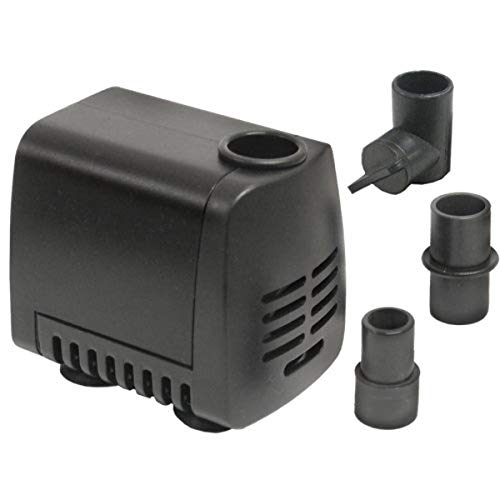
Beckett Submersible Pond Pump
Beckett tuned this pump for the range most backyard ponds actually need, between small container ponds and larger koi setups. A quick-disconnect fitting pulls the pump free for cleaning without disturbing the tubing run. Epoxy encapsulation around the motor keeps water out of the electrical components even after years submerged.
Pros
- Quick-disconnect fitting simplifies cleaning
- Handles small to mid-size ponds without strain
- Epoxy-sealed motor resists water intrusion
Cons
- No adjustable flow control
- Prefilter sponge needs frequent rinsing in leafy yards

Alpine Corporation Cyclone Pump
This Cyclone Pump pushes far more water than a typical backyard model, built for koi ponds and multi-tier waterfalls. Continuous heavy-duty use wears less on the ceramic shaft and stainless steel handle than on lesser materials. Higher wattage reflects the higher output, so running cost climbs above the smaller pumps on this list.
Pros
- Moves enough water for large koi ponds
- Ceramic shaft resists wear from continuous running
- Reaches tall waterfalls other pumps cannot
Cons
- Overkill and wasteful for ponds under 1000 gallons
- Higher wattage raises running cost

EcoPlus Eco Submersible Pump
EcoPlus keeps the design simple here, an oil-free epoxy-filled motor paired with a single-speed impeller and no dial to fiddle with. Strong GPH for the size suits small ponds, hydroponic reservoirs and fountains alike. A shorter cord means it works best placed near the outlet.
Pros
- Strong flow rate for the cost
- Simple design with few parts to fail
- Works equally well in ponds or hydroponic systems
Cons
- Short 6 foot cord limits placement
- No flow adjustment or included fittings

VIVOSUN Submersible Water Pump
VIVOSUN pairs a low wattage draw with an adjustable flow dial, tuning output down without swapping pumps. Consistent pull through the dial’s range comes from a ceramic shaft and copper coil motor. Running cost stays low even with the pump cycling continuously through a hot summer.
Pros
- Low wattage keeps running cost down
- Adjustable dial fine-tunes flow without a new pump
- Ceramic shaft holds up to continuous cycling
Cons
- Max head height limits taller waterfalls
- Cord length is short for larger ponds

TotalPond Submersible Pump
TotalPond built this pump to pair with its own waterfall filter boxes, though it works fine with other brands’ tubing. A quick-disconnect valve splits output between a waterfall and a fountain head at once. Pressure holds up even across several feet of vertical run thanks to the higher head height rating.
Pros
- Splits flow between waterfall and fountain outlets
- Maintains pressure over tall vertical runs
- Long cord reaches outlets set back from the pond
Cons
- Larger housing takes up more room in shallow ponds
- Draws more wattage than pumps with similar GPH

Homasy Submersible Pond Pump
Homasy targets noise here, pairing a ceramic shaft with a copper coil motor to cut the hum other submersible pumps produce. Several nozzle heads ship with it, so one pump handles a bubbling fountain or a straight jet. Lower GPH keeps it suited to smaller, quieter water features rather than koi ponds.
Pros
- Noticeably quieter than similarly sized pumps
- Multiple nozzle heads included for different spray patterns
- Compact housing fits shallow basins
Cons
- Flow rate too low for large or koi ponds
- Nozzle attachments clog faster in ponds with algae
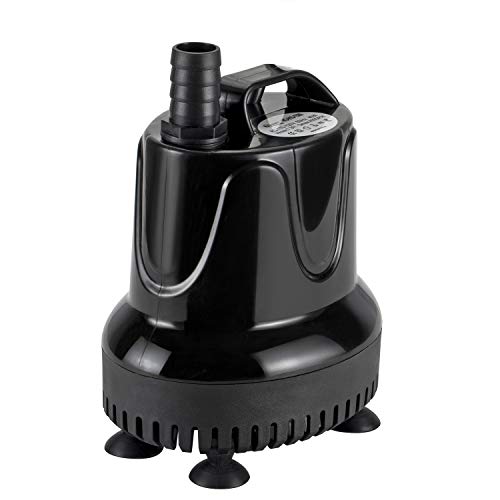
Hygger Submersible Pond Pump
Hygger scales this pump down for desktop fountains, small container ponds and aquariums rather than backyard ponds. Suction cup feet hold it steady on a smooth basin floor. Nozzle attachments included switch between a fountain spray and a straight flow for filtration.
Pros
- Suction cups keep it stable in small basins
- Low wattage suits always-on small features
- Nozzle set covers fountain and filtration use
Cons
- Flow rate too low for ponds over a few hundred gallons
- Not rated for continuous heavy debris load
How they compare
| # | Model | Flow rate | Best for | Score | Price |
|---|---|---|---|---|---|
| 1 | Beckett Submersible Pond Pump | 1000 GPH | Best overall | 9.4 | Check price |
| 2 | Alpine Corporation Cyclone Pump | 3170 GPH | Best for large koi ponds and high flow | 9.1 | Check price |
| 3 | EcoPlus Eco Submersible Pump | 792 GPH | Best value | 8.9 | Check price |
| 4 | VIVOSUN Submersible Water Pump | 800 GPH adjustable | Best energy efficient | 8.6 | Check price |
| 5 | TotalPond Submersible Pump | 2100 GPH | Best for waterfalls and fountains | 8.4 | Check price |
| 6 | Homasy Submersible Pond Pump | 800 GPH | Best quiet operation | 8.2 | Check price |
| 7 | Hygger Submersible Pond Pump | 396 GPH | Best for small water features | 8.0 | Check price |
Good to know
How do I size a pond pump to my pond’s gallons?
Measure your pond’s volume, then look for a pump rated to move that volume once every one to two hours for a standard pond, or once an hour for a koi pond. Subtract for head height and fittings, since real output runs lower than the GPH printed on the box.
Can a pond pump run all winter?
Some pumps carry a year round rating and keep a small opening in the ice, which helps gas exchange for fish. Others should come out before hard freezes, since ice can crack the housing or seize the impeller. Check the specific model’s cold weather rating first.
How much does it cost to run a pond pump?
Multiply the wattage by hours run per day, then convert to kilowatt hours. A 65 watt pump run 24 hours draws about 1.5 kilowatt hours daily, while a 12 to 20 watt model draws a fraction of that over the same period.
Will a pond pump work with my existing filter?
Most submersible pumps connect to standard tubing sizes, commonly half inch to one inch, so they fit most filter boxes and UV clarifiers with the right adapter. Check the pump’s outlet diameter against your filter’s inlet, and confirm the GPH matches what the filter handles.
Are submersible pond pumps loud?
Submerged in water, most pumps run quieter than an above ground pump of similar output, since water muffles the motor hum. Ceramic shaft designs paired with copper coil motors tend to run quieter still. A pump propped against rock or a hard pond liner can transmit more vibration noise than one resting on gravel.
Is a submersible pond pump safe for fish?
Yes, when the intake has a strainer or prefilter fine enough to keep small fish and fry away from the impeller. Larger koi ponds usually add a separate skimmer basket for extra protection. Running the pump keeps oxygen moving through the water, which benefits fish more than it risks them.
How long should a pond pump cord be?
Cord length ranges from about 6 feet on compact fountain pumps to 20 feet on larger pond models. Measure the distance from the planned pump placement to the nearest GFCI outlet before choosing, since an outdoor rated extension cord is a fallback rather than the only option.
How much head height do I need for a waterfall?
Add the vertical rise from the pond surface to the top of the waterfall, then add roughly one foot of head loss for every ten feet of horizontal tubing run and each fitting. Choose a pump with a max head height rating comfortably above that total, since GPH drops fast as height climbs.
What is the best pond pump for a small water feature or fountain?
Hygger’s Submersible Pond Pump and the Homasy model both scale down for desktop fountains and small basins, moving under 800 GPH at low wattage. Larger backyard ponds outgrow these quickly, but a tabletop feature rarely needs more.
Pond pump versus fountain pump, what is the difference?
A pond pump usually pushes higher GPH at a lower head height, built for circulation and filtration across a larger volume. A fountain pump focuses on a steady, even flow through a nozzle rather than raw volume, and often runs at lower wattage.
The bottom line
Beckett’s Submersible Pond Pump is the pick for dependable flow and easy cleaning in a typical backyard pond under 1000 gallons. Koi keepers and anyone running a multi-tier waterfall should size up to the Alpine Corporation Cyclone Pump, since its higher GPH and head height handle the extra demand. Owners who just need reliable circulation without extra features get solid value from the EcoPlus Eco Submersible Pump.