How to Read Pool Temperature Without Fishing Out a Gauge
Govee WiFi Pool Thermometer sends readings to a phone app, making it the top pick for remote monitoring. INKBIRD IBS-P01R covers wireless reading at a lower cost. Pentair Endura Floating Thermometer remains the simplest reliable analog option for a quick glance.
Three thermometers lead this list. Govee WiFi Pool Thermometer pushes readings to a phone app over WiFi. Checking temperature no longer means walking to the pool edge. INKBIRD IBS-P01R Wireless Floating Thermometer gives similar remote convenience at a friendlier price. Pentair Endura Floating Thermometer skips electronics entirely, staying reliable for anyone who wants a quick visual check.
A floating dial thermometer reads surface temperature only. That can run several degrees warmer than water a few feet down, especially in direct sun. Wireless models solve this by placing a sensor below the surface and transmitting the reading elsewhere. We compared reading method, wireless range, battery life, and owner reports of drift or failure after a season of chlorine and sun exposure.
What we recommend

Govee WiFi Pool Thermometer H5052
A submerged sensor reports temperature to a phone app over WiFi. Checking pool temperature no longer requires leaving the house. The app logs history and can alert when temperature drops outside a set range, useful before opening a pool for swimming. Its floating housing resists tipping in light chop.
Pros
- Remote monitoring from anywhere with WiFi
- App logs temperature history over time
- Alerts when temperature drops out of range
Cons
- Requires WiFi setup and an app account
- Costs more than analog alternatives

INKBIRD IBS-P01R Wireless Floating Pool Thermometer
A Bluetooth connection sends readings to an included receiver display. No phone or WiFi network is required to check temperature indoors. Battery life runs several months per set on the floating sensor. It skips the app based history logging of pricier smart options, keeping setup simple.
Pros
- No WiFi or app account needed
- Long battery life on the floating unit
- Simple receiver display for quick checks
Cons
- Shorter range than WiFi connected options
- No historical data logging
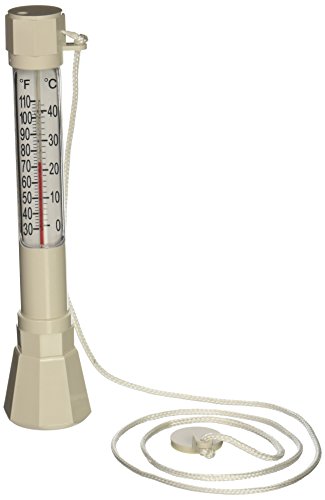
Pentair Endura Floating Thermometer
A large analog dial reads clearly from poolside without batteries or an app. Pentair builds it with a shockproof case that survives bumping against pool walls and steps. It reads surface temperature only, so results run slightly warm compared to depth readings on sunny days.
Pros
- No batteries or setup required
- Large dial reads easily from a distance
- Shockproof housing resists pool wall impacts
Cons
- Reads surface temperature only
- Less precise than digital alternatives
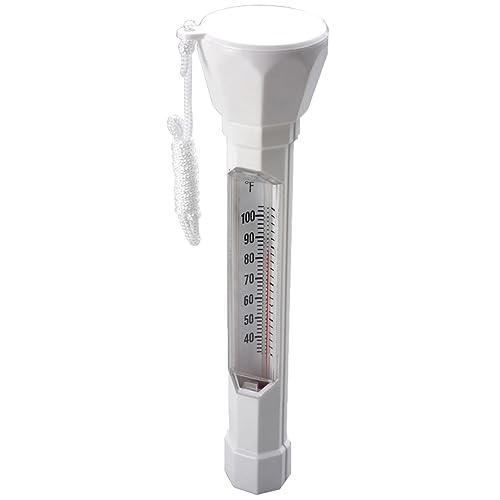
Blue Wave Deluxe Floating Thermometer
A tether keeps this thermometer from drifting to the far end of the pool, useful for above ground pools without a nearby skimmer. Its dial reads easily up close, though smaller than premium analog models. It suits casual pool owners who just want an occasional check.
Pros
- Tether prevents drifting across the pool
- Inexpensive entry point for basic monitoring
- Simple design with nothing to charge
Cons
- Smaller dial than other analog options
- Surface only reading like other analog units
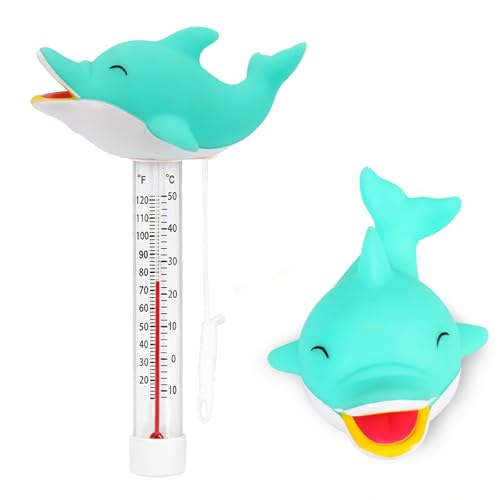
Kokido Floating Pool Thermometer
Large printed numbers make this thermometer readable from several feet away, useful for checking temperature before kids swim. Its rounded shape resists cracking if stepped on near the pool edge. No digital features keep cost low and setup at zero.
Pros
- Large numbers readable from a distance
- Durable rounded shape resists cracking
- No setup or charging needed
Cons
- No remote or app based reading
- Basic accuracy compared to digital sensors
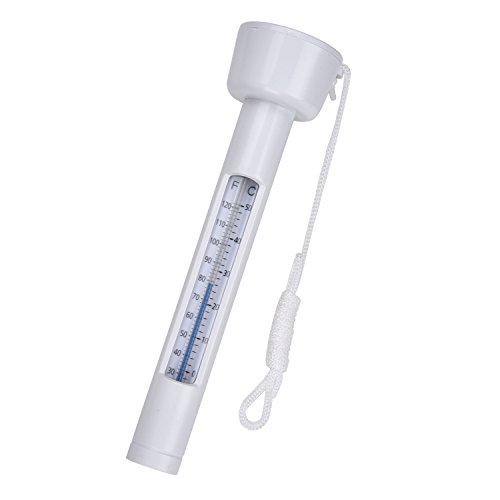
Milliard Floating Pool and Spa Thermometer
Shatterproof casing suits pools where the thermometer might get bumped by a diving board or pool toy regularly. It works in both pools and spas, with a dial rated for higher hot tub temperatures. A string attachment doubles as a way to secure it near a ladder or step.
Pros
- Shatterproof casing survives rough handling
- Rated for higher spa temperatures too
- Attachment string keeps it near a fixed point
Cons
- Analog only, no digital or app feature
- String can tangle in pool equipment

AcuRite Digital Pool Thermometer
A digital LCD display gives a more precise readout than an analog dial, useful in spas where a few degrees matters for comfort. It floats but works equally well weighted down in a hot tub corner. Battery life covers a full season before replacement in most climates.
Pros
- Digital display gives a precise readout
- Works well in spas and hot tubs
- Battery lasts a full season typically
Cons
- No wireless or app connectivity
- Display can be harder to read in bright sun
What to look for
What actually differs between pool thermometer types Analog floating thermometers read surface temperature with a simple dial and need no power source. That makes them reliable but limited to a quick visual check. Digital and wireless models add a submerged sensor plus either a receiver display or app connection, giving a more consistent reading and, in some cases, remote access. Choose based on how often you check temperature and from where.
Why surface readings can mislead swimmers Sun heats the top few inches of pool water faster than the water below. A floating dial thermometer can read several degrees warmer than what a swimmer actually feels at depth. This gap grows on calm, sunny days without much water circulation. Submerged sensor thermometers, like the Govee and INKBIRD models, avoid this by measuring below the surface.
When a WiFi or Bluetooth connected thermometer earns its cost Households that open a pool seasonally benefit from checking temperature remotely before deciding whether to run a heater. That avoids a wasted trip outside on a cold morning. Pools used daily by people already walking past them get less added value from remote monitoring. A simple analog dial works fine for them instead.
Choosing between pool use and spa or hot tub use Standard pool thermometers are calibrated for typical swimming pool ranges. Spa use often runs into higher temperatures that some dials are not rated to display accurately. Models rated for both, like the Milliard floating thermometer, avoid this mismatch if you own both a pool and a hot tub.
Compared at a glance
| # | Model | Reading method | Best for | Score | Price |
|---|---|---|---|---|---|
| 1 | Govee WiFi Pool Thermometer H5052 | Submerged sensor, WiFi app | Best overall | 9.2 | Check price |
| 2 | INKBIRD IBS-P01R Wireless Floating Pool Thermometer | Bluetooth to receiver display | Best wireless value | 8.8 | Check price |
| 3 | Pentair Endura Floating Thermometer | Analog dial | Best simple analog | 8.5 | Check price |
| 4 | Blue Wave Deluxe Floating Thermometer | Analog dial | Best budget | 8.1 | Check price |
| 5 | Kokido Floating Pool Thermometer | Analog dial | Best for easy reading | 8.0 | Check price |
| 6 | Milliard Floating Pool and Spa Thermometer | Analog dial | Best shatterproof | 8.2 | Check price |
| 7 | AcuRite Digital Pool Thermometer | Digital LCD | Best for hot tubs and spas | 8.4 | Check price |
Common questions
What is the most accurate way to measure pool temperature?
A submerged digital sensor gives a more consistent reading than a floating surface dial, since it measures water below the sun warmed top layer. Wireless models with a submerged probe, like the Govee H5052, come closest to actual swimming temperature.
Do floating pool thermometers need batteries?
Analog floating thermometers need no batteries at all. Digital and wireless models require a battery in the floating or submerged sensor, typically lasting several months to a full season.
Can I use a pool thermometer in a hot tub?
Some can, but check the dial’s rated range first. Standard pool thermometers may not display accurately above typical swimming pool temperatures. Models labeled for both pools and spas handle the higher range correctly.
How often should I check pool water temperature?
Daily checks help when running a pool heater, since catching a drop early avoids wasted energy reheating cold water. Casual pool owners without a heater often check only before swimming.
What is a safe swimming pool temperature?
Most recreational pools stay comfortable between 78 and 82 degrees Fahrenheit. Competitive swimming often runs slightly cooler. Hot tubs commonly run 100 to 104 degrees, well above comfortable pool range.
Why does my floating thermometer drift to one side of the pool?
Wind and pool jets push untethered floats toward the downwind edge or a skimmer intake. A tethered design, like the Blue Wave Deluxe, or a heavier weighted float resists this drift better.
Is a WiFi pool thermometer worth it over a basic dial?
It pays off mainly for remote checking before deciding to heat a pool, or for logging temperature trends over a season. For a quick poolside glance, a basic analog dial does the same job for less.
How accurate are cheap floating dial thermometers?
Most basic analog dials read within about 2 degrees Fahrenheit of actual temperature. That is accurate enough for general swimming comfort checks but not precise enough for chemical dosing calculations that depend on exact temperature.
The bottom line
For households that want to check pool temperature without walking outside, the Govee WiFi Pool Thermometer delivers the most convenience through app based monitoring. The INKBIRD IBS-P01R offers similar wireless reading at a lower cost for buyers who skip history logging. When simplicity matters most, the Pentair Endura Floating Thermometer remains a dependable, battery free choice.


